
Quick Summary: Choosing the right SRA audits company requires evaluating specialist expertise in SRA Accounts Rules, ICAEW regulation status, proven law firm experience, transparent pricing, and practical compliance support. The best providers combine technical audit knowledge with proactive guidance on breach prevention and regulatory updates. Your decision should prioritize firms that understand legal sector nuances and can streamline the audit process while protecting your reputation.
Law firms in England and Wales face a critical compliance requirement: the SRA Accounts Rules audit. If your firm holds client money, this isn't optional.
But here's the thing—not all audit providers are created equal. The right audit company does more than tick a regulatory box. They protect your reputation, identify vulnerabilities before they become problems, and provide practical guidance that actually makes sense.
Choosing poorly? That can mean missed breaches, wasted time, and compliance headaches down the line.
This guide breaks down exactly what to look for when selecting an SRA audits company, from essential qualifications to red flags that should send you looking elsewhere.
What Makes SRA Audits Different from Standard Financial Audits
Standard financial audits examine overall business accounts. SRA audits focus specifically on how law firms handle client money under the Solicitors Regulation Authority Accounts Rules.
The distinction matters because client funds carry unique risks. Money held in trust must be protected, segregated, and properly accounted for. A breach can trigger regulatory action, reputational damage, and in serious cases, intervention by the Solicitors Regulation Authority.
SRA audits require reporting accountants to submit an accountant's report confirming compliance—or flagging breaches. The auditor must understand legal accounting conventions, client account structures, residual balances, and the specific compliance tests mandated by the Solicitors Regulation Authority.
Generic accountants who dabble in legal work won't cut it. This work demands specialists who know what the Solicitors Regulation Authority expects and how law firm finances actually operate.
Essential Qualifications Your SRA Audit Company Must Have
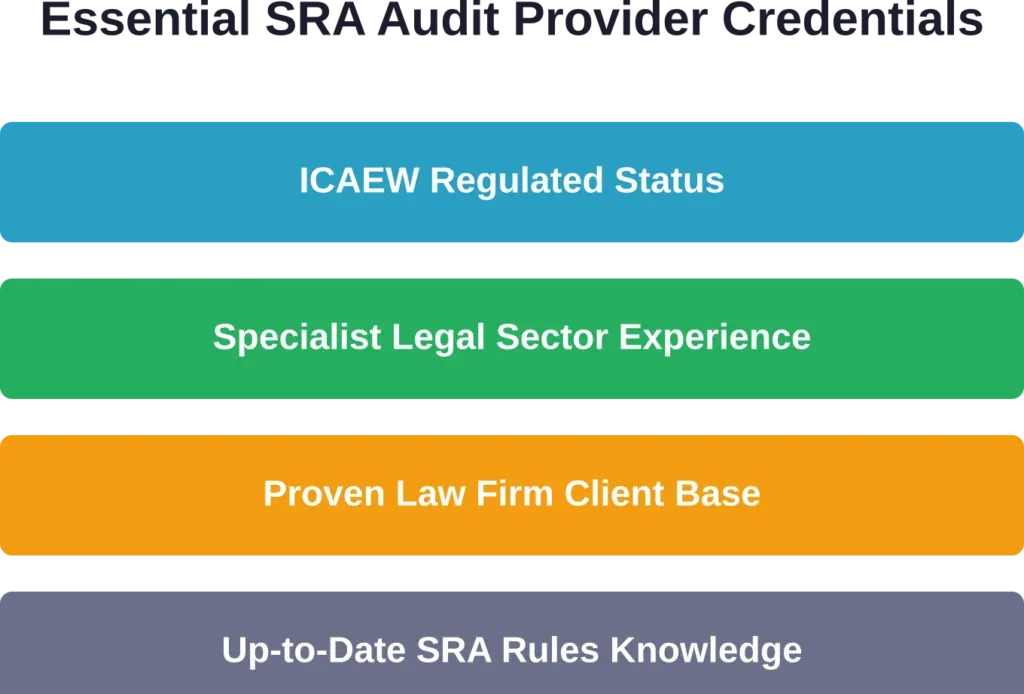
Before anything else, verify credentials. The reporting accountant must be a member of a recognized supervisory body—typically the Institute of Chartered Accountants in England and Wales (ICAEW).
ICAEW regulation ensures the accountant meets professional standards, carries appropriate insurance, and faces disciplinary oversight. Firms regulated by ICAEW undergo regular quality reviews and must maintain continuing professional development in their specialist areas.
Check the firm's registration status directly with ICAEW. Don't just take their word for it.
Beyond basic registration, look for dedicated legal sector experience. Some firms list solicitor audits as one service among dozens. Others focus almost exclusively on law firms—those specialists typically offer deeper insight.
Ask potential providers:
- How many law firms do they audit annually?
- What size practices do they typically serve?
- Do they have in-house specialists dedicated to legal sector work?
- How long have they provided SRA audit services?
Experience matters because breach patterns and compliance risks vary by firm size, practice area, and client account volume. Specialists recognize these patterns quickly.
Specialist Knowledge of SRA Accounts Rules
The SRA Accounts Rules underwent significant revision in 2019. Your audit provider must know the current framework inside out—not the old rules they learned years ago.
Key areas where specialist knowledge shows up:
- Client account structures: Understanding the difference between general client accounts, separate designated client accounts, and when each is appropriate. Knowing how to test for proper segregation.
- Residual balances: Identifying and handling small leftover amounts in client accounts. Rules around clearance procedures and notification requirements.
- Reconciliation procedures: How often reconciliations must occur, what documentation is required, and common errors that create discrepancies.
- Breach identification: Recognizing when a deviation becomes a reportable breach versus a minor procedural lapse. Understanding materiality thresholds and reporting obligations.
During initial conversations, ask about recent changes to the rules. A knowledgeable provider will discuss updates, clarifications from the Solicitors Regulation Authority, and how these affect audit procedures.
Vague answers or outdated references? Red flag.
Manage SRA Audits With Acumon
SRA audits need a careful review of how client money is handled, recorded, reconciled, and reported. For law firms, the work often connects with accounts rules, internal controls, compliance processes, and the way finance teams manage day-to-day records. Acumon supports businesses with audit, accounts, risk assurance, tax, and advisory work, which can help when SRA audit requirements sit within a wider finance or governance review.
They are a UK-based firm of chartered accountants, auditors, and advisors with 90+ professionals. Their team works across audit services, accounts, risk and tech assurance, tax, company secretarial, payroll, and business support, giving firms access to broader financial support where audit findings lead to follow-up questions.
Considering Your SRA Audit Options?
Acumon can help with:
- Supporting SRA audit requirements
- Reviewing client money records and reconciliations
- Checking accounting and reporting processes
- Looking at controls, governance, and risk points
- Connecting SRA audit findings with wider finance processes
👉 Contact Acumon to discuss your SRA audit requirements and the right next steps.
Understanding the SRA Audit Process
The audit process typically follows a structured timeline. Knowing what to expect helps you evaluate whether a provider's approach is thorough or cutting corners.
Most SRA audits involve these stages:
Pre-Audit Planning
The audit firm reviews your practice structure, client account arrangements, and accounting systems. They'll request documentation in advance—bank statements, reconciliations, ledgers, and compliance records.
Strong providers conduct preliminary discussions to understand your specific setup and identify potential focus areas before fieldwork begins.
Fieldwork and Testing
The auditor visits (or conducts remote sessions) to perform substantive tests. This includes verifying bank reconciliations, sampling transactions, testing controls, and reviewing compliance documentation.
Tests must cover the entire reporting period—typically the firm's financial year. The auditor examines whether client money is properly protected throughout.
Breach Evaluation
If issues surface, the auditor assesses severity. Minor operational lapses might require correction but not formal reporting. Material breaches must be disclosed in the accountant's report to the Solicitors Regulation Authority.
Reporting
The accountant's report must be delivered to the SRA within six months of the end of the accounting period only if the report is qualified. Clean (unqualified) reports do not need to be submitted to the SRA, but must be retained by the firm.
A quality provider explains each stage upfront, sets clear expectations for documentation, and keeps you informed throughout. They won't disappear after submitting the report—good firms offer post-audit debrief and recommendations.
Red Flags When Evaluating Audit Providers
Certain warning signs should make you pause—or walk away entirely.
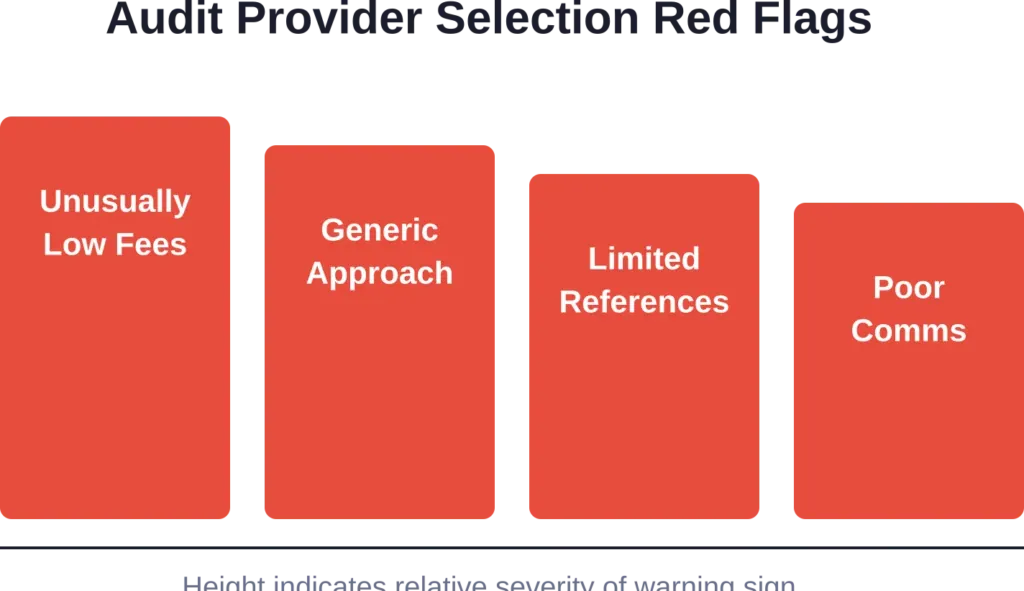
- Unusually low fees: SRA audits require substantial specialist work. Rock-bottom pricing often means corners get cut, junior staff handle complex areas, or the firm lacks true legal sector expertise.
- That said, high fees don't automatically equal quality. Look for transparent pricing that reflects the scope of work.
- Generic audit approach: Providers who treat your SRA audit like any other compliance exercise probably lack legal sector depth. The testing procedures, risk assessment, and reporting requirements are unique to solicitors' practices.
- Limited law firm references: If a provider can't offer multiple law firm references or case studies demonstrating legal sector experience, they're probably not specialists.
- Poor communication: Audits involve back-and-forth on documentation, findings, and compliance questions. Providers who are slow to respond, unclear in explanations, or dismissive of your concerns will frustrate you throughout the engagement.
- No proactive compliance guidance: The best audit firms don't just report findings—they help prevent future issues. Providers who show no interest in internal controls review, staff training recommendations, or process improvements offer minimal value beyond the basic regulatory requirement.
Key Questions to Ask Potential Audit Providers
Before committing, have detailed conversations with shortlisted providers. Here are the questions that reveal true capability:
- How many law firms do you currently audit? Specialists will have dozens of legal clients. Generalists might have a handful.
- What size practices do you typically serve? Ensure they have experience with firms similar to yours in size, structure, and complexity.
- How do you stay current on SRA rule changes? Look for answers involving dedicated training, Solicitors Regulation Authority updates monitoring, and professional development programs.
- What's your process for handling breaches? Experienced providers will explain their approach to materiality assessment, client communication, and reporting obligations without evasion.
- Can you provide law firm references? Speak with current clients about responsiveness, audit disruption levels, and value beyond compliance.
- What happens after the report is submitted? Quality firms offer debrief sessions, compliance recommendations, and ongoing support. One-and-done providers vanish until next year.
- What documentation do you need, and when? Clear expectations prevent last-minute scrambles. Organized providers supply detailed checklists well in advance.
- Who will actually conduct the audit? Ensure experienced professionals—not just trainees—will handle your engagement. Ask about the team structure and who makes final decisions.
Pricing Models and What to Expect
SRA audit fees vary based on firm size, transaction volume, and complexity. Small high-street practices might pay significantly less than large multi-office firms.
Most providers use one of three pricing approaches:
- Fixed fee: A set price agreed upfront based on your practice profile. This offers budget certainty but requires accurate scoping. Significant scope changes (like discovering undisclosed accounts) may trigger additional charges.
- Time-based billing: Fees based on hours worked. This can escalate if your records are disorganized or issues emerge requiring additional investigation. Less predictable but reflects actual work required.
- Hybrid models: A base fee covering standard procedures plus hourly rates for additional work if needed. Balances predictability with flexibility.
Ask for written fee proposals detailing what's included, what might trigger additional charges, and payment terms. Compare like-for-like—a lower quote might exclude services others bundle in.
Remember that cost is important, but it shouldn't be the deciding factor. A slightly higher fee for a specialist who prevents compliance issues and provides strategic guidance delivers better value than a cheap provider offering bare-minimum service.
The Value of Proactive Compliance Support
Here's where top-tier audit providers separate themselves: they don't just react to what they find. They help you build systems that prevent problems.
Strong firms offer guidance on internal controls, staff training, reconciliation procedures, and best practices for client account management. They identify process weaknesses before they become breaches.
Some providers conduct pre-audit reviews—internal checks months before the formal audit to catch and fix issues early. This dramatically reduces the risk of qualified reports and Solicitors Regulation Authority attention.
Look for providers who discuss internal pre-audit reviews, compliance health checks, and ongoing support. These services might cost extra, but they're worth considering if your firm has complex client account arrangements or has experienced past compliance issues.
Technology and Remote Audit Capabilities
Post-pandemic, many audit providers offer remote audit options using secure document sharing and video conferencing. This can reduce disruption and streamline the process.
However, ensure the provider has proper security protocols for handling sensitive financial data. Ask about encryption, access controls, and data retention policies.
Some firms use specialized audit software that integrates with common legal accounting systems. This can speed up data extraction and testing. Ask what technology they use and how it affects the audit timeline.
Traditional on-site audits aren't obsolete—some complex situations benefit from in-person fieldwork. The best approach depends on your specific circumstances, systems, and preferences.
| Selection Criteria | Why It Matters | How to Verify |
|---|---|---|
| ICAEW Regulation | Ensures professional standards, insurance, and oversight | Check ICAEW register directly |
| Legal Sector Focus | Specialist knowledge of SRA rules and law firm accounting | Ask about law firm client count and experience |
| Proven Track Record | Demonstrates capability and reliability | Request law firm references and case studies |
| Transparent Pricing | Prevents surprise costs and budget overruns | Get written fee proposals with scope details |
| Proactive Guidance | Prevents future breaches and improves processes | Ask about compliance support and training offerings |
| Clear Communication | Ensures smooth audit process and understanding | Assess responsiveness during initial discussions |
Making Your Final Decision
After gathering information, shortlist two or three providers who meet your essential criteria. Arrange detailed discussions with each to assess fit.
Consider these final factors:
- Chemistry and trust: You'll share sensitive financial information and discuss potential problems. Choose a provider you're comfortable with—one who explains things clearly without condescension.
- Long-term relationship potential: SRA audits recur annually. A provider who learns your firm over time delivers increasing value. Frequent provider changes disrupt continuity and knowledge transfer.
- Sector reputation: Ask fellow solicitors which audit firms they use and recommend. Legal sector networks often surface both positive experiences and providers to avoid.
- Responsiveness: How quickly did they respond to initial inquiries? How thoroughly did they answer questions? This previews how they'll handle issues during the audit.
Make your decision based on the complete picture—credentials, experience, approach, pricing, and fit. The cheapest option rarely proves most valuable. The right provider protects your firm, supports compliance improvement, and becomes a trusted advisor.
Preparing for a Successful Audit Relationship
Once you've selected a provider, set the relationship up for success.
Schedule a kick-off meeting to discuss timelines, documentation requirements, and communication protocols. Clarify who in your firm will be the primary contact and ensure they have time allocated for audit support.
Organize records in advance. Waiting until the auditor asks wastes time and increases costs. Most providers supply preparation checklists—use them.
If this is your first audit with a new provider, consider a transition meeting where the previous auditor (if applicable) shares relevant context with the new firm. This smooths continuity.
Treat the audit as a partnership, not an adversarial inspection. Good auditors want you to succeed and will work with you to identify and resolve issues. Defensive or evasive responses create friction and raise concerns.
Common Mistakes When Choosing Audit Providers
Law firms frequently make these missteps when selecting audit companies:
- Defaulting to the cheapest quote: Price competition has its place, but audit quality affects your regulatory standing. Cheap audits often mean inexperienced staff, rushed work, or missed issues.
- Not checking credentials: Assuming someone is qualified without verifying ICAEW registration or legal sector credentials. Always confirm.
- Ignoring red flags: Proceeding despite poor communication, vague answers, or lack of references because you've already invested time. Cut losses early.
- Waiting until the last minute: Engaging an auditor weeks before your reporting deadline leaves no buffer for issues. Start the selection process months in advance.
- Not reading the engagement letter: Failing to understand scope, limitations, and responsibilities before signing. Read carefully and ask questions about anything unclear.
- Choosing based solely on personal relationships: Using your friend's firm or a referral without proper due diligence. Relationships matter, but credentials and capability matter more.
What the SRA Accounts Rules Require
Understanding the rules helps you assess whether potential audit providers truly grasp the compliance framework.
Client Money Protection
Client funds must be held in separate accounts and must not be used for firm purposes. Proper segregation is fundamental.
Regular Reconciliations
Firms must reconcile client accounts at least every five weeks. Documentation must be retained and available for audit.
Accountant's Reports
Firms that hold client money must obtain an accountant's report annually unless exempt. The report covers a 12-month accounting period.
Record Keeping
Detailed records of all client money transactions, including receipts, payments, transfers, and reconciliations, must be maintained.
Breach Reporting
Material breaches discovered during the audit must be reported to the Solicitors Regulation Authority by the reporting accountant.
Your audit provider should demonstrate a thorough understanding of these requirements and how they apply to your specific practice structure.

Frequently Asked Questions
SRA audit fees vary widely based on firm size, transaction volume, and complexity. Small sole practitioner firms might pay £1,500-£3,000, while mid-sized practices could see £3,000-£8,000, and large multi-office firms may pay £10,000 or more. Always request detailed written proposals from multiple providers to compare pricing and scope accurately.
Law firms holding client money must obtain an accountant's report annually, covering a 12-month accounting period. The report must be submitted to the Solicitors Regulation Authority within six months of the accounting period end. Firms that don't hold client money or qualify for exemptions may not require annual audits.
Only if they're qualified and experienced in SRA Accounts Rules compliance. The reporting accountant must be a member of a recognized supervisory body like ICAEW and should have specialist knowledge of legal sector accounting and SRA regulations. General business accountants often lack this expertise, even if excellent at standard financial work.
The severity determines the outcome. Minor operational lapses might require correction and improved procedures but won't necessarily be reported to the Solicitors Regulation Authority. Material breaches must be disclosed in the accountant's report. The Solicitors Regulation Authority then decides whether further action is warranted, ranging from guidance to investigation or enforcement in serious cases.
Location matters less than expertise. Local firms offer convenient face-to-face meetings, while national specialists might provide deeper legal sector knowledge. With remote audit capabilities now common, geographic proximity is less critical than credentials, experience, and service quality. Evaluate providers based on capability first, convenience second.
Timeline depends on firm size and record organization. Small practices with well-organized records might complete fieldwork in one to two days. Larger or more complex firms could require a week or more of auditor time spread over several visits. The overall process from engagement to final report typically spans two to three months.
You can change providers, but plan carefully. Start searching for a new auditor well before your next audit deadline—ideally four to six months in advance. Ensure proper transition by requesting your records from the current provider and arranging knowledge transfer to the new firm. Never switch auditors in the middle of an audit period without compelling reason.
Taking Action: Your Next Steps
Choosing an SRA audits company isn't a decision to rush. The right provider protects your practice, supports compliance improvement, and becomes a valued partner in managing regulatory obligations.
Start by creating a shortlist of ICAEW-regulated firms with proven legal sector experience. Request written proposals detailing scope, approach, team credentials, and fees. Conduct detailed interviews focusing on the questions outlined in this guide.
Check references thoroughly—speak with law firms similar to yours about their audit experiences. Verify credentials independently rather than taking claims at face value.
Make your decision based on the complete picture: technical expertise, service quality, communication style, and value—not just price. The cheapest option often costs more in the long run through missed issues, poor service, or compliance problems.
Begin your search months before your audit is due. Last-minute scrambles force compromises and create unnecessary pressure. Starting early gives you time to evaluate properly and prepare effectively for a smooth audit process.
The right audit provider doesn't just help you meet regulatory requirements—they strengthen your client account management, improve internal controls, and give you confidence that your compliance is genuinely robust, not just technically adequate.