
Quick Summary: Choosing a grant audits company requires evaluating their government audit experience, GAGAS compliance, peer review reports, and specialized expertise in federal grant regulations. Prioritize firms with CPAs meeting the 80-hour biennial GAGAS training requirement and proven track records with single audits under the Uniform Guidance.
Federal grant recipients face increasing scrutiny. As grant programs multiply and compliance requirements tighten, finding the right audit partner isn't optional—it's essential for survival.
The wrong audit firm can mean missed compliance issues, regulatory penalties, or even grant fund clawbacks. The right one? That's your shield against federal audit nightmares.
Organizations that receive more than $1,000,000 in federal awards in a single fiscal year must undergo a single audit conducted under Generally Accepted Government Auditing Standards. This isn't a routine financial audit. It's a specialized compliance examination that requires deep expertise in federal regulations.
But here's the thing—not all audit firms are created equal when it comes to grant work. Many CPAs excel at corporate financial statements yet stumble through the labyrinth of 2 C.F.R. 200 requirements.
Understanding What Grant Audits Actually Require
Before evaluating potential audit firms, organizations need clarity on what grant audits entail. Federal grant audits differ fundamentally from standard financial audits in scope, standards, and regulatory framework.
Single audits conducted under the Uniform Guidance examine both financial statements and federal award compliance. They verify that grant funds were spent according to program requirements, that cost allocation methods are reasonable, and that internal controls prevent waste or fraud.
These audits follow the Generally Accepted Government Auditing Standards (GAGAS)—commonly called Yellow Book standards—issued by the Government Accountability Office. GAGAS imposes stricter independence requirements, continuing education mandates, and reporting protocols than regular audit standards.
The threshold matters. As of recent updates, organizations expending $1,000,000 or more in federal awards during their fiscal year trigger the single audit requirement. Some states impose additional thresholds—North Carolina, for example, requires audits for entities receiving $1,000,000 or more in state financial assistance.
Core Qualifications Every Grant Audit Firm Must Have
Not every CPA firm qualifies to perform government audits. Specific credentials and training separate qualified firms from those merely offering audit services.
GAGAS Compliance and Continuing Education
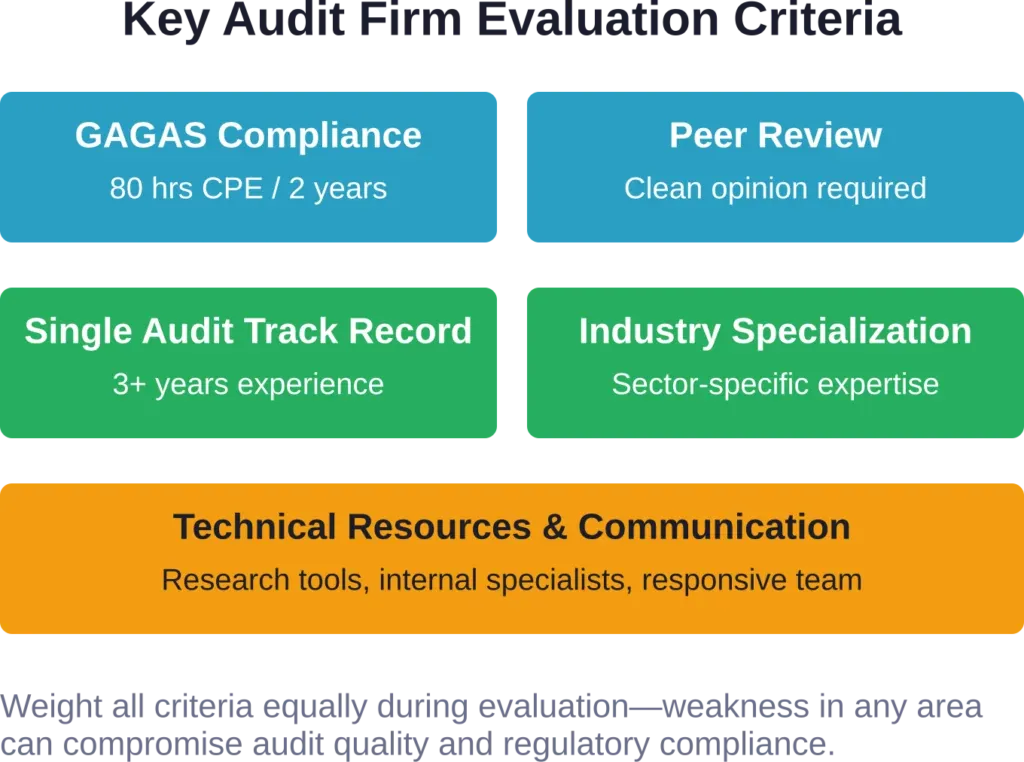
Auditors performing work under GAGAS must complete continuing professional education requirements. Organizations should verify specific CPE requirements with their state boards, as standards vary by jurisdiction and may include requirements for government auditing content.
This isn't a suggestion—it's a regulatory requirement. Firms that don't maintain these CPE standards cannot legally perform Yellow Book audits.
Ask potential audit firms directly: Do your assigned auditors meet the GAGAS CPE requirements? Request documentation. Reputable firms will provide this without hesitation.
Peer Review Reports
According to federal regulations at 2 C.F.R. § 910.509, when procuring audit services, organizations must request a copy of the audit firm's peer review report. This requirement isn't optional.
Peer reviews evaluate a firm's quality control system and compliance with professional standards. The American Institute of CPAs administers peer review programs for firms performing governmental audits.
Look for firms with unqualified (clean) peer review opinions. Red flags include modified opinions, findings, or deficiencies noted in the peer review report. These signal systemic quality control problems that could compromise your audit.
Government Audit Experience
Generic audit experience doesn't translate to grant audit competence. Federal grant regulations form their own specialized domain—think cost allocation plans, indirect cost rates, allowable costs, procurement standards, and program-specific compliance requirements.
Firms experienced in governmental auditing understand these nuances. They know how to test compliance with OMB requirements, interpret federal agency guidance, and navigate the schedule of expenditures of federal awards.
During firm evaluation, ask for specific examples: How many single audits has the firm completed in the past three years? What types of federal programs? Have they worked with organizations similar to yours in size and grant portfolio?
Prepare Grant Audits With Acumon
Grant audits often need more than checking spend against a funding agreement. They can involve supporting documents, eligibility rules, restricted funds, reporting deadlines, internal controls, and the way grant income or expenditure has been recorded. Acumon supports businesses and organisations with audit, accounts, tax, risk assurance, and advisory work, which can help where grant audit requirements need clear financial evidence and practical compliance support.
They are a UK-based firm of chartered accountants, auditors, and advisors with 90+ professionals. Their audit experience includes work with charities and non-profits, as well as limited companies and other organisations, which can be useful when grant funding is tied to specific reporting duties or assurance requirements.
Considering Your Grant Audit Options?
Acumon can help with:
- Reviewing grant income and expenditure records
- Checking supporting documents and reporting requirements
- Supporting audit and assurance work
- Looking at controls around restricted or funded activity
- Connecting grant audit findings with wider accounts and compliance processes
👉 Contact Acumon to discuss your grant audit requirements and the right next steps.
Evaluating Firm Expertise and Resources
Beyond baseline qualifications, dig deeper into what separates adequate firms from exceptional partners.
Industry Specialization
Some audit firms specialize in specific sectors—higher education, nonprofit social services, healthcare, or for-profit grant recipients. This specialization matters because program-specific compliance requirements vary dramatically across federal agencies.
A firm with deep experience auditing Department of Education grants may struggle with Department of Defense contract compliance. A firm that primarily serves nonprofits might lack expertise in for-profit cost accounting standards.
Match the firm's specialization to your organization's grant profile. If you're a for-profit entity receiving federal research grants, prioritize firms with demonstrated expertise in that exact space.
Technical Resources and Support
Quality grant audits require substantial technical infrastructure. Does the firm maintain current research databases for federal regulations? Do they have internal specialists for complex areas like indirect cost rate calculations or IT security compliance?
Smaller firms can deliver excellent service but may lack depth in specialized areas. Larger firms offer more resources but might assign less experienced staff to your engagement.
Ask about the engagement team structure. Who will lead your audit? What's their experience level? How accessible will senior personnel be when questions arise?
The RFP Process and Firm Selection
Federal procurement standards emphasize obtaining high-quality audits rather than simply finding the lowest price. The selection process should reflect that priority.
Crafting an Effective Request for Proposal
Clear RFPs produce better responses. Define your organization's scope explicitly—fiscal year covered, federal programs involved, total federal expenditures, and any special circumstances like first-year audits or prior findings.
Request specific information: firm qualifications, peer review results, engagement team composition, audit approach and timeline, fee structure, and references from similar clients.
According to regulatory guidance, when requesting proposals for audit services, organizations must make the audit objectives and scope clear and must request the audit firm's peer review report.
Evaluating Proposals Beyond Price
Cost matters, but cheapest rarely means best in grant auditing. Low bids often signal inexperience, inadequate scope understanding, or plans to assign junior staff.
Evaluate proposals holistically. Consider firm qualifications, proposed approach, timeline reasonableness, team experience, and yes—price. But weight quality factors heavily.
Red flags include proposals that underestimate complexity, promise unrealistically fast turnaround, or lack detail about the audit approach. Quality firms provide substantive proposals demonstrating they understand your organization and the regulatory environment.
Reference Checks and Final Selection
Contact references—and ask pointed questions. Did the audit finish on time? Were there surprise findings that should have been communicated earlier? How responsive was the firm when questions arose? Would you hire them again?
Schedule interviews with finalist firms. Meet the actual engagement team, not just partners who won't work on your audit. Assess communication style and cultural fit.
Real talk: you'll work closely with these people for weeks. Chemistry matters. Technical competence with poor communication creates frustration. Find firms that offer both.
Warning Signs and Red Flags
Certain signals should prompt immediate concern during the selection process.
Firms that can't produce clean peer review reports or won't discuss their GAGAS CPE compliance should be eliminated immediately. These are non-negotiable baseline requirements.
Be wary of firms that minimize compliance risk or promise "easy" audits. Grant audits are inherently complex. Firms that oversimplify either don't understand the work or are setting unrealistic expectations.
Watch for firms that won't commit specific senior personnel to your engagement. Bait-and-switch tactics—promising experienced partners who then disappear after contract signing—plague the industry.
Unrealistically low fees signal problems. Quality audits require time. Firms bidding substantially below market rates either don't understand scope or plan to cut corners.
Post-Selection: Setting Up for Success
Choosing the right firm is step one. The audit's success depends equally on what happens next.
Establish clear communication protocols upfront. Who's the primary contact on each side? How will document requests be handled? What's the schedule for status updates?
Prepare systematically. Grant management best practices suggest maintaining organized documentation throughout the year rather than scrambling when audit season arrives. Well-prepared organizations experience smoother audits with fewer surprises.
View the audit firm as a compliance partner, not an adversary. Quality firms offer valuable insights about control improvements and regulatory updates beyond the formal audit report.
That said, don't expect audit firms to function as consultants during the engagement. Independence requirements limit how much implementation advice they can provide while serving as your auditor.
| Selection Factor | Weight | What to Verify |
|---|---|---|
| GAGAS Qualifications | Critical | 80-hour CPE compliance, 24 hours in government subjects |
| Peer Review Status | Critical | Unqualified opinion, no findings or deficiencies |
| Single Audit Experience | High | 3+ years, 10+ engagements, similar organizations |
| Industry Expertise | High | Federal programs matching your grant portfolio |
| Engagement Team | Medium | Senior personnel commitment, staff experience levels |
| Technical Resources | Medium | Research databases, internal specialists available |
| Communication Approach | Medium | Responsiveness, accessibility, cultural fit |
| Fee Structure | Low-Medium | Reasonable and competitive, not lowest bid |
Common Mistakes Organizations Make
Understanding what not to do helps avoid costly errors.
- Many organizations select audit firms based primarily on existing relationships or convenience. "We've always used them" isn't a qualification for grant audit work. General business auditors often lack specialized government audit expertise.
- Others focus excessively on price, selecting the lowest bidder without adequate quality assessment. This creates false economy—inadequate audits can result in findings, questioned costs, or compliance failures far exceeding any fee savings.
- Some organizations fail to verify credentials, accepting firms' claims about GAGAS compliance or peer review status without requesting documentation. Always verify.
- Waiting until the last minute to engage an audit firm creates problems. Quality firms book their schedules months in advance. Organizations starting the selection process late get stuck with whoever has availability—rarely the best option.
For-Profit Entities: Special Considerations
For-profit companies receiving federal grants face unique audit considerations. Many for-profit entities don't realize they're subject to single audit requirements until they've already accepted grant funding.
Cost accounting standards for for-profit entities differ from nonprofit or governmental organizations. Audit firms must understand these distinctions, particularly around indirect cost allocation and allowability determinations.
For-profit entities also face different documentation expectations around cost allocation methodologies and internal controls over financial reporting. Firms without for-profit grant audit experience may miss these nuances.
When evaluating audit firms, for-profit grant recipients should specifically ask about experience with commercial entities, not just nonprofit or governmental clients. The regulatory framework overlaps but isn't identical.
Looking Forward: Audit Relationship Management
The firm you select will likely serve as your auditor for multiple years. Building an effective long-term relationship maximizes value.
Schedule annual post-audit debriefs to discuss findings, near-miss issues, and control improvement opportunities. Quality firms use these conversations to provide proactive compliance guidance.
Stay current on regulatory changes through your audit firm's communications. Many firms offer client alerts, webinars, or technical updates about Uniform Guidance changes or agency-specific requirement updates.
Periodically reassess whether the relationship still serves your needs. As organizations grow or grant portfolios change, different expertise may be required. Regular evaluation ensures the firm's capabilities still match your requirements.
But don't change firms without good reason. Auditor continuity has value—experienced audit teams work more efficiently and provide better insights over time. Balance stability with quality.
Frequently Asked Questions
Financial audits examine whether financial statements present fairly an organization's financial position and results of operations. Single audits include financial statement examination plus extensive testing of federal award compliance, internal controls over federal programs, and adherence to specific program requirements under the Uniform Guidance. Organizations expending $1,000,000 or more in federal awards during their fiscal year require single audits.
Grant audit fees vary significantly based on organization size, number of federal programs, transaction volume, and internal control quality. Single audit fees vary significantly based on organization size, number of federal programs, transaction volume, and internal control quality. Request detailed fee proposals during the RFP process rather than relying on generic estimates.
Yes, many organizations engage one firm to perform both their financial statement audit and their single audit simultaneously. This approach often creates efficiencies since single audits include financial statement examination. However, ensure the firm has both general audit competence and specialized GAGAS qualifications for the federal compliance portion.
Request documentation directly from the firm. Ask for copies of individual auditors' CPE transcripts showing completion of the required 80 hours every two years, with 24 hours in government subjects. For peer review verification, request a copy of the firm's most recent peer review report. Legitimate firms provide these documents readily. The AICPA also maintains databases of firms enrolled in peer review programs.
Begin at least six months before your fiscal year-end. Quality firms book their audit schedules well in advance. Starting early allows adequate time for RFP development, proposal evaluation, selection, and engagement letter execution before year-end. Late starts force organizations to accept whoever has availability rather than selecting the best qualified firm.
Audit findings indicate noncompliance with federal requirements or internal control deficiencies. Findings must be reported to federal agencies through the Federal Audit Clearinghouse. Organizations must develop corrective action plans addressing each finding. Material noncompliance can result in questioned costs, grant funding restrictions, or program disallowance. Quality audit firms help organizations understand findings and develop appropriate corrective actions.
Not necessarily, but evaluate whether your current firm has expertise in the new programs. If you're adding federal programs from agencies your audit firm hasn't worked with before, assess their capability to handle the new compliance requirements. Firms can expand their expertise, but dramatic shifts in your grant portfolio may warrant selection reassessment.
Taking the Next Step
Selecting a grant audits company isn't a decision to rush. The stakes—regulatory compliance, funding continuity, organizational reputation—demand careful evaluation.
Start with the non-negotiables: GAGAS compliance, clean peer reviews, and demonstrated single audit experience. Layer in considerations around industry expertise, engagement team quality, and communication fit.
Request proposals from multiple qualified firms. Evaluate comprehensively rather than focusing narrowly on price. Check references thoroughly and meet engagement teams in person when possible.
Sound like a lot of work? It is. But investing time upfront in proper selection prevents years of audit headaches, compliance problems, and potential regulatory consequences.
Organizations that treat audit firm selection as a strategic decision rather than a procurement task consistently experience better outcomes—smoother audits, fewer findings, and stronger compliance frameworks.
The right grant audit partner doesn't just check compliance boxes. They provide insights that strengthen your entire grant management system and position you for continued federal funding success.