
Quick Summary: Choosing a CASS 6 audits company requires evaluating the firm's FCA-regulated audit experience, understanding of custody asset arrangements, and ability to meet strict reporting deadlines. The right auditor will assess your safe custody controls, provide reasonable assurance opinions, and help your firm avoid non-compliance penalties that can exceed £700,000. Look for providers with specialist knowledge of CASS rules, client asset segregation requirements, and experience in your specific business model.
Selecting a CASS auditor isn't just ticking a compliance box. It's about finding a firm that genuinely understands how your business handles custody assets and can spot control weaknesses before they become regulatory headaches.
The consequences of getting this wrong? The FCA has issued fines ranging from £700,000 to approximately £9 million for CASS failings in recent years. And here's the thing—sometimes those failures start with an auditor who didn't ask the right questions.
So how do you separate the specialist providers from those just offering CASS audits as an afterthought?
Understanding What CASS 6 Audits Actually Cover
CASS 6 deals specifically with custody rules. If your firm holds financial instruments belonging to clients—whether in the course of MiFID business or as safe custody assets—these rules apply.
The audit itself is an assurance engagement. The auditor examines whether your firm complies with the FCA's custody rules and issues an assurance opinion. But not all CASS audits are identical.
Different firms face different requirements based on their activities. Some need reasonable assurance reports. Others require limited assurance. Payment firms that have not safeguarded more than £100,000 in relevant funds over a period of at least 53 weeks are completely exempt from the annual safeguarding audit requirement.
Key Areas Your CASS Auditor Will Examine
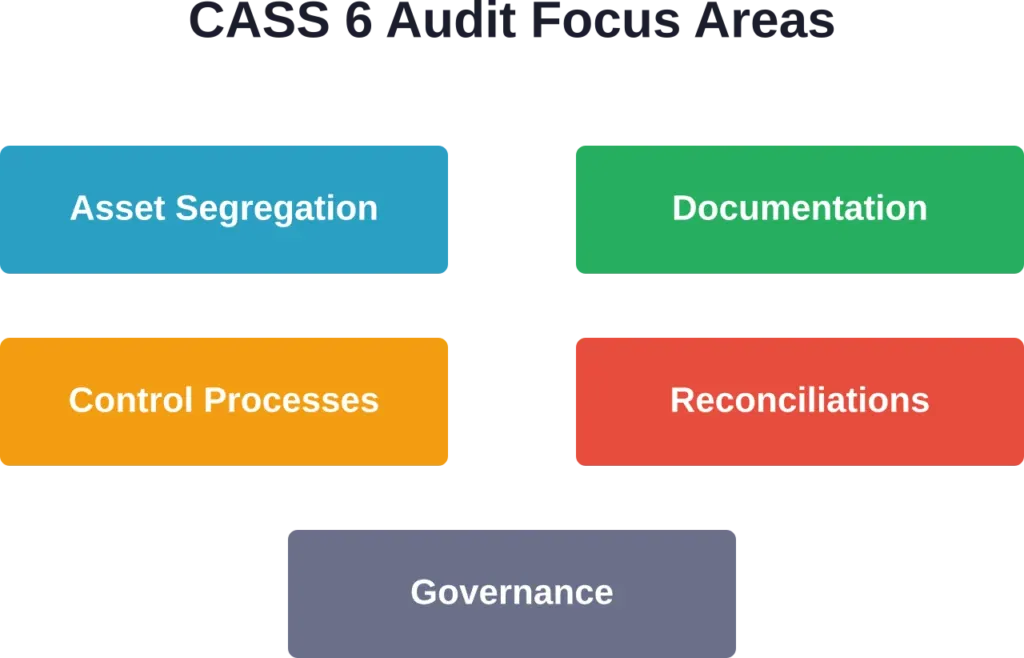
CASS auditors focus on several critical areas:
- Segregation of client safe custody assets from the firm's own financial instruments
- Proper documentation and record-keeping for custody arrangements
- Control processes around asset movements and reconciliations
- Compliance with specific CASS 6 rules on bearer form documents and allocated assets
- Internal oversight and governance structures
The FCA Handbook specifies that firms must keep documents of title to applicable assets in bearer form separate from client safe custody assets in bearer form. That's the kind of granular detail a competent CASS auditor knows cold.
Essential Qualities in a CASS 6 Audit Provider
Not all audit firms are created equal when it comes to CASS work. Here's what matters.
Specialist Knowledge of FCA-Regulated Business
Generic auditors won't cut it. CASS rules sit within a complex regulatory framework that's constantly evolving. The right provider needs current knowledge of:
- FCA custody rules and how they interact with other regulations
- Recent enforcement actions and what triggers regulatory concern
- Industry-specific custody arrangements in wealth management, asset management, or payment services
- Safeguarding requirements for electronic money institutions
Ask potential auditors about recent CASS-related regulatory changes. Their answer will tell you whether they're actively engaged in this space or just reading from outdated checklists.
Experience With Your Business Model
A firm auditing high-volume payment institutions faces different risks than one examining boutique wealth managers. Custody arrangements vary significantly across business models.
Some providers specialize in particular niches. Others maintain broad experience across financial services. Neither approach is wrong, but the auditor needs demonstrable experience with firms similar to yours.
Request references from clients in your sector. Better yet—ask about specific control issues they've identified in similar businesses and how those were resolved.
Capacity to Meet Your Reporting Timeline
CASS audit deadlines are non-negotiable. Firms must submit their CASS audit reports to the FCA within specific timeframes based on their accounting reference date.
Some audit providers juggle dozens of CASS clients with similar year-ends. That creates bottlenecks. Others maintain smaller client books with better scheduling flexibility.
Clarify the provider's capacity before engagement. How many CASS audits will they conduct during your reporting period? Who specifically will lead your engagement? What's their backup plan if that person becomes unavailable?
Manage CASS 6 Audits With Acumon
CASS 6 audits need a careful look at how custody assets are recorded, protected, reconciled, and controlled. The work can sit across finance, operations, compliance, and audit teams, so it helps to use a firm that can review both the numbers and the process behind them. Acumon supports businesses with audit, accounts, risk assurance, tax, and advisory work, which can help when CASS 6 requirements connect with wider reporting or governance issues.
They are a UK-based firm of chartered accountants, auditors, and advisors with 90+ professionals. Their audit and risk assurance services can support firms that need clearer oversight of controls, records, compliance processes, and the finance systems linked to custody asset arrangements.
Considering Your CASS 6 Audit Options?
Acumon can help with:
- Supporting CASS 6 audit requirements
- Reviewing custody asset records and controls
- Checking reconciliations and reporting processes
- Looking at governance, risk, and assurance matters
- Connecting CASS 6 findings with wider finance processes
👉 Contact Acumon to discuss your CASS 6 audit requirements and the right next steps.
Red Flags When Evaluating CASS Auditors
Certain warning signs should make you pause.
Generic Audit Firms Without Financial Services Focus
CASS audits demand specialized knowledge. Firms that primarily audit manufacturing companies or retail businesses rarely develop the necessary expertise.
Look—this doesn't mean large generalist firms can't do CASS work. Many have dedicated financial services teams with genuine expertise. But the team matters more than the firm's name.
Unusually Low Fees
Quality CASS audits require significant professional time. Auditors need to understand your control environment, test segregation procedures, examine reconciliations, and assess documentation.
Suspiciously low quotes often signal corner-cutting. That might mean junior staff with minimal supervision, superficial testing, or templated reports that miss your firm's specific risks.
The FCA has publicly censured auditors for CASS failings. That's rare—but it happened. Don't let cost-cutting expose your firm to that risk.
Poor Communication During Scoping
The scoping conversation reveals how the auditor thinks. Strong providers ask probing questions about your custody arrangements, client base, technology systems, and control procedures.
Weak providers send standard questionnaires and propose fees without meaningful dialogue. That approach misses the nuances that determine audit scope and risk assessment.
If the auditor doesn't ask difficult questions upfront, they probably won't identify control weaknesses later.

Questions to Ask Potential CASS Audit Firms
Here's the thing—most firms won't volunteer their weaknesses. You need to ask directly.
About Their CASS Experience
- How many CASS 6 audits does your firm complete annually?
- Which team members would work on our audit, and what's their CASS background?
- Can you provide references from firms similar to ours?
- What's the most complex CASS issue you've identified in the past year?
About Their Approach
- How do you tailor your audit procedures to different business models?
- What sample sizes do you typically use for testing custody controls?
- How do you stay current on FCA regulatory developments?
- What's your process if you identify control deficiencies during fieldwork?
About Practical Logistics
- What's your availability during our preferred audit window?
- How much advance documentation preparation do you need?
- What's your typical timeline from fieldwork completion to report issuance?
- Who will be our primary contact throughout the engagement?
The answers matter less than how they're delivered. Strong providers respond with specific examples and practical detail. Weak ones offer generic reassurances.
Comparing CASS 6 Audit Provider Types
The UK market includes several provider categories, each with strengths and limitations.
| Provider Type | Strengths | Considerations |
|---|---|---|
| Large Accountancy Networks | Deep resources, broad regulatory knowledge, international reach | Higher fees, potential for junior staff leverage, may prioritize larger clients |
| Mid-Tier Specialist Firms | Focused financial services expertise, partner involvement, competitive pricing | Smaller resource pool, may have capacity constraints during busy periods |
| Boutique CASS Specialists | Highly specialized, personalized service, senior team attention | Limited capacity, potentially higher per-hour rates, less geographic coverage |
| Regional Practices | Local presence, relationship-driven service, flexible approach | Variable CASS expertise, may lack depth in complex arrangements |
There's no universally correct choice. A £10 million wealth manager needs something different than a £500 million asset management group.
The Engagement Process: What to Expect
Understanding the typical CASS audit workflow helps set realistic expectations.
Planning and Scoping
The auditor will request extensive information about your custody arrangements—client agreements, reconciliation procedures, organizational charts, system descriptions, and previous audit reports.
This phase determines audit scope and fee. Firms with complex multi-jurisdictional arrangements or significant custody volumes require more extensive testing.
Fieldwork and Testing
Auditors will examine documentation, observe processes, test control operation, and perform sample-based verification of custody asset records.
Expect requests for supporting evidence—reconciliation workpapers, board minutes, client correspondence, system reports. The more organized your documentation, the smoother this phase runs.
Reporting and Opinion
The auditor issues a formal assurance report with one of several opinion types—unqualified (clean), qualified (specific exceptions noted), or adverse (significant non-compliance).
Qualified or adverse opinions trigger mandatory FCA reporting and likely regulatory scrutiny. That's precisely why choosing a competent auditor matters.
Preparing Your Firm for the CASS Audit
Good preparation makes the audit more efficient and often identifies issues before the auditor does.
Six Months Before Year-End
Engage your auditor and agree on the scope. Review and update custody procedures. Ensure reconciliation processes are functioning properly.
Three Months Before Year-End
Conduct internal control testing. Document any process changes implemented during the year. Address any known weaknesses in your control environment.
At Year-End
Perform complete reconciliations of all custody accounts. Compile documentation the auditor will need. Brief staff who'll support the audit fieldwork.
But here's what many firms miss—preparation isn't just about documentation. It's about having staff who understand why specific controls exist and can articulate how they operate.
Auditors notice when firms just go through the motions versus genuinely managing custody risk.
Cost Considerations and Value Assessment
CASS audit fees vary significantly based on firm size, custody complexity, and provider type.
Small firms with straightforward arrangements might pay several thousand pounds. Large institutions with complex multi-currency custody operations can face fees exceeding £50,000.
But cost shouldn't be the primary decision factor. Remember those FCA fines? Even the lower end (£700,000) represents decades worth of audit fees.
Value comes from:
- Confidence that your control environment actually works
- Early identification of weaknesses before they become compliance failures
- Credible assurance that satisfies regulators and business partners
- Practical advice on strengthening your custody arrangements
The cheapest auditor rarely delivers the most value.
Ongoing Auditor Relationships
CASS audits aren't one-off events. Most firms maintain multi-year relationships with their auditors.
That continuity offers advantages—the auditor develops institutional knowledge, understands your business model, and can track control improvements year-over-year.
But it also creates risks. Overly comfortable relationships sometimes lead to complacency. Controls that should be challenged get a pass because "that's how they've always done it."
Consider periodic rotations or second opinions. Not necessarily changing auditors entirely, but introducing fresh perspectives every few years.
Frequently Asked Questions
Ideally six months before your year-end. This allows proper scoping, scheduling, and advance preparation. Waiting until after year-end creates unnecessary time pressure and reduces the auditor's ability to observe controls in operation.
Often, yes—many firms bundle both engagements with the same provider for efficiency. However, ensure the financial audit team actually has CASS expertise. Some firms have separate specialist teams for regulatory audit work.
The auditor will document findings and recommend remediation. Significant deficiencies may result in a qualified opinion and mandatory reporting to the FCA. Less severe issues might be noted without qualification. Either way, address findings promptly and document corrective actions.
Not necessarily. Many CASS auditors handle both custody assets (CASS 6) and client money (CASS 7) work. If your firm holds both, confirm the auditor's experience across both regimes during the selection process.
Payment institutions and electronic money institutions face adjusted requirements based on their relevant funds levels. Firms below the £100,000 threshold are exempt from the annual safeguarding audit requirement. Ensure your auditor understands these nuances and has experience with payment sector custody arrangements.
Technically yes, but it's disruptive and potentially problematic. The new auditor needs to understand work performed by the predecessor and assess whether they can issue an opinion. Switches mid-year often signal problems and may attract regulatory attention. Plan changes to occur at natural year-end transitions.
Ask for their professional indemnity insurance details, regulatory registrations, team CVs, example audit reports (redacted), and client references. Also request their engagement letter template to understand scope, responsibilities, and limitations before committing.
Making Your Final Decision
Choosing a CASS 6 audit provider comes down to balancing expertise, capacity, cost, and cultural fit.
The technical competence is non-negotiable. Your auditor must genuinely understand FCA custody rules and your specific business model. Everything else builds from that foundation.
But don't overlook the relationship aspect. You'll work closely with this firm during stressful audit periods. Clear communication, responsiveness, and practical business understanding matter.
Request proposals from at least three providers. Compare not just fees but approach, team composition, timeline, and value-added services.
And remember—this decision affects your firm's regulatory standing, operational risk profile, and ultimately your ability to continue holding custody assets for clients.
That's worth getting right. Take the time to evaluate properly, ask tough questions, and choose the provider who demonstrates genuine expertise in your corner of the financial services landscape.
Need help assessing your current CASS arrangements or preparing for your next audit? Engage with specialist advisors who understand both the regulatory requirements and practical operational challenges FCA-regulated firms face.