
Quick Summary: Choosing the right CASS 7 audits company requires evaluating their FCA regulatory expertise, understanding of client money rules, and proven track record with investment firms. Look for auditors who offer control-based assessments, understand reconciliation requirements, and provide clear reporting on segregation compliance. The best CASS audit firms combine technical knowledge of CASS 7 regulations with practical experience in client money handling procedures.
FCA-regulated firms holding client money face strict compliance requirements under the Client Assets Sourcebook. The CASS 7 audit isn't just a regulatory checkbox—it's an assurance engagement that validates how the firm protects client funds through proper segregation, reconciliation, and record-keeping.
Selecting the wrong audit company can mean missed control weaknesses, inadequate reporting, or worse—regulatory breaches that damage client trust. The right auditor brings specialized knowledge of client money rules and delivers actionable insights that strengthen compliance frameworks.
Here's what matters when choosing a CASS 7 audits company.
Understanding CASS 7 Audit Requirements
CASS 7 governs how designated investment firms handle client money. The regulations require firms to segregate client funds, maintain proper records, and conduct regular reconciliations to ensure client money balances match what's held in trust.
The audit itself is an assurance engagement. Auditors assess whether the firm's controls over client money are designed effectively and operating as intended. This has shifted from simple sample testing to a control-based approach that examines the entire operational process.
According to the FCA Handbook, CASS 7 applies to firms that receive or hold money for clients, or on behalf of clients. The rules cover segregation requirements, organizational controls, third-party arrangements, and the internal reconciliation framework.
What CASS 7 Auditors Examine
A CASS audit company will review several critical areas:
- Client money segregation—proper separation from firm funds in designated trust accounts
- Internal reconciliations—daily and periodic reconciliation processes matching internal records to bank statements and client ledgers
- Organizational requirements—governance structures, policies, and staff responsibilities
- Record-keeping—accuracy and completeness of client money records
- Third-party arrangements—acknowledgment letters and oversight of banks or other parties holding client money
The auditor produces an assurance opinion on whether the firm complies with CASS rules. This opinion goes to the FCA and provides stakeholders with confidence that client money is properly protected.
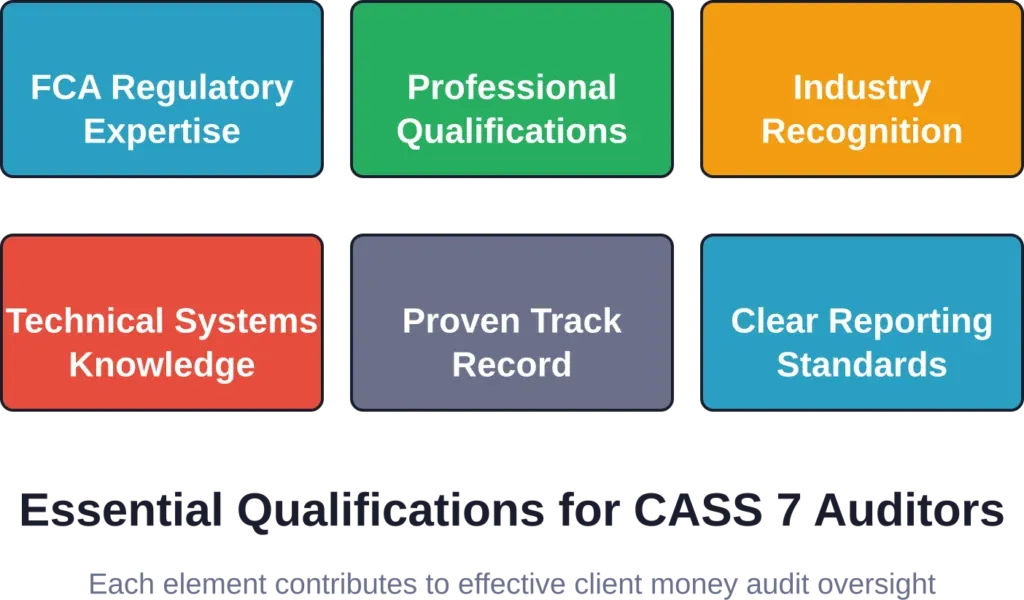
Key Qualifications for CASS Audit Companies
Not every accounting firm understands CASS regulations deeply enough to conduct effective audits. Specialized knowledge matters.
FCA Regulatory Expertise
The audit company must demonstrate current knowledge of FCA requirements. CASS rules evolve—the regulations have undergone multiple updates to strengthen client protection. Firms approaching their CASS year-end need auditors who understand the latest regulatory expectations.
Look for audit companies that actively work with FCA-regulated firms. Ask how many CASS audits they conduct annually. A firm performing dozens of CASS engagements will spot control weaknesses faster than one doing occasional client money audits.
Professional Qualifications and Standards
CASS auditors should hold appropriate professional certifications. According to IFAC standards, engagement partners responsible for audits must meet specific competence requirements. While the IFAC framework sets general audit standards, CASS work demands additional specialization in financial services regulation.
Check whether the audit firm's professionals pursue continuing professional development focused on financial services. IFAC's input-based approach typically requires 120 hours of CPD over a rolling 3-year period, with at least 60 hours in relevant CPD. For CASS specialists, this should include regular updates on FCA rule changes.
Industry Recognition
Leading audit firms for CASS work often have formal recognition. Some are listed by industry bodies or appear frequently in FCA guidance materials. While not mandatory, this recognition signals depth of experience.
Manage CASS 7 Audits With Acumon
CASS 7 audits need careful handling because they involve client money rules, records, reconciliations, controls, and reporting duties. Small gaps in process can create bigger problems later, especially where client money is involved. Acumon supports businesses with audit, risk assurance, accounts, tax, and advisory work, so CASS 7 requirements can be reviewed alongside the wider control and finance environment.
They are a UK-based firm of chartered accountants, auditors, and advisors with 90+ professionals. Their audit and risk assurance work can support firms that need help with compliance, governance, reporting processes, and the controls linked to client money arrangements.
Considering Your CASS 7 Audit Options?
Acumon can help with:
- Supporting CASS 7 audit requirements
- Reviewing client money controls and processes
- Checking records, reconciliations, and reporting issues
- Looking at risk, governance, and assurance matters
- Connecting CASS 7 findings with wider finance processes
👉 Contact Acumon to discuss your CASS 7 audit requirements and the right next steps
Evaluating Experience and Track Record
Experience separates competent auditors from exceptional ones. The complexity of client money rules means practical exposure matters as much as theoretical knowledge.
Client Portfolio Diversity
Ask potential audit companies about their client base. Do they work with investment firms similar in size and business model to yours? A firm that audits large asset managers may struggle with the specific challenges facing smaller wealth advisors or retail brokers.
Diversity of experience helps too. Auditors who've worked across different FCA-regulated sectors—investment management, stockbroking, retail trading platforms—bring broader perspective on how firms structure client money controls.
Control-Based Methodology
CASS audits have evolved from substantive testing to control-based approaches. This shift emphasizes prevention rather than detection. The audit company should explain their methodology for assessing control design and operating effectiveness.
Control-based audits challenge whether critical controls actually prevent client money breaches. Effective auditors don't just test samples—they evaluate the entire control framework supporting daily reconciliations, segregation procedures, and oversight mechanisms.
References and Case Studies
Request client references, particularly from firms with similar CASS profiles. What did previous clients value most? How did the auditor handle complex reconciliation challenges or unusual client money arrangements?
Some audit companies publish case studies (anonymized to protect client confidentiality) demonstrating how they've helped firms strengthen CASS compliance. These provide insight into their problem-solving approach.
Questions to Ask Potential CASS Auditors
The selection process should include detailed conversations with shortlisted firms. Here's what to ask.
Technical Understanding
- How do you assess internal reconciliation processes under CASS 7.15 and 7.16?
- What's your approach to evaluating client money segregation at third parties?
- How do you test acknowledgment letters from banks under CASS 7.18?
- What constitutes a material control weakness versus an observation in your reporting?
Strong answers demonstrate detailed knowledge of specific CASS provisions, not just general audit principles.
Process and Timeline
- What information do you need before the audit begins?
- How long does a typical CASS 7 audit take for a firm of our size?
- What's your approach to interim testing versus year-end work?
- When will we receive the draft audit report, and what's the review process?
Clear timelines prevent last-minute scrambles to meet FCA reporting deadlines. Many firms approaching their CASS year-end benefit from planning audits well in advance.
Value Beyond Compliance
The best CASS auditors don't just issue opinions—they help firms improve. Ask how the firm provides insights beyond the formal audit report. Do they offer management letters identifying control enhancements? Will they explain findings to boards or audit committees?
Some audit companies reduce ongoing CASS workload by recommending automation or process improvements during the audit. This advisory element adds substantial value.
| Evaluation Criteria | Why It Matters | Red Flags to Watch |
|---|---|---|
| Number of annual CASS audits | Volume builds pattern recognition and regulatory insight | Fewer than 10 CASS audits annually suggests limited specialization |
| Staff continuity | Consistent team members develop firm-specific knowledge | Different audit team each year means lost institutional knowledge |
| Regulatory update process | CASS rules evolve; auditors must stay current | No structured CPD program for FCA regulation updates |
| Report clarity | Clear findings enable boards to make informed decisions | Vague or overly technical reports that obscure key issues |
| Response time | Quick answers during audit prevent delays | Slow communication or unavailable partners during fieldwork |
Understanding Audit Methodology and Approach
The audit methodology directly impacts the value received. Two firms might charge similar fees but deliver vastly different insights based on their approach.
Risk-Based Testing
Effective CASS audits identify where client money risks concentrate, then focus testing accordingly. A firm with complex third-party arrangements needs more scrutiny of acknowledgment letters and oversight controls. A firm with high transaction volumes needs robust daily reconciliation testing.
Ask how the auditor tailors their testing plan to specific risk profiles. Generic audit programs miss nuances that matter for client protection.
Technology and Tools
Modern CASS audits leverage data analytics. Rather than sampling transactions, advanced auditors can analyze entire populations of reconciliation breaks, client money movements, or segregation calculations.
Ask what audit technology the firm uses. Do they perform exception testing across full datasets? Can they visualize reconciliation patterns to identify systemic issues?
Continuous Monitoring Perspective
While CASS audits happen annually, client money controls operate daily. Forward-thinking audit companies help firms implement continuous monitoring approaches that provide real-time assurance rather than year-end discoveries.
This might include automated reconciliation checks, exception reporting dashboards, or control self-assessment frameworks that reduce reliance on periodic audits.
Cost Considerations and Fee Structures
CASS audit fees vary based on firm size, complexity, and the auditor's approach. Understanding fee structures helps budget appropriately.
What Drives Audit Costs
Several factors influence CASS 7 audit pricing:
- Client money volume and transaction complexity
- Number of client money bank accounts and third-party relationships
- Quality of existing reconciliation processes and documentation
- Whether the firm has previous audit findings requiring follow-up
- Interim testing versus compressed year-end audit timelines
Firms with well-organized records and strong controls typically face lower audit costs because testing proceeds more efficiently.
Fixed Fee vs. Time-Based Pricing
Some audit companies offer fixed fees for CASS engagements, providing cost certainty. Others bill hourly, which can escalate if unexpected issues arise or documentation is incomplete.
Fixed fees work best when scope is clearly defined and the firm's CASS arrangements are straightforward. Time-based fees offer flexibility for complex situations but require careful monitoring.
Value Versus Price
The cheapest auditor rarely delivers best value. An audit company charging 20% less but missing critical control weaknesses creates far greater risk than paying appropriately for thorough work.
Consider the total cost of poor audit quality—regulatory fines, reputational damage, client compensation, and remediation expenses dwarf audit fee savings.
Red Flags When Selecting CASS Auditors
Certain warning signs should prompt caution during the selection process.
Limited CASS-Specific Experience
General audit firms sometimes claim CASS capability based on broad financial services work. But CASS regulations require specific expertise that doesn't transfer automatically from other audit types.
If the proposed engagement partner hasn't personally conducted at least 10 CASS audits, look elsewhere.
Inflexible Methodology
Cookie-cutter audit programs that don't adapt to specific firm circumstances miss important risks. The auditor should explain how they'll tailor testing to unique client money arrangements.
Poor Communication During Proposal
If the audit company is unresponsive, vague, or fails to demonstrate understanding during the proposal phase, those problems will intensify during the engagement.
No Advisory Capability
Firms that simply issue pass/fail opinions without helping strengthen controls provide minimal value. The best CASS auditors act as knowledgeable advisors who enhance the firm's overall compliance framework.
Making the Final Decision
After evaluating qualifications, methodology, and cost, narrow choices to 2-3 finalists. Arrange in-person or virtual meetings where proposed engagement teams present their approach.
Pay attention to chemistry and communication style. The audit relationship works best when both parties communicate openly about challenges and collaborate on solutions.
Check references thoroughly. Ask previous clients about the auditor's responsiveness, quality of insights, and ability to meet deadlines. Were audit findings clearly explained? Did management letters provide actionable recommendations?
Finally, ensure the engagement letter clearly defines scope, deliverables, timing, and fees. Ambiguity here causes disputes later.
The right CASS 7 audits company becomes a valuable partner in protecting client money and maintaining FCA compliance. Choose carefully, and the investment pays dividends through stronger controls, clearer assurance, and reduced regulatory risk.
Frequently Asked Questions
Most firms holding client money under CASS 7 require annual audits. The audit report must be submitted to the FCA within four months of the firm's accounting reference date. Firms should plan audits well before this deadline to allow time for fieldwork, report review, and any necessary remediation.
While not prohibited, independence considerations apply. The audit firm must maintain objectivity. If the same firm handles bookkeeping or prepares reconciliations that the audit will review, independence may be compromised. Best practice typically separates operational accounting from CASS audit work to ensure independent oversight.
CASS 5 governs client money held by insurance intermediaries, while CASS 7 applies to designated investment firms. The underlying principles around segregation and reconciliation are similar, but specific rules differ. Ensure the audit company has experience with the specific CASS regime applicable to the firm's permissions.
Duration varies by firm size and complexity. Small investment firms with straightforward client money arrangements might complete audits in 2-3 weeks of fieldwork. Larger firms with multiple bank relationships, significant third-party arrangements, and high transaction volumes may require 6-8 weeks. Planning, preparation, and report drafting add additional time before and after fieldwork.
The auditor will document findings in the audit report and typically provide a management letter with recommendations. Material weaknesses must be disclosed to the FCA. The firm should develop remediation plans addressing identified issues and may need follow-up testing to confirm controls are corrected. Severe or repeated breaches can trigger regulatory action.
Continuity offers benefits—the auditor develops institutional knowledge of the firm's specific arrangements and history. However, periodic rotation (every 5-7 years) can provide fresh perspective. Some firms alternate between two qualified audit companies to balance continuity with independent viewpoints.
Auditors typically request client money bank statements, internal reconciliations, client ledgers, acknowledgment letters from banks, organizational charts showing CASS responsibilities, policies and procedures, and evidence of oversight and review controls. Well-organized documentation accelerates the audit and reduces costs. Firms should maintain audit trails throughout the year rather than scrambling to assemble evidence at year-end.
Conclusion
Selecting a CASS 7 audits company demands careful evaluation of specialized expertise, proven methodology, and alignment with the firm's specific needs. The right auditor brings deep knowledge of FCA client money rules, applies rigorous control-based testing, and delivers clear insights that strengthen compliance frameworks.
Look beyond cost to assess qualifications, track record, and the auditor's ability to add value through practical recommendations. Ask detailed questions about methodology, timeline, and how the firm will tailor testing to specific client money risks.
Strong CASS audits protect clients, satisfy regulatory requirements, and provide assurance to stakeholders that client money controls operate effectively. Invest time in selecting qualified auditors—the decision directly impacts regulatory standing and client trust.
Start the selection process early, particularly if approaching the CASS year-end. Qualified audit firms schedule engagements months in advance, and rushing the selection compromises quality. Choose wisely, and the audit becomes a valuable control enhancement rather than merely a compliance exercise.