
Quick Summary: Choosing an interim reviews company requires evaluating their credentials, industry expertise, technology infrastructure, and turnaround capabilities. Organizations should verify AICPA compliance, assess the firm's experience with your specific financial reporting requirements, and confirm their ability to meet regulatory deadlines—particularly given the SEC's 2026 semiannual reporting proposals.
The regulatory landscape for interim financial reporting has shifted dramatically. With the SEC proposing amendments in May 2026 to permit optional semiannual reporting instead of quarterly reports, organizations face critical decisions about their interim review processes.
Selecting the right interim reviews company isn't just about checking boxes. The wrong choice can delay filings, trigger compliance issues, and erode investor confidence. The right partner brings technical expertise, efficiency, and peace of mind during tight reporting windows.
Here's what organizations need to evaluate when choosing an interim reviews firm.
Understanding Interim Review Engagements
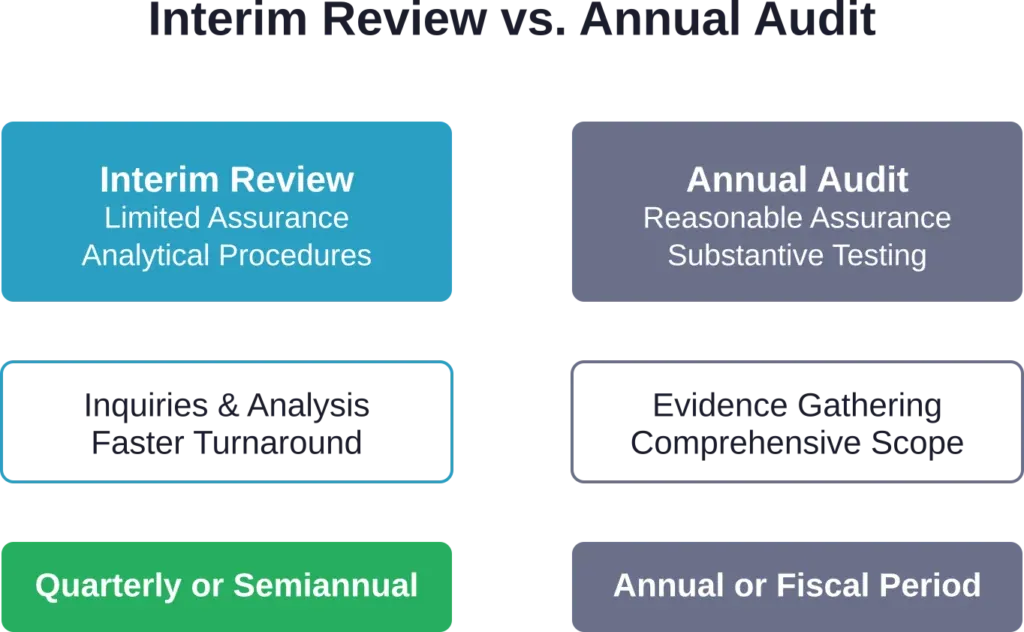
Interim financial information reviews differ fundamentally from annual audits. These engagements provide limited assurance that interim financial statements conform to applicable accounting frameworks—typically conducted quarterly or semiannually.
According to the AICPA, more organizations are outsourcing functions to third parties for efficiency and cost-effectiveness. Along with these benefits come risks that need proper assessment and management. SOC for Service Organizations engagements help organizations manage third-party risks effectively.
The accountant performing the review must establish sufficient knowledge of the entity's business and internal controls. Review procedures primarily consist of analytical procedures and inquiries, not the substantive testing required in full audits.
The Regulatory Context
The SEC's May 2026 proposal represents a significant shift. Public companies may now choose to file one semiannual report on the new Form 10-S instead of three quarterly reports on Form 10-Q. This option aims to reduce regulatory burden while maintaining investor transparency.
SEC Chairman Paul S. Atkins noted this proposal forms part of the "Make IPOs Great Again" agenda designed to incentivize companies to go and stay public. The amendment recognizes that quarterly reporting obligations can create substantial compliance costs without proportional benefits for all organizations.
But flexibility brings complexity. Organizations must decide whether quarterly or semiannual reporting better serves their stakeholder needs—and select review firms capable of supporting either approach.
Essential Credentials and Compliance Standards
The foundation of any interim reviews company selection starts with credentials. Not every accounting firm possesses the qualifications to perform these specialized engagements.
AICPA and PCAOB Standards
Firms performing interim reviews must comply with relevant professional standards. For public companies, PCAOB Auditing Standard AS 4105 governs reviews of interim financial information. The standard was recently amended, with changes effective December 15, 2026.
AS 4105 establishes specific requirements for review procedures, communications with audit committees, and reporting formats. The accountant must have adequate knowledge of the entity's accounting principles, practices, and internal control over financial reporting.
For private companies and other entities not subject to PCAOB oversight, AICPA Statements on Standards for Attestation Engagements (SSAEs) and Statements on Auditing Standards (SASs) apply. These standards are currently effective and downloadable from AICPA Professional Standards.
Service Organization Controls
When organizations outsource financial functions, SOC reports become critical. The AICPA provides SOC for Service Organizations engagements specifically designed to help organizations manage third-party risks.
If the interim reviews company will access sensitive financial data or interface with outsourced service providers, verify they understand SOC 1, SOC 2, and SOC 3 reporting requirements. This knowledge ensures proper consideration of controls operated by service organizations.
| Credential Type | Applicability | Key Verification |
|---|---|---|
| PCAOB Registration | Public company reviews | Check PCAOB registered firm database |
| AICPA Membership | All interim reviews | Verify firm and individual CPA licenses |
| Peer Review | Quality assurance | Request recent peer review results |
| SOC Expertise | Service organization clients | Ask for SOC engagement experience |
| Industry Certifications | Specialized sectors | Confirm relevant industry credentials |
Industry Expertise and Sector Experience
Generic accounting knowledge isn't enough. Interim reviews require understanding of industry-specific accounting treatments, revenue recognition patterns, and seasonal fluctuations that affect analytical procedures.
Matching Firm Experience to Your Sector
A firm with deep technology sector experience may struggle with real estate investment trust accounting. Healthcare organizations face unique regulatory requirements that demand specialized knowledge.
Request case studies or references from companies in your industry. Ask specific questions about unusual or complex situations they've encountered—these scenarios appear in Appendix B of AS 4105 and require seasoned judgment.
The accountant must understand the business model well enough to identify unusual trends during analytical procedures. According to Appendix A of AS 4105, analytical procedures may include comparing current interim financial information with anticipated results, prior periods, or industry data.
Size and Complexity Alignment
A firm accustomed to Fortune 500 engagements may apply unnecessarily rigorous procedures to a mid-market company, inflating costs and timelines. Conversely, a firm lacking experience with complex consolidations or international operations may miss material issues.
Look for firms that regularly serve organizations of similar size and operational complexity. This alignment ensures efficient, appropriately scoped engagements.
Arrange Interim Reviews With Acumon
An interim review can give a business a clearer view of its financial position before year-end, a transaction, a funding discussion, or a reporting deadline. It can also help identify accounting or control issues earlier, before they become harder to fix. Acumon provides audit, accounts, tax, advisory, and risk assurance support, which gives businesses a practical way to review financial information before larger decisions are made.
They are a UK-based firm with 90+ professionals, all based in the UK. Alongside audit and accounts work, their team also covers tax, payroll, company secretarial, business support, and risk and tech assurance. That wider service base can be useful when an interim review affects planning, compliance, reporting, or future audit work.
Considering Your Interim Review Options?
Acumon can help with:
- Reviewing interim financial information
- Checking accounting, tax, and reporting points
- Supporting audit preparation
- Identifying control or governance issues
- Preparing finance teams for year-end requirements
👉 Contact Acumon to discuss your interim review requirements and the right next steps.
Technology Infrastructure and Data Security
Modern interim reviews depend on technology. Firms using outdated methods create bottlenecks and security vulnerabilities.
According to the International Ethics Standards Board for Accountants (IESBA), ethics and independence matter significantly for technology use. IESBA published guidance addressing how the profession should navigate rapid technological change while maintaining professional standards.
Data Analytics Capabilities
Advanced firms employ data analytics tools to perform analytical procedures more efficiently and comprehensively. These technologies can analyze entire populations rather than samples, identifying anomalies human reviewers might miss.
Ask potential firms about their analytics platforms. Do they use continuous monitoring tools? Can they integrate with your ERP system to extract data automatically? How do they validate data integrity?
Cybersecurity Measures
Interim financial information often contains market-sensitive data. According to the Federal Trade Commission's guidance on cybersecurity for small business, organizations can't afford to lose time, information, or money to cyberattacks.
When evaluating interim reviews companies, assess their cybersecurity posture. Do they use encrypted file transfer protocols? How do they control access to client data? What incident response procedures are in place?
The FTC emphasizes that businesses using third-party software must ensure all parties comply with relevant regulations. This principle applies equally to interim review engagements—both client and firm share responsibility for data protection.
Turnaround Time and Resource Capacity
Interim reporting deadlines are non-negotiable. Public companies must file quarterly reports within specific SEC deadlines (typically 40 days for large accelerated and accelerated filers, and 45 days for non-accelerated filers). The proposed semiannual reporting would extend some deadlines but still requires timely completion.
Assessing Engagement Timelines
Ask prospective firms about their standard engagement timelines. How quickly can they complete fieldwork after receiving preliminary financial statements? What's their track record for meeting filing deadlines?
Request specific examples. Have they handled rush engagements when clients faced unexpected delays? What additional resources do they deploy during peak periods when multiple clients have simultaneous deadlines?
Team Depth and Availability
A firm stretched too thin creates risks. If the engagement partner oversees 30 simultaneous reviews, individual clients won't receive adequate attention.
Inquire about team composition. Who will lead the engagement? What's the staffing model? How does the firm handle vacations, illnesses, or unexpected departures during critical periods?
The firm should demonstrate clear escalation procedures for technical accounting questions and capacity to surge resources if issues arise.
Communication and Reporting Practices
AS 4105 requires specific communications with management and audit committees. The quality and timeliness of these communications significantly impact the review process.
Establishing Clear Expectations
According to AS 4105, the accountant must establish an understanding with the audit committee regarding the nature and limitations of interim review procedures. This understanding should be documented in the engagement letter.
Evaluate how prospective firms approach this initial communication. Do they provide clear explanations of review scope and limitations? Do they proactively discuss how their procedures differ from audit procedures?
Ongoing Updates and Issue Resolution
Problems discovered during interim reviews require immediate attention. Firms should have structured processes for communicating issues to management and audit committees.
AS 4105 specifies that accountants must communicate matters to audit committees when they become aware of fraud, illegal acts, or significant deficiencies in internal control. The firm's communication protocols should align with these requirements.
Ask about communication frequency and formats. Will you receive regular status updates? How quickly does the team respond to questions? What collaboration tools do they use?
Cost Structure and Value Proposition
Interim review fees vary widely based on company size, industry complexity, geographic location, and engagement scope.
Understanding Fee Arrangements
Most firms charge fixed fees for interim reviews, calculated based on estimated hours and hourly rates. Some offer annual arrangements covering multiple interim periods at a bundled rate.
Request detailed fee proposals that break down anticipated hours by team level. This transparency helps evaluate whether the proposed approach matches engagement needs.
Watch for potential additional charges. What circumstances trigger extra fees? How does the firm handle scope changes if unexpected accounting issues arise?
Evaluating Total Value
Cost must be weighed against quality and risk mitigation. A firm charging 20% less but lacking industry expertise may ultimately cost more if they miss issues that trigger restatements.
Consider the total value proposition. Does the firm offer additional services like technical accounting consultations or SEC filing assistance? Can they provide interim CFO support if needed?
| Service Level | Typical Features | Best For |
|---|---|---|
| Basic Review | Standard analytical procedures, required communications | Straightforward quarterly filings |
| Enhanced Review | Expanded analytics, technical consultations, filing support | Complex transactions or accounting areas |
| Integrated Services | Review plus interim reporting prep, XBRL tagging, press release review | Organizations with limited internal resources |
| Advisory Retainer | Ongoing technical accounting support, transaction structuring advice | High-transaction volume businesses |
Reference Checks and Due Diligence
Never skip reference checks. Speaking with current and former clients reveals insights no proposal can provide.
Questions for References
Ask references specific questions about their experience. How did the firm handle tight deadlines? Were there any surprises in billing? How responsive was the engagement team?
Probe for weaknesses. What could the firm improve? Would the reference hire them again? Have they ever switched to a different interim reviews provider, and why?
Request references from companies with similar characteristics—industry, size, complexity, and regulatory requirements. A firm excellent at serving tech startups may not suit an established industrial manufacturer.
Regulatory and Disciplinary History
Check the firm's regulatory record. For PCAOB-registered firms, inspection reports are publicly available and reveal quality control issues and engagement deficiencies.
Review state board of accountancy records for any disciplinary actions against the firm or key personnel. Professional liability claims, while sometimes confidential, may be disclosed in certain contexts.
This due diligence protects organizations from engaging firms with patterns of quality problems or ethical lapses.
Making the Final Decision
After evaluating credentials, expertise, technology, capacity, communication, cost, and references, synthesize the information into a decision framework.
Scoring and Comparison
Create a weighted scorecard that reflects organizational priorities. If deadline compliance is critical, weight turnaround time and resource capacity heavily. If the organization faces complex technical accounting issues, emphasize industry expertise and technical depth.
Score each finalist objectively across all criteria. This structured approach prevents decisions based solely on personal rapport or the lowest fee.
Engagement Letter Review
Once a firm is selected, carefully review the engagement letter before signing. The letter should clearly specify scope, deliverables, timelines, fees, and communication protocols.
According to AS 4105, the engagement letter should document the understanding with the audit committee regarding review objectives and limitations. Ensure these elements are present and accurately reflect expectations.
Have legal counsel review indemnification and limitation of liability clauses. These provisions can significantly impact risk allocation if issues arise.
Transition Planning
If switching from a previous firm, plan the transition carefully. The new firm will need access to prior period workpapers, management representation letters, and communications with the audit committee.
Build in sufficient time for the new firm to gain necessary knowledge of the business before the first interim review. A rushed transition creates quality risks and defeats the purpose of selecting a superior provider.
Special Considerations for 2026 and Beyond
The regulatory environment continues evolving. Organizations selecting interim reviews companies must consider emerging trends and potential changes.
Semiannual Reporting Optionality
The SEC's May 2026 proposal to permit optional semiannual reporting changes the calculus. Organizations considering this option need firms experienced with both quarterly and semiannual approaches.
If the organization may switch to semiannual reporting, discuss this possibility during the selection process. How would the firm's approach change? Would fees adjust proportionally? Can they provide guidance on whether semiannual reporting suits the organization's circumstances?
Technology and Ethics Standards
IESBA's guidance on ethics and independence in technology use signals increased focus on how firms employ emerging technologies. Organizations should expect interim reviews firms to demonstrate responsible AI and automation practices.
Ask how firms are adapting to technological change while maintaining professional standards. Do they have policies governing AI tool usage? How do they ensure technology-assisted procedures meet quality standards?
Increasing Scrutiny of Service Organizations
As more organizations outsource financial functions, interim reviews increasingly involve consideration of service organization controls. According to AICPA guidance, organizations must identify, assess, and manage third-party risks.
Select firms with demonstrated expertise in evaluating controls at service organizations and incorporating SOC reports into interim review procedures. This capability becomes more critical as cloud-based systems and outsourced processes proliferate.
Frequently Asked Questions
Interim reviews provide limited assurance through analytical procedures and inquiries, while audits provide reasonable assurance through substantive testing and evidence gathering. Reviews are less comprehensive, faster, and less expensive than audits. Most public companies require interim reviews for quarterly periods and full audits only annually.
Private companies aren't legally required to have interim reviews unless specified by lenders, investors, or contractual agreements. Many credit facilities and private equity arrangements mandate quarterly reviewed financial statements. Organizations should check their financing agreements and investor requirements to determine obligations.
Engagement timelines vary based on company size and complexity, but most interim reviews require 2-4 weeks from receiving preliminary financial statements to issuing the review report. Organizations with clean accounting records, strong internal controls, and experienced finance teams typically fall toward the shorter end of this range.
Yes, organizations can engage separate firms for interim reviews and annual audits, though this approach is uncommon. Using different firms creates coordination challenges and may reduce efficiency since the interim review firm must still understand the business thoroughly. Most organizations prefer consistency between interim and annual engagements.
When reviewers identify material errors, management must correct the interim financial statements before filing. The review report will reference the corrected financial statements. If management refuses to make necessary corrections, the accountant will modify the review report or withdraw from the engagement, depending on the severity of the issues.
Interim review fees vary widely based on company size, industry complexity, geographic location, and engagement scope.
Industry expertise typically outweighs firm size for most organizations. A mid-sized firm with deep experience in your sector will usually deliver better results than a large firm lacking that specialization. The exception is when organizations need global reach, multi-jurisdictional expertise, or services beyond standard interim reviews—in those cases, larger firms may offer advantages.
Conclusion
Selecting an interim reviews company requires methodical evaluation across multiple dimensions. Credentials and compliance form the foundation, but industry expertise, technology capabilities, resource capacity, and communication practices ultimately determine engagement success.
The regulatory landscape of 2026—with optional semiannual reporting, evolving technology standards, and increasing third-party risk focus—demands forward-thinking firms that can adapt to change while maintaining quality.
Organizations that invest time in thorough selection processes, conduct comprehensive due diligence, and clearly define expectations position themselves for smooth, compliant interim reporting. The right interim reviews partner becomes a strategic asset, not just a compliance necessity.
Start your evaluation process well before the first reporting deadline. Build relationships with prospective firms, assess their capabilities honestly, and select based on fit rather than convenience. The quality of your interim financial reporting—and stakeholder confidence in your organization—depends on this critical decision.