
Quick Summary: Choosing a Title Transfer Collateral Arrangements (TTCA) company requires understanding regulatory compliance, particularly FCA guidelines on client asset protection. Firms must ensure the company operates within CASS rules, avoids inappropriate use of TTCAs that transfer insolvency risk to clients, and maintains transparent collateral practices. The right provider should demonstrate clear segregation between genuine collateral needs and client money protection obligations.
Title Transfer Collateral Arrangements have become a focal point for financial regulators, particularly after the FCA issued stark warnings about inappropriate practices. Selecting a company to handle these arrangements isn't just a business decision—it's a regulatory minefield that can expose firms to significant compliance risk.
The stakes are high. Get it wrong, and client assets could be at risk during insolvency scenarios.
Understanding Title Transfer Collateral Arrangements
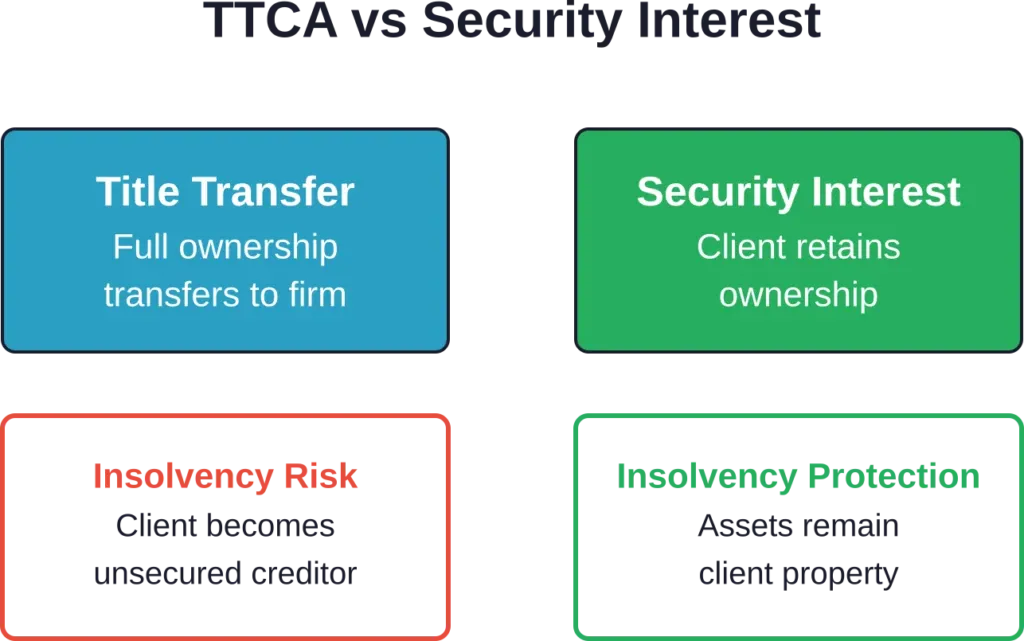
A Title Transfer Collateral Arrangement represents a specific type of financial collateral where full ownership of assets transfers from the client to the firm. This differs fundamentally from security interests, where the client retains ownership and the firm merely holds a charge over the assets.
Under a TTCA, the firm becomes the legal owner of the collateral. The client holds only a contractual right to receive equivalent assets back.
According to the European Directive 2002/47/EC, TTCAs encompass arrangements where title to financial collateral is transferred for the purpose of securing or covering relevant financial obligations. These arrangements appear most commonly in bilateral securities lending, bilateral repo transactions, and bilateral derivatives.
Here's the thing though—this ownership transfer fundamentally changes the risk profile. If the firm becomes insolvent, the client becomes an unsecured creditor for the return of equivalent assets. The collateral itself sits on the firm's balance sheet, available to all creditors.
Why Firms Enter TTCAs
Firms use these arrangements primarily for margin requirements in wholesale financial markets. Clearing brokers and prime brokers regularly enter TTCAs with clients to meet their own obligations to central counterparties or prime brokers further up the chain.
The operational simplicity appeals to many. The firm can reuse the collateral freely without tracking segregated client assets.
But that simplicity creates risk. The FCA has made clear that many firms have crossed the line from legitimate collateral arrangements into inappropriate use that effectively circumvents client money protection rules.
Regulatory Framework Governing TTCA Companies
The FCA's Client Assets Sourcebook (CASS) provides the primary regulatory framework for firms handling client assets. CASS 7 specifically addresses client money rules that apply to firms receiving or holding money in connection with MiFID business or designated investment business.
The FCA has made its position crystal clear through Dear CEO letters and focused supervisory work: firms cannot use TTCAs to avoid client asset protection requirements.
The FCA Perimeter and TTCA Oversight
According to the FCA perimeter report published in March 2026, the regulatory boundary defines what falls within FCA oversight. For business lending where the borrowing is under £25,000 and the SME is a sole trader or small entity, FCA regulation extends to this lending. But for investment business and client asset protection, different thresholds and rules apply.
The FCA views technology and innovation as central to improving SME access to financial services. Between November 2025 and February 2026, the Open Finance Techsprint explored practical solutions to leveraging data for financial product access challenges.
Yet none of this innovation absolves firms from basic client protection duties.
CASS Rules for Client Money Transfers
Under CASS 7, specific rules govern when client money ceases to be client money during business transfers under de minimis provisions.
Firms are required to hold unclaimed client money according to CASS rules before any other disposition.
These provisions exist to protect client assets. TTCAs that effectively convert client money into firm assets circumvent these protections entirely.
Review TTCA Arrangements With Acumon
TTCA arrangements can become difficult to manage when they sit across client asset rules, contracts, reporting, and audit requirements. Acumon supports businesses with audit, tax, accounts, risk assurance, and advisory work, so they can help review the wider financial and compliance side rather than treating TTCA as a separate technical issue.
Acumon is a UK-based firm of chartered accountants, auditors, and advisors with 90+ professionals. Their team works across audit services, risk and tech assurance, tax, accounts, payroll, company secretarial, and business support, which can be useful when TTCA questions connect with wider finance, governance, or reporting processes.
Considering Your TTCA Arrangement Options?
Acumon can help with:
- Reviewing the accounting and compliance impact
- Supporting audit and assurance requirements
- Checking related tax and reporting issues
- Advising on risk, controls, and governance
- Connecting TTCA questions with wider finance processes
👉 Contact Acumon to discuss your TTCA arrangements and the right next steps.
Key Selection Criteria for TTCA Providers
Choosing a TTCA arrangements company requires systematic evaluation across multiple dimensions. The right provider demonstrates not just operational capability but deep regulatory understanding.
Regulatory Compliance and Authorization
Start with the basics. Is the firm properly authorized by the FCA for the activities it conducts? Check the FCA register directly—don't rely on the firm's representations.
Look for evidence of robust compliance infrastructure. Does the firm have dedicated compliance personnel with relevant expertise? What's their track record with regulatory examinations?
Ask for copies of their most recent CASS audit reports. Firms subject to CASS must obtain independent audits of their client asset arrangements. These reports reveal compliance gaps and remediation efforts.
Transparency in Collateral Practices
The firm should clearly explain when and why it uses TTCAs versus other collateral arrangements. Red flags include:
- Vague explanations of why title transfer is necessary
- Standard use of TTCAs for all client relationships regardless of circumstances
- Inability to articulate what genuine collateral need the TTCA serves
- Resistance to providing alternative arrangements even when clients request them
Transparency matters. Firms using TTCAs appropriately can articulate exactly what counterparty exposure the collateral covers and why full title transfer serves a legitimate business need.
Client Asset Segregation Policies
Even when using TTCAs, firms should maintain clear policies distinguishing between different types of client assets. The firm should demonstrate:
- Clear internal procedures for determining when TTCAs are appropriate
- Senior management oversight of TTCA usage
- Regular monitoring of TTCA balances relative to genuine collateral needs
- Client disclosure documents that clearly explain the risks of TTCAs
A quality provider maintains detailed records showing the business rationale for each TTCA arrangement. They should be able to demonstrate that TTCA balances correspond to actual margin or collateral requirements, not merely operational convenience.
| Selection Factor | What to Verify | Red Flags |
|---|---|---|
| FCA Authorization | Current registration for relevant activities | Permissions that don't match actual services offered |
| CASS Audit History | Clean recent audits with no material findings | Recurring issues or qualified audit opinions |
| TTCA Documentation | Clear client agreements explaining risks | Boilerplate terms without risk disclosure |
| Operational Controls | Daily reconciliation of collateral positions | Manual processes without adequate oversight |
| Alternative Options | Willingness to offer non-TTCA arrangements | TTCA as only option regardless of client needs |
Understanding Inappropriate TTCA Use
The FCA has focused supervisory attention on inappropriate use of TTCAs—arrangements that effectively transfer insolvency risk to clients without genuine business justification. Understanding what regulators consider inappropriate helps identify providers to avoid.
Warning Signs of Regulatory Concern
The FCA has highlighted several concerning practices. Firms using TTCAs to hold client money that should be segregated under CASS rules face enforcement risk. This includes situations where firms require clients to enter TTCAs covering amounts well in excess of actual margin or collateral needs.
Another red flag: firms using TTCAs as a default arrangement without assessing whether genuine collateral requirements exist. The mere fact that a firm can use client assets under a TTCA doesn't mean they should.
Look out for these specific warning signs:
- TTCA balances that remain static rather than fluctuating with actual exposure
- Collateral requirements that significantly exceed the firm's obligations to third parties
- Inability to provide clear documentation of how TTCA amounts are calculated
- Pressure to agree to TTCAs as a condition of receiving services
The Legitimate Use Case
TTCAs serve legitimate purposes when used appropriately. A prime broker with genuine exposure to a client's trading positions can reasonably require collateral. When that prime broker must post collateral to its own counterparties, a TTCA allowing reuse of client collateral makes economic sense.
The key distinction: the TTCA amount should correspond to actual exposure and collateral needs, not serve as a general buffer or operational convenience.
Sound familiar? Many firms have historically used TTCAs precisely as that general buffer. That practice now sits squarely in regulators' crosshairs.
Due Diligence Process for TTCA Companies
Selecting a TTCA provider demands structured due diligence. A thorough process protects both the firm and its clients from regulatory risk and operational failures.
Documentation Review
Request and carefully review all standard documentation the provider uses for TTCA arrangements. This includes client agreements, risk disclosures, and terms of business.
The documentation should clearly state:
- That title to assets transfers to the firm
- That clients become unsecured creditors in insolvency
- How the firm calculates collateral requirements
- Whether and how the firm reuses collateral
- The client's rights to request return or substitution of collateral
Vague or incomplete disclosures suggest the provider hasn't thought through regulatory requirements or deliberately obscures risks.
Operational Assessment
Understanding the provider's operational capabilities matters enormously. Request information about:
- Systems for tracking collateral positions in real time
- Reconciliation processes and frequency
- Controls preventing over-collateralization
- Reporting provided to clients on collateral usage
Weak operational controls increase the risk that TTCA amounts will drift away from genuine needs. Manual processes without adequate oversight present particular concern.
Reference Checks
Speak with existing clients of the provider, particularly those in similar business lines. Ask about their experience with:
- Transparency of collateral calculations
- Responsiveness to queries about TTCA amounts
- Any regulatory issues that have arisen
- Overall satisfaction with the relationship
Real talk: providers uncomfortable with reference checks should raise immediate concern. Reputable firms welcome the opportunity to demonstrate satisfied clients.
Ongoing Monitoring and Risk Management
Selecting a TTCA provider isn't a one-time decision. Ongoing monitoring ensures the relationship remains compliant and appropriate as business circumstances evolve.
Regular Collateral Reviews
Establish a schedule for reviewing TTCA arrangements and amounts. Monthly reviews work well for most relationships, with more frequent checks during volatile markets or periods of significant trading activity.
Each review should verify that TTCA amounts correspond to current exposure and collateral requirements. Challenge any significant increases or static balances that don't reflect actual business activity.
Regulatory Update Monitoring
The regulatory landscape around TTCAs continues evolving. The FCA's focused attention since 2020 signals that enforcement may follow for firms that fail to address inappropriate practices.
Stay current on regulatory developments by monitoring FCA publications, particularly Dear CEO letters and policy statements related to CASS and client assets. Industry groups often provide useful guidance on emerging regulatory expectations.
Alternative Arrangement Assessment
Periodically assess whether alternatives to TTCAs might better serve business needs while reducing risk. Options include:
- Security interests rather than title transfer
- Segregated collateral accounts
- Third-party custodian arrangements
- Reduced collateral requirements through netting or portfolio margining
The regulatory pressure on TTCAs means exploring alternatives makes sound risk management sense, even if current arrangements technically comply with rules.
| Monitoring Activity | Frequency | Key Metrics |
|---|---|---|
| Collateral balance review | Monthly | TTCA amount vs actual exposure |
| Provider compliance update | Quarterly | CASS audit status, regulatory findings |
| Client disclosure review | Annual | Adequacy of risk explanations |
| Alternative assessment | Annual | Cost and feasibility of other arrangements |
| Regulatory landscape scan | Ongoing | FCA guidance, enforcement actions |
International Considerations for Cross-Border TTCAs
Firms operating across borders face additional complexity when selecting TTCA providers. Regulatory regimes differ significantly between jurisdictions.
The European Directive 2002/47/EC provides a framework for financial collateral arrangements across EU member states. But implementation details vary by country, creating potential conflicts and gaps in protection.
U.S. rules governing collateral arrangements differ materially from European approaches. The Securities and Exchange Commission oversees certain trust arrangements, but TTCAs may fall under different regulatory frameworks depending on the specific structure and parties involved.
For cross-border arrangements, verify:
- Which jurisdiction's law governs the TTCA
- Whether that jurisdiction recognizes title transfer as intended
- How insolvency proceedings in different jurisdictions might affect the arrangement
- Whether the provider has appropriate authorizations in all relevant jurisdictions
The complexity of cross-border arrangements makes legal advice essential. Don't rely solely on the provider's representations about how different jurisdictions will treat the arrangement.
Technology and Innovation in TTCA Management
Technology increasingly shapes how firms manage collateral arrangements. The right provider leverages technology to enhance transparency, reduce operational risk, and ensure real-time compliance monitoring.
Look for providers offering:
- Real-time collateral position reporting accessible to clients
- Automated reconciliation between TTCA amounts and underlying exposure
- Alert systems flagging unusual collateral movements or over-collateralization
- Integration with clients' risk management systems
The FCA's focus on technology and innovation in financial services extends to operational capabilities. Providers relying on outdated manual processes face greater operational risk and compliance challenges.
But wait. Technology alone doesn't solve regulatory compliance issues. Automated systems managing inappropriate TTCA arrangements simply create compliance failures more efficiently. The underlying business model and controls matter more than the technology platform.
Cost Considerations and Fee Structures
TTCA arrangements involve various costs that vary by provider. Understanding fee structures helps evaluate total relationship cost.
Common fees include:
- Collateral management fees
- Custodian fees for holding underlying assets
- Transaction fees for collateral movements
- Interest spreads on cash collateral
Providers may offset some fees through returns generated from reusing collateral. Transparency about this reuse and any revenue sharing becomes important.
Be wary of providers offering significantly below-market fees for TTCA services. Extremely low fees may signal that the provider generates revenue through aggressive collateral reuse or by requiring excessive collateral amounts.
The lowest-cost provider rarely represents the best value when regulatory risk and client protection considerations enter the equation.
Frequently Asked Questions
A TTCA is a financial arrangement where full legal ownership of collateral transfers from the client to the firm, rather than the firm holding only a security interest. Under a TTCA, the client retains only a contractual right to receive equivalent assets back. If the firm becomes insolvent, the client becomes an unsecured creditor for return of the collateral.
The FCA has focused on TTCAs used to circumvent client asset protection rules under CASS. Inappropriate use includes requiring TTCAs to hold client money that should be segregated, requiring collateral amounts well beyond genuine business needs, or using TTCAs as a default arrangement without proper justification. These practices transfer insolvency risk to clients without legitimate business rationale.
CASS rules require firms to segregate client money and assets to protect them in insolvency. TTCAs where title transfers to the firm remove assets from CASS protection, making them available to all firm creditors. The FCA expects firms to demonstrate genuine business justification for using TTCAs rather than keeping assets within CASS protections.
Ask for detailed explanations of when and why they use TTCAs versus other arrangements, documentation of their CASS audit history, examples of their client disclosure documents, and information about their operational controls for monitoring collateral amounts. Request references from existing clients and verify their FCA authorization covers the specific services they offer. Ask how they calculate collateral requirements and whether they offer alternatives to TTCAs.
Monthly reviews of TTCA balances against actual exposure and collateral requirements represent best practice for most firms. Quarterly assessments of the provider's overall compliance status, including CASS audit results and any regulatory findings, help identify emerging risks. Annual comprehensive reviews should evaluate whether alternative arrangements might better serve business needs while reducing regulatory risk.
No. While the European Directive 2002/47/EC provides a framework across EU member states, implementation varies by country. U.S. rules differ materially from European approaches. For cross-border arrangements, the governing law, recognition of title transfer, and treatment in insolvency proceedings can all vary significantly. Legal advice specific to the relevant jurisdictions is essential for cross-border TTCAs.
The primary risks include regulatory enforcement action for inappropriate TTCA use, loss of client assets if the provider becomes insolvent, reputational damage if clients suffer losses, and operational failures in managing collateral positions. Providers with weak compliance infrastructure or unclear business practices expose firms to significant regulatory scrutiny, particularly given the FCA's current focus on TTCA arrangements.
Conclusion
Choosing a TTCA arrangements company requires balancing operational needs against regulatory requirements and client protection obligations. The FCA's clear warnings about inappropriate practices mean firms can no longer treat these arrangements as mere operational conveniences.
The right provider demonstrates transparent practices, robust operational controls, and genuine understanding of regulatory requirements. They can articulate clear business justification for TTCA use and maintain collateral amounts that correspond to actual exposure rather than excessive buffers.
Thorough due diligence before selection and ongoing monitoring after engagement protect firms from regulatory risk while ensuring clients receive appropriate protection. As regulatory scrutiny continues intensifying, firms that carefully evaluate TTCA providers and maintain appropriate oversight of these arrangements will be best positioned to avoid enforcement action.
The stakes extend beyond compliance. Client trust depends on transparent, fair treatment of their assets. Selecting TTCA providers that prioritize client protection alongside operational efficiency ultimately serves everyone's long-term interests.
Ready to evaluate current TTCA arrangements? Start by requesting detailed documentation of collateral calculations and reviewing whether amounts correspond to genuine business needs rather than operational convenience.