
Quick Summary: Choosing the right pension administration services company requires evaluating their regulatory compliance expertise, technology platforms, service responsiveness, and fiduciary support capabilities. The best providers combine actuarial knowledge, hands-on plan design experience, and transparent fee structures while staying current with IRS and Department of Labor requirements.
Retirement plan administration feels like trying to read tax code while juggling flaming torches. The rules never stop changing, deadlines multiply like rabbits, and one misstep can trigger penalties that make your CFO cry.
That's exactly why third-party administrators exist. But here's the thing—not all pension administration services companies are created equal.
Some TPAs act like glorified form-fillers. Others become strategic partners who actually understand your business goals and keep you miles ahead of compliance disasters. The difference between these two? It can mean thousands in unnecessary costs or, worse, a failed audit.
What Pension Administration Actually Includes
Pension administration is basically being the accountant for your retirement plan. Every transaction, contribution, distribution, and compliance test flows through these services.
The core responsibilities break down into several categories. Plan design and consulting come first—helping you structure benefit formulas, eligibility requirements, and vesting schedules that make sense for your workforce. Then comes the daily operational work: processing contributions, tracking participant data, calculating benefits, and managing distributions.
Compliance is where things get technical fast. According to the IRS, qualified plans must satisfy Internal Revenue Code requirements in both form and operation. That means your plan document needs proper language AND your day-to-day administration must follow those rules exactly.
Testing season hits annually. Nondiscrimination testing ensures benefits don't favor highly compensated employees—those earning $160,000 or more (highly compensated employee threshold for 2025/2026). Coverage testing, top-heavy testing, and 401(k) ADP/ACP tests all require precise calculations and data analysis.
Government reporting demands precision too. The annual Form 5500 filing, participant notices, summary plan descriptions—all carry specific deadlines and content requirements. Miss one? The Department of Labor can assess penalties that escalate quickly.
Questions That Separate Good TPAs from Great Ones
Start with regulatory expertise. Ask how the administrator stays current with ERISA requirements and IRS operational compliance changes. According to the Department of Labor, fiduciary responsibilities extend to anyone with discretionary authority over plan administration or assets.
Real talk: if your TPA can't explain how recent legislation affects your specific plan type, that's a red flag the size of a billboard.
Technology matters more than most employers realize. What systems does the provider use for recordkeeping? How do participants access their accounts? Can payroll integrations happen automatically, or will someone manually key data every pay period?
Manual data entry breeds errors. Errors breed corrections. Corrections breed missed deadlines and frustrated employees calling HR.
Service Responsiveness and Communication
Here's where the rubber meets the road. Ask about average response times for routine questions versus urgent issues. Who's the primary contact? Will that person actually answer emails, or disappear into the void?
Request references from current clients with similar plan types and company sizes. Then actually call those references. Ask about service quality during crunch times—year-end processing, audit season, plan amendments.
| Evaluation Factor | What to Ask | Red Flags |
|---|---|---|
| Compliance Expertise | How do you track regulatory changes? What's your audit success rate? | Vague answers, no specific examples, reluctance to share audit results |
| Technology Platform | What systems do you use? How do participants access data? | Outdated software, manual processes, no mobile access |
| Service Model | Who's my contact? What are response time commitments? | No dedicated contact, unclear SLAs, slow reference responses |
| Fee Structure | How are fees calculated? What triggers additional charges? | Complex pricing, hidden fees, unwillingness to provide written estimates |
Actuarial and Investment Support
For defined benefit plans especially, in-house actuarial capability isn't optional—it's essential. These plans require annual valuation work and contribution calculations that directly affect company cash flow.
According to SEC data, total private pension fund assets reached over $6.3 trillion by 2011, covering 129 million participants. Managing that scale requires teams with deep technical knowledge, not generalists who Googled pension formulas last Tuesday.
Ask whether the TPA has credentialed actuaries on staff. Do they handle investment consulting, or work with separate advisors? How do they coordinate between administrative and investment functions?
Handle Pension Administration With Acumon
Pension administration needs accurate records, timely processing, and a clear understanding of payroll and compliance duties. It can affect employees, employers, tax reporting, and wider finance processes, so it helps when the work is handled alongside payroll and accounting support. Acumon provides payroll, accounts, tax, business support, and advisory services, which can help companies keep pension administration connected to the rest of their finance function.
They are a UK-based firm with 90+ professionals, all based in the UK. Their wider service base includes payroll processing, PAYE and National Insurance, pension administration, accounts, tax, audit, and company secretarial work, which can be useful when pension questions overlap with payroll deadlines, employee records, or compliance requirements.
Considering Your Pension Administration Options?
Acumon can help with:
- Pension administration support
- Payroll processing and employee records
- PAYE and National Insurance matters
- Checking pension-related reporting and compliance
- Connecting pension administration with wider payroll and accounts work
👉 Contact Acumon to discuss your pension administration requirements and the right next steps.
Fee Structures and Cost Transparency
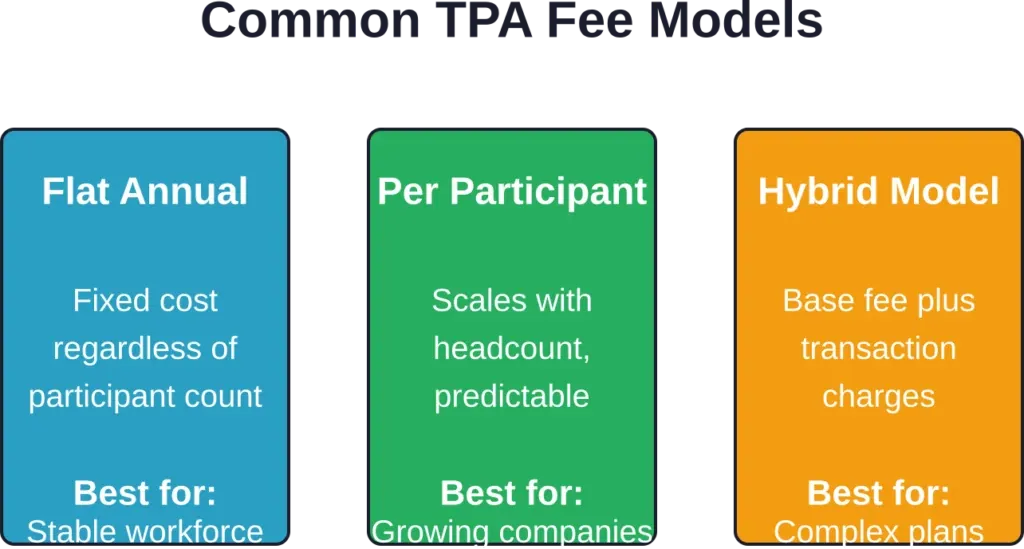
Pricing models vary wildly across providers. Some charge flat annual fees. Others use per-participant pricing. Still others combine base fees with transaction charges for distributions, loans, and plan amendments.
None of these models is inherently better. What matters is transparency and predictability.
Request detailed fee schedules in writing. Ask about circumstances that trigger additional charges. What happens if participant counts grow? What about complex distributions or mid-year plan changes?
According to GAO analysis, fee differences can significantly impact long-term retirement savings. The same principle applies to administrative fees—seemingly minor cost differences add up across decades of plan operation.
Fiduciary Services and Risk Management
Some TPAs offer 3(16) fiduciary services, assuming legal responsibility for certain administrative functions. This shifts liability from the employer to the administrator for covered duties.
Sound appealing? It should. But understand exactly which responsibilities transfer and which remain with the plan sponsor. Review the fiduciary agreement carefully, preferably with legal counsel who specializes in ERISA.
The Department of Labor is clear: plan fiduciaries include anyone who exercises discretionary control over plan management or assets, has authority over administration, or provides investment advice for compensation. That's a broad net.
Ask potential administrators how they manage fiduciary risk. What errors and omissions insurance do they carry? What's their claim history? How do they handle regulatory changes that affect existing procedures?
Technology and Participant Experience
Participants don't care about nondiscrimination testing or actuarial valuations. They care about checking balances, requesting distributions, and updating beneficiaries without calling HR seventeen times.
Evaluate the participant portal. Is it actually intuitive, or does it look like it was designed during the dial-up era? Can participants access accounts on mobile devices? What educational resources are available?
Integration capabilities matter too. How does the TPA system connect with payroll? What about HR information systems? Manual data transfers between platforms create opportunities for errors and delays.
Making the Final Decision
- Narrow your list to three finalists. Request proposals that address your specific plan type, participant demographics, and service requirements.
- Schedule in-depth presentations with each provider. Bring your CFO, HR director, and anyone else who'll interact regularly with the administrator. Ask hard questions. Push back on jargon-heavy answers.
- Check credentials and affiliations. Are key staff members credentialed actuaries (FSA, EA) or pension professionals (QPA, QKA)? Does the firm belong to professional organizations like ASPPA or the American Society of Pension Professionals?
- Review transition timelines and support. How long does implementation take? What resources does the TPA provide during conversion? Who handles participant communication about system changes?
The right pension administration partner doesn't just process transactions—they help optimize plan design, navigate regulatory complexity, and keep participants satisfied. That's worth the effort to choose carefully.
Frequently Asked Questions
A third-party administrator handles compliance testing, government reporting, and plan document maintenance. A recordkeeper tracks individual account balances and transactions. Many providers offer both services, but they're technically distinct functions. Some plans use separate vendors for each role.
Conduct formal evaluations every 3-5 years minimum. Annual informal check-ins help too. Review service quality, fee competitiveness, and technology capabilities. Plan sponsors have fiduciary duties to ensure service providers remain appropriate for the plan's needs.
Technically yes, but it's complicated and often inadvisable. Transitions work best at year-end when data conversion is cleaner. Mid-year changes require splitting annual testing, dual reporting, and careful coordination. Only switch mid-year if service failures justify the added complexity.
Reputable administrators carry errors and omissions insurance and have established correction procedures. The IRS offers voluntary correction programs for many mistakes. Ask potential TPAs about their error resolution process and insurance coverage limits before signing contracts.
Core compliance requirements apply regardless of size, but service needs differ. Small plans benefit from hands-on consulting and educational support. Large plans need robust technology and dedicated service teams. Choose a provider experienced with your participant range.
management through one provider. Unbundled structures use separate vendors for each function. Bundled offers simplicity; unbundled provides flexibility and potentially better pricing. Neither is universally superior—match the structure to your priorities.
Look for Enrolled Actuaries (EA) or Fellows of the Society of Actuaries (FSA) for defined benefit plans. Qualified Pension Administrators (QPA) and Qualified 401(k) Administrators (QKA) certifications demonstrate technical knowledge. Industry experience matters as much as credentials though.
Moving Forward with Confidence
Selecting pension administration services ranks among the most consequential vendor decisions a plan sponsor makes. The stakes are high—compliance failures trigger penalties, poor service frustrates participants, and inadequate support wastes internal resources.
But armed with the right questions and evaluation criteria, the decision becomes manageable. Focus on regulatory expertise, technology capabilities, service quality, transparent pricing, and cultural fit.
Schedule consultations with multiple providers. Compare proposals systematically. Check references thoroughly. Then choose the partner positioned to support your plan today and adapt as requirements evolve.
Your retirement plan deserves administration that goes beyond checking boxes. Find the TPA that delivers strategic value, not just transactional processing.