
Quick Summary: Choosing a limited reviews company requires evaluating verification methods, transparency standards, compliance with FTC regulations, and authentic customer feedback practices. Look for platforms that verify purchases, avoid fake review incentives, provide clear pricing, and demonstrate compliance with 2024 anti-fraud regulations that impose penalties up to $53,088 per violation.
The review economy has reached a critical inflection point. Businesses rely on customer feedback to build trust, yet fake reviews have distorted markets so severely that honest sellers lose ground to fraudulent competitors. Research from UCLA Anderson School of Management shows sellers using fake reviews saw unit sales rise an average 27.2%, while honest sellers competing against them lost market share and profits.
That's not a level playing field. That's a broken system.
Selecting a limited reviews company—a platform that collects, verifies, and displays customer feedback—has become a strategic decision with real financial consequences. The wrong choice can expose businesses to regulatory penalties, reputational damage, and lost revenue. The right choice builds authentic credibility.
Here's how to make that choice wisely.
Understanding What a Limited Reviews Company Actually Does
A limited reviews company serves as an intermediary between businesses and customers. These platforms collect feedback, verify authenticity, manage responses, and display reviews across various channels.
But not all review platforms operate the same way. Some prioritize volume over verification. Others create closed ecosystems that limit transparency. The best platforms balance accessibility with rigorous authentication.
The term "limited" typically refers to one of three constraints: limited to verified purchasers only, limited display of reviews based on quality filters, or limited access to premium features. Understanding which limitation applies helps businesses align platform capabilities with their needs.
Why Verification Methods Matter More Than Ever
The Federal Trade Commission has established regulations imposing penalties for violations related to fake reviews. That regulatory shift changed the landscape overnight.
Companies that rely on unverified review sources now face genuine legal exposure. So verification isn't just about authenticity—it's about compliance.
Purchase Verification as the Gold Standard
Platforms like Feefo emphasize verification of customer reviews. That's the benchmark. Purchase verification confirms the reviewer actually bought the product or service before leaving feedback.
Look for platforms that automatically trigger review requests after confirmed transactions. Manual or open submission systems create opportunities for manipulation.
Multi-Factor Authentication
The strongest platforms layer multiple verification steps: email confirmation, purchase matching, and account authentication. This combination makes fraudulent reviews prohibitively difficult to scale.
Ask potential review companies how they prevent duplicate submissions from the same individual. Robust platforms maintain device fingerprints, IP tracking, and behavioral analysis.

Handle Limited Reviews With Acumon
A limited review often needs more than a quick check of the numbers. It may involve accounting records, supporting documents, internal controls, and the way financial information is being prepared for lenders, investors, regulators, or internal decision-makers. Acumon supports businesses with audit, accounts, tax, risk assurance, and advisory work, so the review can sit within the wider finance picture.
They are a UK-based firm of chartered accountants, auditors, and advisors with 90+ professionals. Their team works across audit services, accounts, tax, payroll, risk and tech assurance, company secretarial, and business support, which can help when a limited review raises follow-up questions around reporting, compliance, or finance processes.
Considering Your Limited Review Options?
Acumon can help with:
- Reviewing financial information and supporting records
- Checking accounting and reporting issues
- Supporting assurance requirements
- Looking at controls, governance, and risk points
- Connecting review findings with wider finance processes
👉 Contact Acumon to discuss your limited review requirements and the right next steps.
Red Flags That Signal Unreliable Review Platforms
Certain warning signs indicate a review company prioritizes quantity over quality—or worse, actively enables fraud.
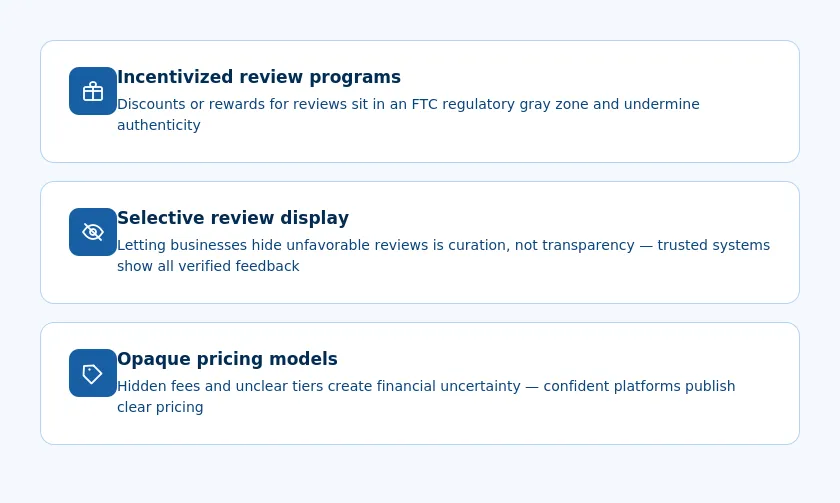
Incentivized Review Programs
Any platform that encourages businesses to offer discounts, rewards, or compensation in exchange for reviews operates in a regulatory gray zone. The FTC has made clear that compensated reviews undermine authenticity.
Legitimate platforms allow businesses to request reviews but prohibit conditioning those requests on positive sentiment or offering incentives.
Selective Review Display
Some platforms give businesses control over which reviews appear publicly. That's not transparency—that's curation designed to hide problems.
Consumer Reports emphasizes that trusted systems display all verified feedback, both positive and negative. Platforms that allow businesses to hide unfavorable reviews fail the credibility test.
Opaque Pricing Models
Review platforms with hidden fees, unclear tier structures, or surprise charges create financial uncertainty. The Regenified certification program faced criticism for requiring farmers to attend multi-day educational workshops with costs not transparently disclosed upfront.
Transparent pricing demonstrates operational integrity. Platforms confident in their value proposition publish clear pricing structures.
Evaluating Platform Features and Business Fit
Different businesses need different review capabilities. A local service provider has different requirements than an e-commerce retailer.
| Business Type | Essential Features | Nice-to-Have Features |
|---|---|---|
| Local Services | Google Business Profile integration, QR code generation, SMS requests | Multi-location management, appointment confirmation triggers |
| E-commerce | Product-level reviews, photo uploads, purchase verification | Review syndication, AI-powered insights, competitor benchmarking |
| B2B Companies | Case study integration, project-based feedback, relationship manager reviews | Anonymous feedback options, NPS tracking, executive dashboards |
| Healthcare Providers | HIPAA compliance, privacy controls, reputation monitoring | Sentiment analysis, staff-level feedback, insurance network display |
Integration Capabilities
The best review platform integrates seamlessly with existing business systems. Look for native connections to CRM platforms, e-commerce systems, and marketing automation tools.
Google Business Profile integration remains critical for local visibility. Platforms that automate review collection through a link or QR code reduce friction in the feedback process.
Analytics and Actionable Insights
Raw review data has limited value. Platforms that transform feedback into actionable insights help businesses identify operational improvements.
Look for sentiment analysis, keyword tracking, competitor benchmarking, and trend identification. These features turn reviews from vanity metrics into strategic intelligence.
Compliance and Legal Considerations
Regulatory compliance isn't optional. The FTC's cybersecurity guidance emphasizes that businesses bear responsibility for vendor security practices.
Data Protection and Privacy
Review platforms collect sensitive customer data. Ensure potential partners comply with applicable privacy regulations: GDPR in Europe, CCPA in California, and emerging state-level privacy laws.
Ask about data retention policies, deletion procedures, and customer rights management. Platforms that resist transparency on these questions create liability exposure.
Anti-Fraud Commitments
Following the Luckin Coffee scandal involving fabricated transactions—corporate governance around data authenticity has intensified.
Review companies should maintain clear policies against fake reviews, publish enforcement actions, and demonstrate active monitoring. Platforms with no visible anti-fraud measures likely aren't taking the problem seriously.
The Cost-Benefit Analysis of Review Platforms
Review platform pricing varies dramatically based on features, volume, and business size. Understanding the return on investment requires looking beyond sticker prices.
Pricing Models Explained
Most review companies use one of four pricing structures: per-location fees for multi-site businesses, per-review charges based on volume, percentage-of-revenue models tied to sales, or flat subscription tiers with feature limits.
Check official websites for current pricing, as costs change frequently and vary by business size.
Hidden Costs to Watch For
Setup fees, integration charges, overage penalties, and premium feature add-ons can double the advertised price. Request a complete cost breakdown including all potential charges before committing.
Some platforms charge separately for customer support, advanced analytics, or API access—features that should be standard.
Testing Before Committing
Never select a review platform without testing the customer experience firsthand.
Trial Period Evaluation
Reputable platforms offer free trials or demo accounts. During this period, evaluate submission ease, mobile responsiveness, load times, and clarity of review requests.
Send test review requests to colleagues or friends. Measure how many complete the process—low completion rates indicate friction that will frustrate real customers.
Customer Support Quality
Problems with review platforms require rapid resolution. Test support responsiveness during the trial period with both simple and complex questions.
Slow or unhelpful support during the sales process only worsens after contracts are signed.
Industry-Specific Considerations
Certain industries face unique review challenges that require specialized platform capabilities.
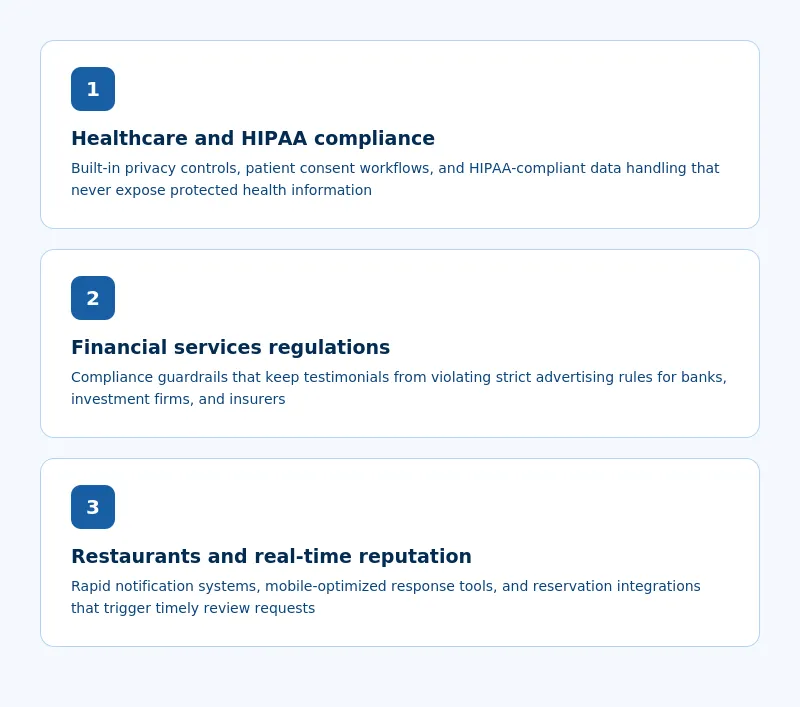
Healthcare and HIPAA Compliance
Medical practices must ensure review platforms never expose protected health information. Look for platforms with built-in privacy controls, patient consent workflows, and HIPAA-compliant data handling.
Financial Services Regulations
Banks, investment firms, and insurance companies operate under strict advertising regulations. Review platforms serving these industries need compliance guardrails that prevent testimonials from violating financial regulations.
Restaurants and Real-Time Reputation
Food service businesses benefit from platforms with rapid notification systems, mobile-optimized response tools, and integration with reservation systems that trigger timely review requests.
Conclusion: Authenticity as a Competitive Advantage
The review landscape has fundamentally changed. Fake reviews that once seemed like a competitive shortcut now represent legal liability and reputational risk.
Choosing a limited reviews company isn't about gaming the system—it's about building authentic credibility that withstands scrutiny. Platforms that prioritize verification, transparency, and compliance position businesses for sustainable growth.
The market rewards authenticity over manipulation. Research confirms that honest sellers suffer when competing against fake reviews, but regulatory enforcement is finally creating consequences for fraud. Businesses that invest in legitimate review practices today gain compounding advantages as enforcement intensifies.
Start by defining specific business needs, then evaluate platforms against verification standards, compliance requirements, and feature alignment. Test thoroughly before committing, and remember that the cheapest option rarely delivers the best long-term value.
The right review platform transforms customer feedback from a vanity metric into strategic intelligence. Make the choice carefully—your reputation depends on it.
Frequently Asked Questions
Limited reviews companies typically restrict submissions to verified customers only, ensuring authenticity through purchase confirmation or multi-factor authentication. Open platforms allow anyone to submit reviews, which increases volume but reduces reliability. The FTC's 2024 regulations make verification-based platforms significantly safer from a compliance perspective.
Pricing varies widely based on business size, review volume, and feature requirements. Check official websites for current pricing, as subscription costs change frequently. Most platforms offer tiered pricing with basic plans for small businesses and enterprise solutions for large organizations. Factor in setup fees, integration costs, and any usage-based charges when calculating total cost.
Legitimate platforms can flag reviews that violate their terms of service or lack verification, but they cannot arbitrarily remove negative feedback. Authentic negative reviews, even if frustrating, must remain visible to maintain platform credibility. Focus on responding professionally to negative feedback rather than seeking removal. Platforms that promise to delete unfavorable reviews likely violate consumer protection standards.
Purchase verification combined with identity confirmation offers the highest level of fraud protection. This approach confirms both that a transaction occurred and that the reviewer is a legitimate individual. Email verification alone provides moderate security but can be circumvented through temporary email addresses. Platforms with no verification create significant fraud risk and regulatory exposure.
For local businesses, Google Business Profile integration is critical because reviews there directly impact local search rankings and customer decision-making. The ability to generate a Google link or QR code to request reviews streamlines the collection process. E-commerce businesses may prioritize product-level reviews on their own websites over Google integration.
Many businesses benefit from a multi-platform strategy, particularly if they serve different customer segments through different channels. However, fragmenting review collection across too many platforms dilutes social proof and complicates management. Generally, two to three complementary platforms provide optimal coverage without excessive operational burden.
Request documentation of FTC compliance policies, data privacy practices including GDPR or CCPA adherence, security certifications such as SOC 2, and anti-fraud enforcement procedures. Platforms that hesitate to provide compliance documentation create unnecessary legal risk. Consumer protection regulations increasingly hold businesses accountable for vendor practices.