
Selecting the right CASS 5 audits company requires evaluating their regulatory expertise, insurance distribution experience, FCA compliance track record, and understanding of client money handling rules. The best firms demonstrate specialized knowledge of CASS 5 requirements, maintain strong regulatory relationships, and deliver clear assurance opinions that protect both intermediaries and clients.
CASS 5 audits aren't optional for insurance intermediaries handling client money. The Financial Conduct Authority mandates these assurance engagements to protect client funds and ensure proper segregation under the Client Assets Sourcebook regulations.
But here's the thing—not all audit firms understand the nuances of insurance distribution activity. Choose the wrong auditor, and firms risk compliance failures that carry serious consequences.
Recent years have seen FCA fines ranging from £700,000 to approximately £9 million for CASS failings. That's a steep price for inadequate oversight.
Understanding CASS 5 Requirements
CASS 5 applies specifically to client money received through insurance distribution activity. These rules sit within the broader Client Assets Sourcebook, which exists to minimize harm when firms fail.
The regulatory framework requires firms to segregate client money properly, maintain accurate records, and conduct regular reconciliations. Insurance intermediaries must protect premiums collected on behalf of clients before those funds reach insurers.
CASS 5.4 rules mandate strict timing requirements—firms can't withdraw commission from the client money trust before receiving the premium from the client. This protects against misappropriation and ensures client funds remain separated from firm operating accounts.
Sound complex? That's exactly why auditor selection matters so much.
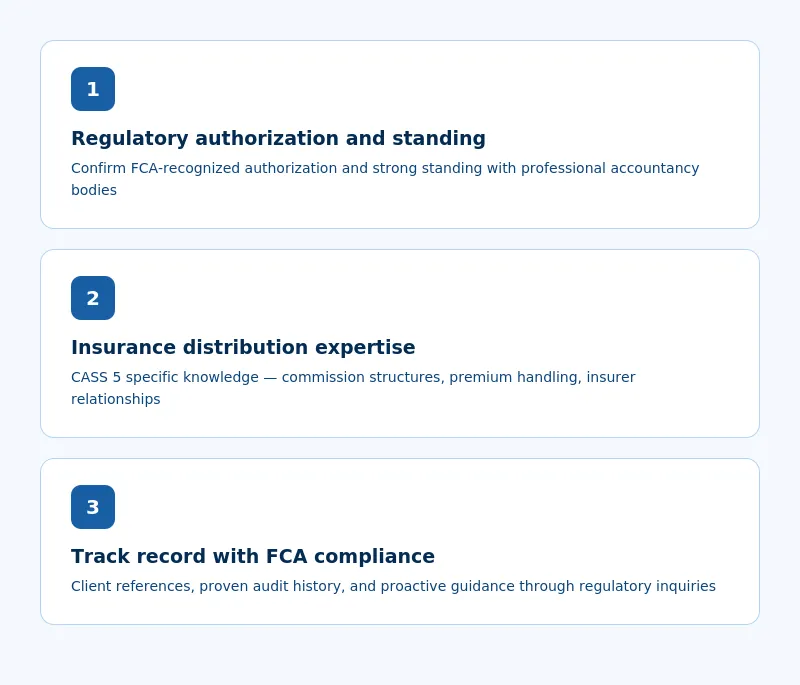
Essential Criteria for Selecting CASS Auditors
The right CASS 5 auditor brings more than general accounting knowledge. Specialized regulatory expertise separates adequate firms from exceptional ones.
Regulatory Authorization and Standing
Verify the firm holds proper authorization to conduct CASS audits. The FCA maintains oversight of audit firms serving regulated entities, and auditors must demonstrate competence in financial services regulation.
Check the auditor's standing with professional bodies. Membership in recognized accountancy institutes signals commitment to continuing professional development and ethical standards.
Insurance Distribution Expertise
CASS 5 differs significantly from CASS 7 (which covers investment firms) or CASS 6 (custody rules). Insurance intermediary operations have unique characteristics—commission structures, premium handling, insurer relationships.
Ask prospective auditors about their insurance client portfolio. How many CASS 5 audits do they conduct annually? What types of insurance distribution models have they reviewed?
Real talk: an auditor who primarily serves investment firms won't understand insurance-specific nuances without significant learning time. That learning happens on the client's dime.
Track Record with FCA Compliance
The consequences of non-compliance extend beyond financial penalties. Regulatory enforcement actions damage reputations and can threaten firm viability.
Request references from current clients subject to CASS 5 requirements. Speak directly with compliance officers or finance directors about their auditor experience.
Has the firm successfully navigated regulatory inquiries? Do they provide proactive guidance on emerging compliance issues?
| Evaluation Factor | Why It Matters | Questions to Ask |
|---|---|---|
| Years conducting CASS audits | Experience translates to efficiency and insight | How long have you provided CASS services? |
| Insurance client percentage | Sector specialization improves audit quality | What portion of CASS work is CASS 5? |
| Team qualification depth | Multiple experts prevent key person risk | Who will lead the engagement team? |
| FCA relationship quality | Regulatory rapport aids issue resolution | How do you interact with regulators? |
| Technology capabilities | Modern tools improve testing accuracy | What audit software do you employ? |

Handle CASS 5 Audits With Acumon
CASS 5 audits can be sensitive because they involve insurance distribution, client money handling, reconciliations, trust arrangements, and compliance records. A small process gap can create problems later, especially where money is held or transferred on behalf of clients. Acumon provides audit, risk assurance, accounts, tax, and advisory support, so CASS 5 work can be reviewed alongside the wider finance and control environment.
They are a UK-based firm with 90+ professionals, all based in the UK. Their wider service base covers audit services, risk and tech assurance, accounts, tax, payroll, business support, and company secretarial work, which can be useful when CASS 5 audit points lead into broader reporting, governance, or process questions.
Considering Your CASS 5 Audit Options?
Acumon can help with:
- Supporting CASS 5 audit requirements
- Reviewing client money records and controls
- Checking reconciliations, trust arrangements, and reporting
- Looking at risk, governance, and compliance processes
- Linking CASS 5 findings with wider finance and audit work
👉 Contact Acumon to discuss your CASS 5 audit requirements and the right next steps.
Red Flags That Signal Wrong Auditor Choice
Certain warning signs indicate an auditor lacks the depth needed for effective CASS 5 engagements.
Generic audit proposals that don't address insurance-specific risks suggest insufficient preparation. CASS 5 audits require tailored approaches reflecting each intermediary's operating model.
Unusually low fee quotes often correlate with inexperienced teams or inadequate scope. Quality assurance work demands time—corner-cutting creates compliance gaps.
But wait. High fees don't automatically equal superior service. Evaluate value relative to expertise and deliverables, not just price tags.
Limited availability during critical periods raises concerns. Firms approaching their CASS year-end need responsive auditors who accommodate tight deadlines.
Assurance Opinion Types and Implications
CASS audits culminate in assurance opinions that carry significant weight with regulators and stakeholders.
Unqualified opinions indicate full compliance with CASS rules. Modified opinions—qualified, adverse, or disclaimer—signal problems ranging from isolated issues to systemic failures.
Understanding opinion types helps firms set realistic expectations. An auditor who promises unqualified opinions before examining controls probably lacks professional skepticism.
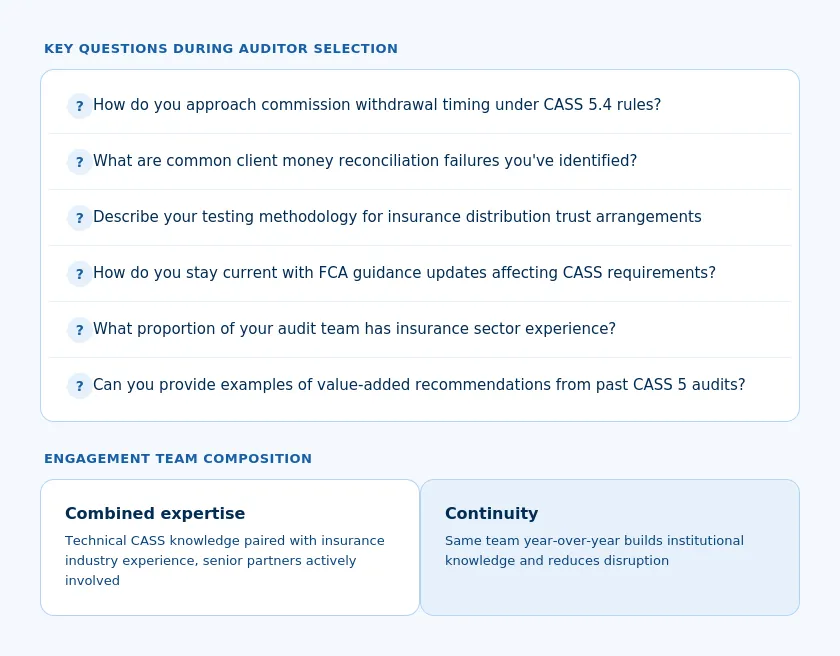
Key Questions During Auditor Selection
Structured inquiry separates capable auditors from pretenders. These questions reveal depth of CASS 5 knowledge:
- How do you approach commission withdrawal timing under CASS 5.4 rules?
- What are common client money reconciliation failures you've identified?
- Describe your testing methodology for insurance distribution trust arrangements.
- How do you stay current with FCA guidance updates affecting CASS requirements?
- What proportion of your audit team has insurance sector experience?
- Can you provide examples of value-added recommendations from past CASS 5 audits?
Strong candidates answer specifically, referencing actual engagement experiences. Vague responses suggest limited practical exposure.
Engagement Team Composition
The individuals conducting fieldwork matter as much as firm reputation. Meet proposed team members before finalizing auditor selection.
Look for teams combining technical CASS expertise with insurance industry knowledge. Junior staff supervised by experienced partners deliver efficiency, but the senior leadership must remain actively involved.
Continuity benefits firms significantly. The same team year-over-year develops institutional knowledge that improves audit quality while reducing disruption.
Timing and Deadline Considerations
CASS audit deadlines are non-negotiable. Firms must submit their auditor's report to the FCA within four months of the end of the period covered by the report.
Now, this is where it gets interesting. Many intermediaries choose calendar year-ends, creating audit capacity constraints during peak season. Booking auditors well in advance—preferably six months before the deadline—secures preferred firms.
Discuss timing expectations explicitly. Can the auditor accommodate your timetable? What information do they need, and when?
Preparation dramatically affects audit efficiency. Firms that maintain organized client money records throughout the year experience smoother engagements with fewer delay issues.
Cost Structure and Fee Transparency
CASS 5 audit fees vary based on firm complexity, transaction volumes, and control environment quality. Typical pricing models include fixed fees or time-based billing with caps.
Request detailed fee breakdowns showing what's included versus potential extras. Surprise billings for routine procedures signal poor scoping or fee transparency issues.
Here's the thing though—the cheapest auditor rarely delivers the best value. Balancing cost with expertise, responsiveness, and relationship quality produces optimal outcomes.
| Cost Factor | Impact on Fees |
|---|---|
| Transaction volume | Higher volumes increase testing sample sizes and hours |
| Number of bank accounts | Multiple accounts expand reconciliation verification work |
| Control documentation quality | Poor documentation extends audit time significantly |
| Prior year findings | Previous issues require additional follow-up procedures |
| Firm location | Travel requirements add expense for distant auditors |
| Rush timing | Compressed deadlines command premium pricing |
Beyond Compliance: Value-Added Services
The best CASS auditors function as strategic advisors, not just compliance checkers. They identify operational inefficiencies and recommend improvements that strengthen controls while reducing administrative burden.
Ask how auditors approach continuous improvement. Do they provide management letters with actionable recommendations? Will they assist with remediation planning if issues surface?
Some firms offer additional services like CASS framework implementation, staff training, or interim compliance reviews. Bundling services with a trusted auditor creates consistency and often achieves cost efficiencies.
Making the Final Decision
Auditor selection deserves deliberate evaluation. Rushing the decision increases the likelihood of poor fit or inadequate service.
Interview at least three qualified firms. Compare their approaches, team composition, fee structures, and cultural fit with the organization.
Trust matters in audit relationships. The auditor will access sensitive financial information and interact with key stakeholders. Chemistry and communication style shouldn't be overlooked.
Document the selection rationale. Board members or senior management may want to understand why particular auditors were chosen over alternatives.
Conclusion
Choosing the right CASS 5 audits company protects both regulatory standing and client interests. The decision demands careful evaluation of specialized expertise, insurance sector experience, and track record with FCA compliance.
Don't settle for generic audit firms lacking CASS 5 depth. The investment in qualified, experienced auditors pays dividends through smoother engagements, valuable insights, and reduced compliance risk.
Start the selection process early—at least six months before audit deadlines. Interview multiple candidates, check references thoroughly, and prioritize firms demonstrating genuine understanding of insurance intermediary operations.
The right auditor becomes a strategic partner in maintaining regulatory compliance while strengthening operational controls. That relationship proves invaluable as CASS requirements evolve and regulatory scrutiny intensifies.
Ready to find the right CASS 5 auditor for your insurance intermediary? Begin evaluating qualified firms today to ensure seamless compliance and protect client money under FCA requirements.
Frequently Asked Questions
CASS auditors must be members of recognized professional accountancy bodies and demonstrate specific competence in financial services regulation. Look for firms with dedicated financial services or regulatory teams, not just general audit capabilities. Experience conducting CASS engagements for insurance intermediaries is essential.
Most CASS 5 audits require four to eight weeks from kickoff to final report delivery, depending on firm size and complexity. Larger intermediaries with high transaction volumes or multiple business lines need longer engagements. Proper preparation and organized documentation significantly accelerate the process.
While technically possible, switching auditors during an audit cycle creates complications and may raise regulatory questions. Plan auditor changes to coincide with CASS year-end transitions. If circumstances require mid-cycle changes, communicate thoroughly with both the departing and incoming auditors and notify the FCA.
Auditors must report material CASS breaches to the FCA. The severity determines regulatory response—minor issues may require corrective action plans, while serious failures can trigger investigations and enforcement. Working with auditors who provide constructive remediation guidance helps firms address problems efficiently before they escalate.
Insurance intermediaries subject to CASS 5 require annual audits. The audit must cover the period up to the firm's CASS resolution assessment date, and reports must reach the FCA within four months. Missing deadlines constitutes a breach that can result in regulatory sanctions.
Not all intermediaries fall under CASS 5 requirements. Firms operating as insurers' agents rather than principals, or those meeting specific exemption criteria, may not need CASS audits. However, determining applicability requires careful regulatory analysis—consult with qualified advisors to confirm obligations.
Auditors need client money bank statements, reconciliation records, segregation documentation, board minutes addressing CASS compliance, control procedures, and transaction registers. Organizing these materials in advance reduces audit time and costs. Many auditors provide preparation checklists to guide documentation gathering.