
Quick Summary: Choosing the right asset tracing services company requires evaluating track record, global reach, investigative methodology, compliance credentials, and technology capabilities. The best firms combine forensic accounting expertise with international networks, maintain strict confidentiality protocols, and deliver actionable intelligence rather than raw data dumps. Look for providers with demonstrable success in complex, multi-jurisdictional cases and transparent pricing structures.
Asset tracing isn't just about finding bank accounts or property records. It's forensic detective work that can make the difference between recovering millions and walking away empty-handed. When debtors obscure assets through offshore trusts, nominee structures, or shell companies, the investigator's expertise becomes the critical variable.
The problem? Asset tracing firms vary wildly in capability, methodology, and ethics. Some deliver comprehensive intelligence that stands up in court. Others provide generic database searches that add little value beyond what legal teams could access directly.
Here's what separates competent asset tracing companies from the pretenders.
Track Record and Case Complexity Matter More Than Years in Business
Longevity doesn't equal competence. A firm that's operated for fifteen years handling straightforward domestic searches isn't necessarily equipped for multi-jurisdictional investigations involving kleptocracy, sovereign recoveries, or complex corporate structures.
Look for demonstrable success in cases similar to yours. Asset tracing for judgment enforcement differs significantly from investigations involving fraud, corruption, or non-performing loans. The methodologies, legal constraints, and intelligence sources vary considerably.
Request case studies—anonymized if necessary—that demonstrate the firm's capability with complex structures. Can they trace assets through nominee arrangements? Have they successfully navigated investigations in jurisdictions with strict banking secrecy laws? Do they understand corporate veil-piercing strategies?
The best firms can articulate their methodology clearly without revealing proprietary techniques. If a provider can't explain their approach beyond "we search public records," that's a red flag.
Global Reach Versus Local Depth
Asset concealment increasingly involves cross-border structures. Debtors use international trusts, offshore accounts, and foreign property holdings to shield wealth. Effective tracing requires either direct presence in key jurisdictions or reliable partner networks.
Evaluate whether the firm maintains investigators in relevant regions or relies on third-party partnerships. Direct presence typically offers better quality control and deeper local knowledge. Partner networks can be effective but introduce coordination challenges and potential quality inconsistencies.
For domestic U.S. cases, prioritize firms with deep knowledge of state-level property records, business registrations, and court filing systems. For international matters, verify the firm maintains compliance with local investigative regulations. According to SEC guidance on beneficial ownership, identifying individuals who own 25 percent or more of the equity interests of entities requires sophisticated corporate structure analysis.
Compliance Credentials and Legal Constraints
Asset tracing operates within strict legal boundaries. Investigators must comply with privacy laws, data protection regulations, and jurisdiction-specific restrictions on information gathering.
Licensing and Regulatory Requirements
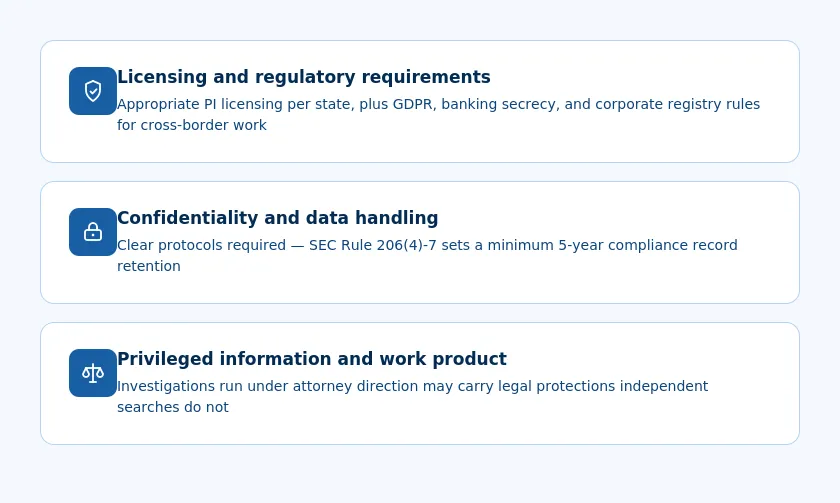
Verify that the firm maintains appropriate licensing. In the U.S., many states require private investigator licenses for certain asset search activities. International investigations may also involve GDPR requirements, local banking secrecy laws, or restrictions on accessing corporate registries.
Confidentiality and Data Handling
The firm should maintain clear protocols for confidentiality and data handling. Investment adviser compliance programs must retain records for at least 5 years according to SEC Rule 206(4)-7 requirements
Privileged Information and Attorney Work Product
Ask about the firm’s approach to privileged information and attorney work product. Investigations conducted under attorney direction may receive legal protections that independent searches do not. Understanding these distinctions matters for litigation strategy.

Trace Assets With Acumon
Asset tracing can involve more than locating where money or assets have moved. It may require a review of accounts, transactions, ownership records, supporting documents, tax issues, and the wider financial history around a dispute or investigation. Acumon supports businesses and individuals with audit, accounts, tax, risk assurance, and advisory work, which can help when asset tracing needs clear financial analysis.
They are a UK-based firm of chartered accountants, auditors, and advisors with 90+ professionals. Their wider advisory, audit, and tax background can be useful where asset tracing connects with business records, estate matters, company structures, or financial reporting questions.
Considering Your Asset Tracing Options?
Acumon can help with:
- Reviewing financial records and transaction history
- Checking ownership, accounting, and supporting documents
- Looking at tax or reporting issues linked to assets
- Supporting investigation and advisory work
- Connecting asset tracing findings with wider financial next steps
👉 Contact Acumon to discuss your asset tracing requirements and the right next steps.
Technology and Data Access Infrastructure
Modern asset tracing combines human intelligence with sophisticated database access and analytical tools. The best firms leverage proprietary technology alongside commercial databases, public records, and curated intelligence sources.
| Capability | Basic Providers | Advanced Firms |
|---|---|---|
| Database Access | Commercial property/credit databases | Multiple integrated sources including international registries |
| Analysis Tools | Manual review and reporting | Network analysis, entity mapping, anomaly detection |
| Intelligence Sources | Public records only | Proprietary sources, local contacts, industry connections |
| Reporting | Data dumps | Actionable intelligence with visualization and analysis |
Comprehensive asset search software should access both public and private records. But technology alone isn't sufficient. Elite firms employ analysts who can interpret data, identify patterns, and distinguish genuine assets from decoys or staged transactions.
Pricing Models and Fee Structures
Asset tracing pricing varies significantly based on case complexity, jurisdictional scope, and time requirements. Common models include flat fees for standard searches, hourly rates for complex investigations, and contingency arrangements tied to recovery success.
Flat-Fee Searches
Flat-fee searches typically cover basic domestic asset identification, such as property ownership, business interests, and vehicle registrations. These searches can range from a few hundred to several thousand dollars, depending on the depth of the work and the number of subjects involved.
Hourly Billing for Complex Investigations
Complex investigations involving offshore structures, multi-jurisdictional tracing, or extensive surveillance work typically bill hourly. Rates vary by firm reputation and investigator expertise. Some firms charge premium rates, but the value may be justified when the investigation produces stronger intelligence and clearer recovery options.
Contingency Arrangements
Contingency arrangements align investigator incentives with client recovery goals. However, they can also create conflicts if the firm prioritizes easily traceable assets over more valuable assets that are harder to locate.
Red Flags That Signal Trouble
Some warning signs indicate a firm may not deliver value or could expose clients to legal or ethical risks.
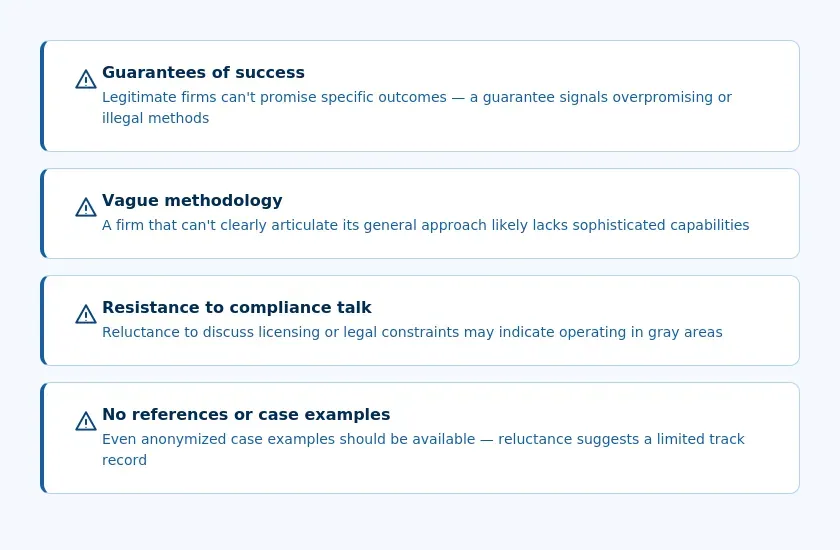
- Guarantees of success are impossible in asset tracing. Legitimate firms can't promise specific outcomes because asset concealment effectiveness varies enormously. If a provider guarantees results, they're either overpromising or planning illegal investigative methods.
- Vague methodology descriptions suggest the firm lacks sophisticated capabilities. While providers shouldn't reveal proprietary techniques, they should articulate their general approach clearly.
- Resistance to discussing compliance, licensing, or legal constraints may indicate the firm operates in gray areas. Professional investigators understand the legal framework and work within it.
- Reluctance to provide references or case examples—even anonymized—suggests limited successful track record. The best firms maintain relationships with satisfied clients who'll vouch for their work.
The Initial Consultation Tells You Everything
How a firm conducts the initial consultation reveals their competence and approach. Elite providers ask probing questions about your case, the debtor's profile, existing intelligence, and strategic objectives.
They should inquire about legal constraints, jurisdiction-specific issues, time sensitivity, and budget parameters. Generic responses or immediate promises without understanding case specifics suggest a transactional rather than strategic approach.
The best firms offer preliminary assessments of likelihood of success, potential challenges, and recommended investigative strategies. This demonstrates analytical capability and honest communication rather than sales-focused optimism.
Making the Final Decision
Choosing an asset tracing services company ultimately comes down to matching capability with case requirements. A straightforward domestic judgment enforcement may need only competent database search services. Complex international fraud recovery demands elite forensic expertise and global networks.
Evaluate multiple providers. Compare their approach, experience with similar cases, and communication style. The cheapest option rarely delivers optimal value, but expensive doesn't automatically mean better.
Trust matters enormously. Asset tracing involves sensitive financial information and strategic intelligence. Select a firm that demonstrates professionalism, ethical standards, and genuine understanding of your objectives. The right partner can mean the difference between successful recovery and expensive futility.
Frequently Asked Questions
Timeline varies dramatically based on case complexity. Basic domestic searches can complete within days. Complex multi-jurisdictional investigations involving offshore structures may require months. Factors affecting duration include jurisdictional cooperation, corporate structure complexity, and whether subjects actively conceal assets.
Asset searches typically involve database queries and public record reviews to identify known holdings. Asset tracing is more sophisticated—following financial flows, analyzing transactions, and uncovering hidden ownership through nominee structures or complex corporate arrangements. Tracing requires forensic accounting skills and investigative expertise beyond database access.
Offshore asset tracing is possible but challenging. Success depends on jurisdiction, asset type, and structure complexity. Some jurisdictions maintain strict banking secrecy and resist information sharing. However, international treaties, correspondent banking relationships, and corporate registry requirements create investigation pathways. Elite firms with established international networks achieve better offshore tracing results.
Pricing ranges from a few hundred dollars for basic database searches to tens of thousands for complex international investigations. Domestic property and business interest searches typically cost between several hundred and a few thousand dollars. Multi-jurisdictional investigations with forensic analysis bill hourly and can reach significant totals depending on duration and resources required.
Cryptocurrency tracing requires specialized expertise in blockchain analysis. While blockchain transactions are transparent, linking wallet addresses to individuals requires investigative skill. Firms with cryptocurrency tracing capabilities use specialized software and analytical techniques to track digital asset flows. Not all traditional asset tracing firms offer robust crypto investigation services.
Legal representation isn't required but often advisable. Investigations conducted under attorney direction may receive attorney-work-product protections. Attorneys can also advise on legal constraints, evidence admissibility, and strategic use of intelligence. For litigation-related tracing, coordination between legal counsel and investigators optimizes results and protects privileged information.
Basic information includes subject's full legal name, date of birth, known addresses, and Social Security number or other identifying information. Additional helpful details include known associates, business relationships, previous addresses, known assets, and any intelligence about asset concealment strategies. More background information typically enables more efficient and comprehensive investigations.