
Quick Summary: Choosing a company formation service in the UK requires evaluating their accreditation with Companies House, pricing transparency, turnaround times, additional services like registered office addresses, and customer support quality. While Companies House allows direct registration for £100 online or £124 by post, formation agents streamline the process and often bundle essential services. Look for ACSP-registered agents with clear pricing, positive reviews, and comprehensive post-formation support.
Setting up a limited company in the UK has become remarkably straightforward. But here's the thing — you're still faced with a choice that'll shape your business journey from day one.
Register directly through Companies House, or use a formation agent?
If you've decided on the latter, the market's crowded with agents promising fast turnaround, low prices, and expert support. Some deliver. Others add hidden fees and disappear after taking your money.
This guide cuts through the noise. You'll learn exactly what matters when choosing a formation service, what to avoid, and how to spot the difference between a professional agent and a budget operation that'll leave you sorting compliance issues alone.
Understanding UK Company Formation Basics
Before evaluating formation services, understand what registration actually involves. The process isn't complicated, but it demands accuracy.
Companies House, the UK's official registrar, maintains records of all limited companies. Every company must register here — there's no workaround. According to official government guidance, you can register directly through their online service for £100, with applications typically processed within 24 hours.
Postal applications using form IN01 cost £124 and take 8 to 10 days to process.
What Registration Requires
Setting up a private limited company means providing specific information to Companies House:
- A unique company name ending in 'Limited' or 'Ltd'
- A registered office address in the same UK country where you're incorporating
- At least one director aged 16 or over
- At least one shareholder (can be the same person as the director)
- Details of people with significant control (PSC) — anyone owning more than 25% of shares or voting rights
- A Standard Industrial Classification (SIC) code describing your business activity
- A memorandum and articles of association
The paperwork sounds daunting, but formation agents handle most of it. That's their value proposition.
Direct Registration vs Formation Agents
So why doesn't everyone just register directly through Companies House? The answer depends on your situation.
Direct registration through the official Companies House web incorporation service costs £100 for standard processing. The platform guides you through each requirement, and the service operates 24 hours a day, seven days a week, with minimal scheduled maintenance.
But here's where agents add value: they bundle services you'd otherwise source separately.
| Aspect | Direct Registration | Formation Agent |
|---|---|---|
| Cost | £100 state fee only | £100 state fee + agent fee |
| Processing Time | 24 hours (standard) | 24 hours + agent processing |
| Registered Address | You must provide | Often included or available |
| Document Templates | Basic articles provided | Customizable templates |
| Ongoing Support | None | Varies by agent |
| Bank Account Assistance | None | Often included |
Formation agents typically charge between £0 (promotional offers with upsells) and £200 for basic incorporation. Premium packages with additional services can reach £300 or more.
Key Factors When Choosing a Formation Service
Not all formation agents operate at the same standard. Some criteria matter more than others.
ACSP Registration Status
This is non-negotiable. Legitimate formation agents must be registered as Authorised Corporate Service Providers (ACSP) with Companies House. This registration confirms they've met identity verification and anti-money laundering requirements.
Check any agent's ACSP status directly on the Companies House website before handing over money or personal details. Unregistered agents can't legally file on your behalf.
Transparent Pricing Structure
The formation industry has a reputation problem with pricing. Many agents advertise eye-catching low fees, then add mandatory charges during checkout.
Look for agents who display total costs upfront, including:
- The £100 Companies House filing fee
- Agent service fees
- Any charges for registered address services
- Costs for additional directors, shareholders, or share classes
- Ongoing annual fees for services like registered office addresses
Real talk: free incorporation offers almost always require purchasing additional services. That's fine if you need those services anyway. It's misleading if the "free" label obscures the true cost.
Processing Speed and Reliability
Companies House processes standard online applications within 24 hours. Most agents can't speed this up — they're submitting through the same system.
What varies is how quickly the agent processes your information before submitting to Companies House. Same-day submission means your company could be registered within 24 hours of placing your order. Agents who take 2-3 days to prepare applications add unnecessary delays.
For urgent incorporations, Companies House offers a same-day service for £56 additional fee (total £156 with the £100 filing fee) if submitted before 3pm Monday to Friday. Check whether your chosen agent provides this option.
Registered Office Address Options
Every UK company needs a registered office address. This address appears on public records and receives official correspondence from Companies House and HMRC.
You can use your home address, but that means your home address becomes publicly searchable. Many founders prefer not to publish their residential address online.
Quality formation agents offer registered office services at their business address. Pricing varies from £30 to £114+ annually for renewal. Check what's included: mail forwarding, scanning services, or just a holding address.
The address must be physical (not a PO Box) and located in the same UK country as your company registration. A company registered in England cannot have a Scottish registered office address, according to Companies House rules.
Form a Company With Acumon
Choosing a company formation services company is easier when the provider can handle the setup and the compliance work that follows. Acumon provides company secretarial and statutory compliance services for UK companies, including Companies House filings, corporate governance support, and company administration services. They can also support businesses with company secretarial, tax, accounts, and broader compliance-related administration.
Turn to Acumon to manage:
- Companies House filings
- Statutory compliance
- Corporate governance support
- Company administration
- Maintenance of company records
- Company secretarial support
👉Contact Acumon to discuss company administration and compliance support.
Essential Services to Consider
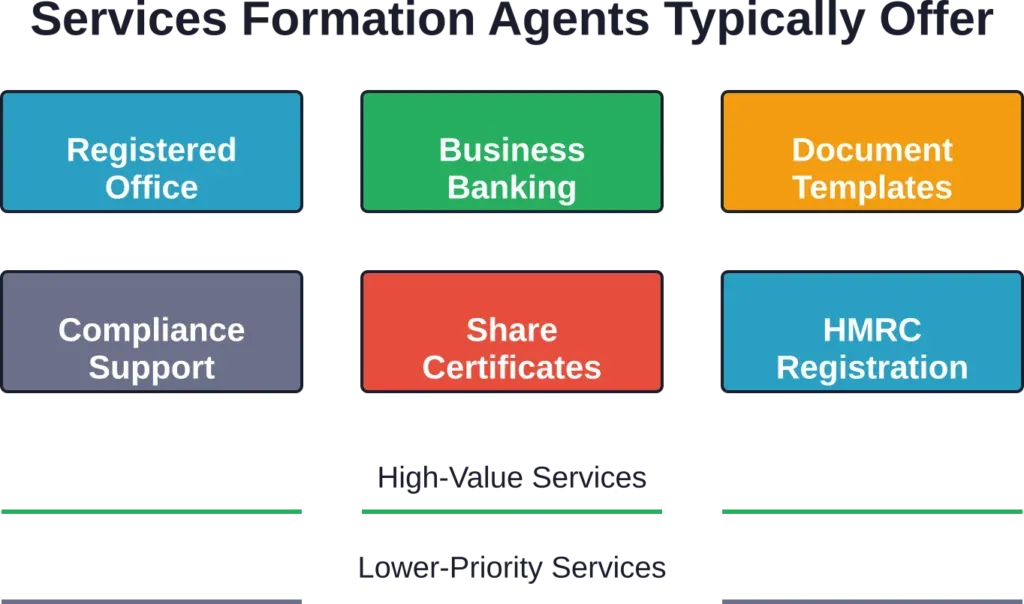
Beyond basic incorporation, formation agents offer bundles that handle adjacent requirements. Some are genuinely useful. Others are padding.
Business Bank Account Assistance
Opening a business bank account can be surprisingly tedious. Banks require proof of incorporation, identification documents, and often want to conduct interviews before approving accounts.
Some formation agents partner with banks to streamline applications. This doesn't guarantee approval, but it simplifies the process. The best agents provide introductions to multiple banks, giving you options.
Community discussions highlight that banking assistance proves particularly valuable for non-UK residents forming companies remotely, where banks impose stricter verification requirements.
HMRC Registration for Corporation Tax
When you register a company through Companies House, they typically notify HMRC automatically, setting you up for Corporation Tax. But dormant companies or certain business structures require manual HMRC registration.
Formation agents handle this communication, ensuring HMRC has accurate information from day one. This prevents compliance issues and confusing letters months later.
Document Templates and Registers
Companies must maintain statutory registers of directors, shareholders, and people with significant control. You'll also need share certificates, board meeting minutes, and potentially shareholder agreements.
Professional agents provide templates and pre-filled documents customized to your company structure. These aren't legally required from an agent — you can download templates online — but tailored documents save time and reduce errors.
Ongoing Compliance Support
Incorporation is just the beginning. Companies face annual requirements: confirmation statements (£50 fee to Companies House), annual accounts, Corporation Tax returns, and maintaining accurate registers.
Some agents offer compliance packages with reminders, document filing services, and access to advisors. For founders focused on building their business rather than mastering company law, this support justifies premium pricing.
Red Flags When Evaluating Formation Agents
Certain warning signs should trigger immediate concern.
No ACSP Registration
Already mentioned, but worth repeating: agents without ACSP registration operate illegally. They cannot file documents with Companies House on your behalf. Full stop.
Pressure Tactics and Upselling
Legitimate agents explain available services and let you choose. Aggressive sales tactics — countdown timers claiming limited-time offers, representatives pushing expensive packages, or suggesting you need services you don't — indicate a company prioritizing sales over service.
Unclear Pricing for Renewal Services
Watch for agents who bundle first-year services at attractive rates but charge significantly more for renewals. Registered office addresses are the classic example: £20 for the first year, then £95 annually thereafter.
Read terms carefully before committing.
Poor Reviews or Customer Support
Check independent review platforms. Look for patterns in complaints: are users reporting hidden fees? Document errors? Inability to reach support after payment?
One or two negative reviews shouldn't disqualify an agent — even excellent companies occasionally disappoint customers. Consistent complaints about the same issues reveal systemic problems.
Offshore or Unlicensed Operations
Some formation services operate from outside the UK without proper licensing. They might offer lower prices but provide no recourse if problems arise. Stick with UK-based, ACSP-registered agents.
Comparing Top UK Formation Agents
The UK company formation market includes dozens of agents. Here's how major players compare across key criteria.
| Feature | Direct (Companies House) | Budget Agents | Mid-Range Agents | Premium Agents |
|---|---|---|---|---|
| Typical Cost | £100 | £100-£130 | £120-£200 | £200-£400+ |
| Registered Office | Not included | Often extra cost | Usually included 1st year | Included, multiple locations |
| Banking Support | None | Rarely | Basic introductions | Dedicated support, multiple banks |
| Document Quality | Standard templates | Basic templates | Customizable templates | Fully tailored documents |
| Customer Support | Email only | Email, slow response | Email and phone | Dedicated account manager |
| Best For | DIY-minded founders | Price-sensitive, simple structures | Most businesses | Complex structures, international founders |
Budget agents work fine if you have a straightforward single-director, single-shareholder company and need minimal ongoing support. Mid-range agents offer the best value for most founders — reasonable pricing with essential services bundled.
Premium agents justify their cost when dealing with complex shareholding structures, multiple share classes, or forming companies remotely from overseas.
Special Considerations for International Founders
Non-UK residents can absolutely form UK companies. The process involves additional verification steps.
Companies House requires identity verification for all company directors and people with significant control. International founders must verify identity through approved services or provide notarized documents.
Formation agents experienced with international clients streamline this process. They understand which documents foreign jurisdictions issue, how to apostille certificates, and which verification services Companies House accepts.
According to industry reports, agents specializing in remote company formation typically charge £119+ for services tailored to non-UK residents, including international-friendly registered office addresses and banking introductions to institutions comfortable with overseas directors.
The Formation Process Step by Step
Regardless of which agent you choose, the process follows a consistent sequence.
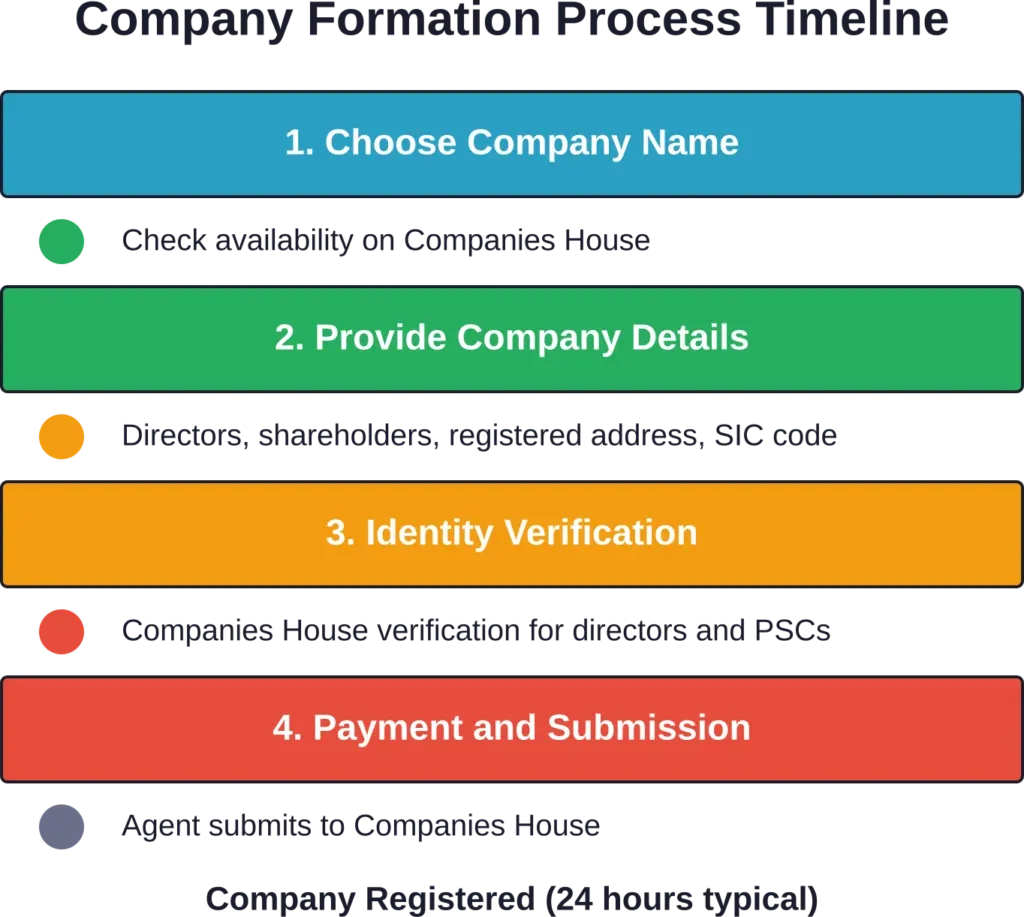
Step 1: Choose and Check Your Company Name
Your company name must be unique and not too similar to existing registered companies. Companies House provides a free name availability checker on their website.
Names must end in 'Limited' or 'Ltd' unless you qualify for exemption (charities and some community interest companies can omit this suffix). Certain words require approval — 'Royal', 'Government', 'British', and others need specific permission.
Step 2: Prepare Company Details
Gather information for all directors, shareholders, and people with significant control. You'll need full names, dates of birth, service addresses, and residential addresses.
Choose your company's registered office address. Decide on share structure — most private companies issue ordinary shares with standard rights, but you can create multiple share classes with different voting or dividend rights.
Select at least one SIC code describing your business activities. Companies House maintains a condensed list of acceptable codes.
Step 3: Complete Identity Verification
All directors and PSCs must verify their identity with Companies House before incorporation. This process provides a verification code you'll use during registration.
Verification typically takes a few days via the official Companies House identity verification service. Some agents offer expedited verification, but they're using the same system — they can't truly accelerate it.
Step 4: Submit Application and Pay
The agent (or you, if registering directly) submits the application to Companies House with the £100 filing fee. Applications undergo automated checks for completeness and name availability.
Most applications receive approval within 24 hours. Companies House emails the certificate of incorporation to the registered email address.
Step 5: Post-Incorporation Tasks
Registration creates the company legally, but several immediate tasks remain:
- Set up business bank accounts
- Create statutory registers (directors, shareholders, PSCs)
- Issue share certificates
- Hold first board meeting and record minutes
- Register for Corporation Tax if not automatically registered
- Register for VAT if turnover exceeds thresholds or you choose voluntary registration
Quality formation agents provide checklists and templates for these tasks. Budget agents might leave you figuring it out alone.
Cost Breakdown: What You're Really Paying
Understanding the cost structure prevents surprises.
One-Time Formation Costs
The £100 Companies House fee is mandatory and non-negotiable. Same-day processing adds £56, bringing the total state fee to £156 for urgent incorporations.
Agent service fees range from £0 (promotional) to £200+ depending on included services. Packages typically bundle:
- Application preparation and submission
- First-year registered office address
- Standard memorandum and articles of association
- Share certificates and registers
- Basic compliance guidance
Customizations add costs: additional directors or shareholders (£10-£20 each), multiple share classes (£50-£100), tailored articles of association (£100-£300), or Companies House name approval applications for restricted words (£80-£100).
Recurring Annual Costs
Don't overlook ongoing expenses. Every UK company faces:
- Confirmation statement filing: £50 annually to Companies House
- Registered office service renewal: £30-£100 annually if using agent's address
- Accountancy services: £300-£2,000+ annually depending on complexity
- Corporation Tax: 19% on profits (rates vary by profit level)
Some agents offer compliance packages covering confirmation statements, reminder services, and basic support for £100-£300 annually. Evaluate whether bundling saves money versus handling tasks yourself or through an accountant.
Questions to Ask Before Choosing an Agent
Smart questions reveal whether an agent suits your needs:
- What's included in your quoted price? Get a complete breakdown of first-year costs, including Companies House fees, agent fees, and any mandatory services.
- What are renewal costs for ongoing services? Understand second-year and beyond pricing, especially for registered office addresses.
- How quickly do you submit applications to Companies House? Look for same-day or next-day submission commitments.
- What support do you provide after incorporation? Clarify whether support includes compliance reminders, access to advisors, or just document delivery.
- Can you assist with business banking introductions? If you need banking support, confirm which banks the agent partners with and what that assistance entails.
- Are you ACSP-registered with Companies House? Verify their registration number and check it against Companies House records.
- What documents will I receive? Confirm you'll get a certificate of incorporation, memorandum and articles of association, share certificates, and statutory registers.
Making Your Final Decision
Choosing a formation service ultimately depends on your specific situation.
Direct registration through Companies House makes sense if you're comfortable with paperwork, have a simple company structure, already have a registered office address, and don't need banking or compliance support. You'll save agent fees and maintain complete control.
Budget formation agents work well when you need basic service bundling but have straightforward requirements. You'll pay slightly more than direct registration but save time on logistics.
Mid-range agents offer the sweet spot for most founders — reasonable fees, comprehensive first-year support, registered office addresses, and banking assistance. The convenience justifies the modest premium over direct registration.
Premium agents earn their place when forming complex structures, operating internationally, requiring specialized industry compliance, or valuing white-glove service. The higher cost buys expertise and dedicated support.
But wait. Here's something often overlooked: agent quality matters more than price. A budget agent that makes errors on your incorporation documents creates problems that cost far more to fix than you saved upfront. Companies House rejects applications with mistakes, delaying your launch. Incorrect share structures require expensive resolutions and filings to correct.
Read independent reviews. Check ACSP registration. Contact agents with questions and evaluate response times and helpfulness. These indicators reveal more than marketing copy.
Frequently Asked Questions
Yes, non-UK residents can register UK companies without restrictions on nationality or residency. You'll need at least one director (who can be a non-UK resident) and must provide a UK registered office address. The identity verification process requires additional documentation for overseas applicants, typically including notarized identification documents. Many formation agents specialize in remote incorporation for international founders and can guide you through the specific requirements.
Companies House processes standard online applications within 24 hours of submission. The total time from starting your application to receiving your certificate of incorporation depends on how quickly you complete identity verification (typically 2-5 days) and how fast your formation agent processes your information before submitting it. Same-day formation is available for £156 if applications reach Companies House before 3pm Monday to Friday, though you still need completed identity verification beforehand.
These terms are used interchangeably when discussing UK companies. Incorporation is the process of forming a limited company and registering it with Companies House. Registration refers to filing your company details with Companies House so they officially record your company's existence. Both terms describe the same legal process of creating a limited company.
You can absolutely register directly through Companies House for £100 without using an agent. Formation agents add value by bundling services like registered office addresses, share certificates, tailored articles of association, banking introductions, and ongoing compliance support. If you're comfortable handling paperwork and have straightforward requirements, direct registration saves money. Agents make sense when you want convenience, professional document preparation, or additional services bundled together.
Companies House rejects applications if your chosen name is identical or too similar to existing company names, includes restricted words without approval, or breaches naming regulations. If rejected, you'll need to choose a different name and resubmit. To avoid rejection, use the Companies House name availability checker before submitting your application.
Yes, these serve different purposes. Your registered office address is the official legal address recorded with Companies House where government correspondence is sent. It must be a physical UK address (not a PO Box) in the same country your company registers in. Your business address is where you actually operate and can be anywhere, including outside the UK. Many companies use their accountant's or formation agent's address as their registered office to keep their home address off public records.
Limited companies must file a confirmation statement annually with Companies House (£50 fee) confirming company details remain accurate. You'll also file annual accounts and Corporation Tax returns with HMRC. Companies must maintain statutory registers of directors, shareholders, and people with significant control, updating these when changes occur. Additional filings are required when you change directors, registered office address, share capital, or other key details. Failing to meet these obligations results in penalties and potential company dissolution.
Conclusion: Choose Based on Your Needs, Not Just Price
The cheapest formation service isn't always the best value. The most expensive isn't automatically the highest quality.
Start by identifying what you genuinely need: Is a registered office address important for privacy? Do you need help opening business bank accounts? Will you benefit from ongoing compliance support? Or are you comfortable handling these tasks independently?
Match services to requirements. Verify ACSP registration. Read independent reviews. Ask detailed questions about pricing transparency, turnaround times, and post-incorporation support.
Company formation is the foundation of your business structure. Getting it right from the start prevents costly corrections later and gives you confidence that compliance obligations are properly handled.
Whether you choose direct registration through Companies House, a budget agent, or a premium full-service provider, make the decision based on informed evaluation of your specific situation. The right choice depends entirely on your needs, experience, and where you want to focus your energy as you build your business.
Take time to compare properly. Your company's formation is worth getting right.