
Quick Summary: Choosing the right business consultancy services company in the UK requires evaluating their industry expertise, accreditations like Chartered Management Consultant (ChMC) status, proven track record, and cultural fit with your organisation. Assess their problem-solving approach, transparency in pricing, and client testimonials to ensure they can deliver sustainable value and measurable results for your specific business challenges.
Management consultants help organisations improve business performance by cutting costs, increasing productivity, creating value, and maximising growth. But here's the thing—not all consultancy firms deliver equal value.
The UK consultancy market is crowded. From boutique specialists to global powerhouses, businesses face countless options when seeking external expertise. Making the wrong choice wastes money, time, and opportunity.
This guide breaks down exactly what to look for when selecting a business consultancy services company that'll actually move the needle for your organisation.
Understanding What Business Consultancy Services Actually Deliver
Business consultants provide objective advice and expertise to help organisations develop specialist skills, improve performance, and navigate change. Their work spans business strategy, financial and management controls, human resources, information technology, marketing, and operational efficiency.
Clients bring in consultants to create and define strategic direction, provide specialist knowledge, or support in planning and implementing specific projects. Common engagements include reviewing a business's position in the market, advising on restructures, implementing new systems, or driving digital transformation.
Real talk: consultants should bring fresh perspectives and capabilities your internal team doesn't have. If they're just echoing what you already know, something's wrong.
Essential Credentials and Accreditations to Look For
Professional accreditation matters. The Chartered Management Consultant (ChMC) Accreditation is the highest recognition of a management consultant's expertise, experience, and talent within the profession. It sets and maintains the highest standards in management consulting.
According to research published by the Management Consultancies Association in February 2024, 79% of respondents emphasised ChMC's role in elevating professional standards within the industry. Additionally, 77% highlighted its significance in assuring clients of the quality of expertise. Nearly four-in-five consultants feel chartered status has reassured clients of the expertise they offer.
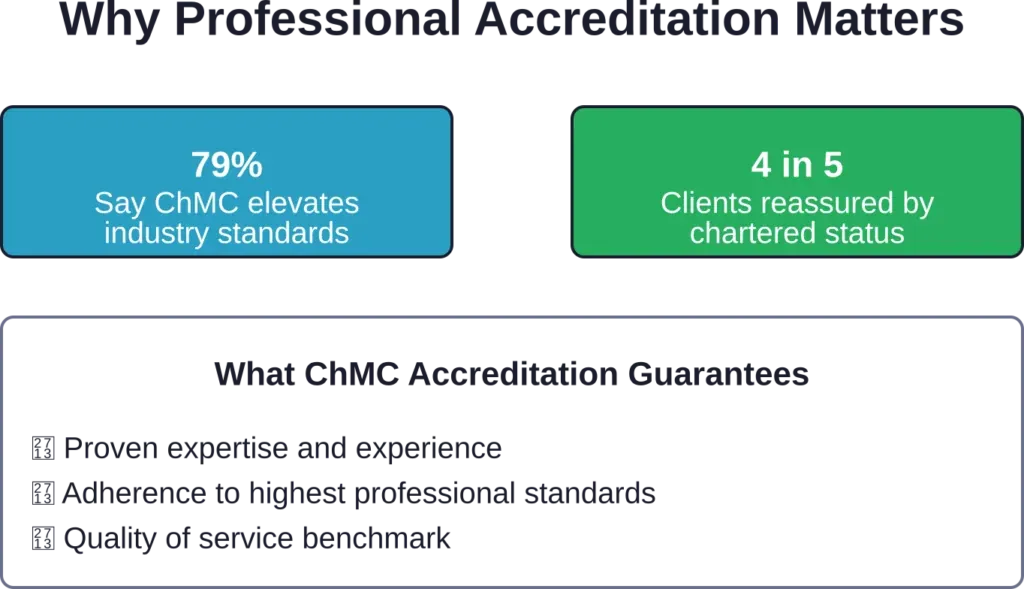
Chartered Management Consultants must prove they serve clients to the highest standards. Look for consultants who've achieved this benchmark—it's a reliable quality filter.
Other relevant credentials include MBA qualifications, industry-specific certifications, and membership in professional bodies like the Institute of Chartered Accountants in England and Wales (ICAEW) for finance-focused consulting.
Evaluating Industry Experience and Specialist Expertise
Generic consultants rarely deliver breakthrough results. Specialist knowledge matters.
When evaluating consultancy firms, examine their track record in your specific industry and the particular challenges you face. A firm brilliant at retail transformation might struggle with manufacturing process optimisation.
Look for case studies, client testimonials, and evidence of tangible outcomes in situations similar to yours. Ask prospective consultants directly: "What's your experience with [specific challenge] in [your industry]?"
Diverse experience in leadership roles boosts consultant confidence and capability. Senior consultants should have navigated complex business problems across multiple client engagements, not just theoretical knowledge.
Assessing Approach and Methodology
How consultants work matters as much as what they know. Different firms employ vastly different methodologies.
Some consultancies favour data-driven analytical approaches. Others emphasise collaborative workshops and change management. Many blend multiple techniques depending on engagement needs.
| Approach Type | Best For | Potential Drawbacks |
|---|---|---|
| Data-driven analysis | Strategic decisions, market entry, performance optimisation | Can miss cultural and human factors |
| Collaborative workshops | Change management, team alignment, innovation | May lack rigorous quantitative validation |
| Implementation-focused | Technology deployment, process redesign | Can prioritise execution over strategic thinking |
| Advisory-only | Board-level strategy, governance | Recommendations may lack practical execution paths |
Ask consultancies to walk through their typical engagement process. Red flags include vague answers, one-size-fits-all methodologies, or unwillingness to adapt their approach to your organisation's context.
Understanding Pricing Models and Value for Money
Consultancy pricing varies dramatically. Common models include:
- Hourly or daily rates: Straightforward but can incentivise longer engagements
- Fixed project fees: Predictable costs but may discourage flexibility
- Retainer arrangements: Ongoing access to expertise but requires commitment
- Value-based pricing: Tied to outcomes achieved but harder to negotiate
Transparent consultancies clearly explain their pricing structure upfront. Be wary of firms that avoid detailed cost discussions or bury fees in confusing terms.
Value matters more than cost. For example, a highly experienced consultant might command premium daily rates but solve critical problems efficiently, delivering stronger returns on investment than a lower-cost consultant requiring extended engagement periods and delivering mediocre recommendations.
Request detailed proposals outlining scope, deliverables, timeline, and total investment. Compare these across multiple firms to understand market rates for your specific needs.
Evaluating Cultural Fit and Working Style
Even brilliant consultants fail when cultural misalignment exists.
Some firms bring armies of junior analysts. Others send small teams of senior experts. Some consultancies work independently and present findings. Others embed within your teams for collaborative problem-solving.
Consider your organisation's culture and preferences. Formal corporate environments might clash with casual boutique consultancies. Hierarchical organisations might struggle with consultants who prefer flat, collaborative structures.
Interview potential consultants like you'd interview employees. Assess communication style, responsiveness, and interpersonal skills. You'll work closely with these people—personality matters.
Checking References and Track Record
Never skip reference checks. Reputable consultancies readily provide client references.
When speaking with references, ask specific questions:
- What specific outcomes did the consultancy deliver?
- How did they handle unexpected challenges or scope changes?
- Would you hire them again for similar work?
- What could they have done better?
Look beyond polished case studies. Dig into real results, implementation success rates, and client satisfaction. Online reviews and community discussions provide additional perspectives, though weigh these appropriately.
Considering Technology Adoption and Digital Capabilities
Consultancy increasingly relies on digital tools and data analytics. According to research by LexisNexis, 80% of management consultants are using Gen AI-based tools in their daily tasks.
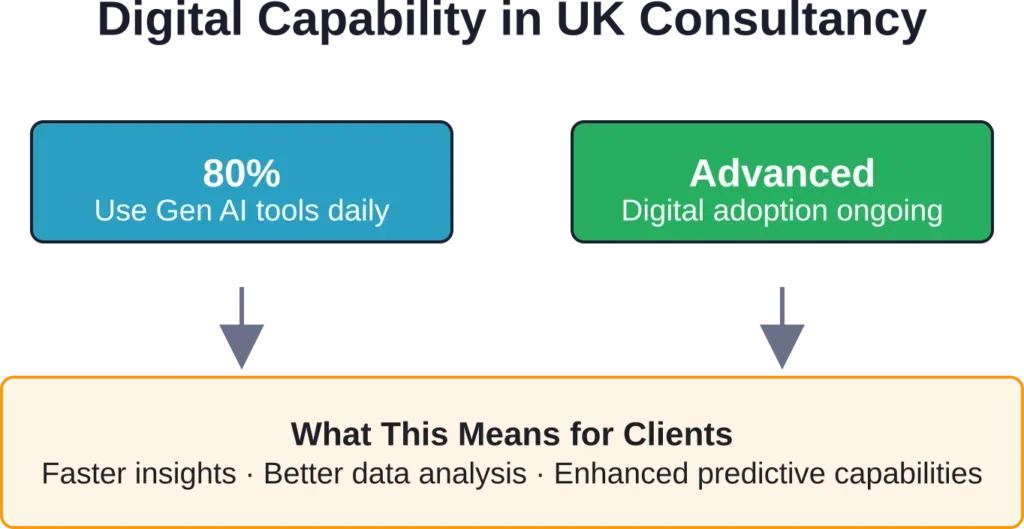
Ask prospective consultancies about their technology stack and digital capabilities. Firms still relying solely on Excel and PowerPoint may lag competitors using advanced analytics platforms, AI-powered research tools, and sophisticated visualisation software.
That said, technology serves strategy—it doesn't replace it. Beware consultancies so enamoured with tech tools they forget the human elements of business transformation.
Get Practical Business Consultancy From Acumon
Choosing a business consultancy services company works best when the advice is connected to real numbers, not just broad strategy. Acumon provides business support and advisory services, including budgeting, forecasting, cash flow management, financial reporting, KPI development, profitability review, and management reporting. This makes Acumon relevant for businesses that need help with planning, performance review, funding preparation, or clearer financial decision-making.
Business consultancy areas Acumon can support:
- Budgeting and forecasting
- Cash flow management
- Financial reporting and review
- KPI and performance reporting
- Profitability and cost review
- Management accounts and business reporting
Get in touch with Acumon to discuss business advisory and reporting support for your company.
Red Flags to Watch Out For
Some warning signs indicate problematic consultancies:
- Vague deliverables: Cannot clearly articulate what you'll receive
- No relevant experience: Lack case studies or references in your industry
- Aggressive sales tactics: Pressure immediate decisions or disparage competitors
- Lack of transparency: Won't discuss methodology, team composition, or pricing openly
- Unrealistic promises: Guarantee specific outcomes without understanding your situation
- Poor communication: Slow to respond, unclear in explanations, dismissive of questions
Trust your instincts. If something feels off during initial conversations, it rarely improves once contracts are signed.
Making the Final Decision
Choosing a consultancy requires balancing multiple factors. Create a structured evaluation framework covering:
| Evaluation Criteria | Weight | Assessment Method |
|---|---|---|
| Relevant expertise | High | Case studies, references, consultant CVs |
| Professional credentials | Medium | Accreditations, qualifications, memberships |
| Methodology fit | High | Proposal review, methodology presentations |
| Cultural alignment | Medium | Interviews, working style discussions |
| Value for money | High | Detailed proposals, comparative pricing |
| Track record | High | Reference checks, client testimonials |
Involve key stakeholders in the selection process. The teams who'll work with consultants should have input—they'll spot compatibility issues leadership might miss.
Don't default to the biggest name. Large global firms bring resources and prestige but may assign junior staff to smaller engagements. Boutique specialists often provide partner-level attention and deeper expertise in niche areas.
Frequently Asked Questions
Look for Chartered Management Consultant (ChMC) accreditation, which represents the highest professional standard. Relevant degrees in business, finance, or related fields are common, with many consultants holding MBAs. Industry-specific certifications and memberships in professional bodies like the Management Consultancies Association add credibility. Experience matters as much as formal qualifications—seek consultants with proven track records in situations similar to yours.
Pricing varies dramatically based on firm size, consultant seniority, and engagement complexity. Daily rates can range from £500 for junior consultants to £3,000+ for senior partners at prestigious firms. Project fees depend on scope and duration. Always request detailed proposals outlining all costs. Focus on value delivered rather than lowest price—effective consultants pay for themselves through the improvements they enable.
Both have advantages. Large firms offer extensive resources, global reach, and breadth of expertise across multiple disciplines. Smaller specialists provide focused expertise, partner-level attention, and often better value. Consider your needs: complex, multi-faceted transformations may suit large firms, while specific technical challenges often benefit from specialist boutiques. Cultural fit and relevant experience matter more than firm size.
Engagement duration depends entirely on scope. Quick assessments or workshops might take days or weeks. Strategic planning projects typically run 2-4 months. Major transformations or implementations can span 6-18 months. Be wary of consultancies that cannot articulate clear timelines or whose engagements consistently expand beyond original estimates. Effective consultants work themselves out of a job—they transfer knowledge and build internal capability.
Ask about specific experience with challenges like yours, methodology and approach, team composition and seniority levels who'll actually do the work, expected deliverables and success metrics, similar client outcomes and references, pricing structure and total investment, and how they handle scope changes or unexpected challenges. Pay attention to how consultants listen and ask questions about your situation—great consultants diagnose before prescribing.
Establish clear success metrics before engagement begins. These might include financial targets, operational KPIs, timeline milestones, or capability development measures. Effective consultancies build measurement frameworks into their proposals. Request regular progress reviews with data-backed updates. The best consultancy work delivers measurable, sustainable improvements that persist long after consultants leave.
Contract terms vary significantly. Many include termination clauses with notice periods, though you may still owe payment for work completed. Review contracts carefully before signing, ensuring they outline deliverables, timelines, and exit provisions. Some consultancies offer satisfaction guarantees or staged payments tied to milestones. Discuss concerns early rather than waiting—good consultants adjust approaches when client feedback indicates problems.
Conclusion
Selecting the right business consultancy services company in the UK demands thorough evaluation. Professional credentials like ChMC accreditation, relevant industry expertise, transparent methodologies, and demonstrated track records separate exceptional consultancies from mediocre ones.
Don't rush the decision. The consultancy you choose shapes your organisation's future trajectory. Invest time in detailed assessments, reference checks, and cultural fit evaluation.
Start by defining exactly what you need. Then systematically evaluate candidates against those needs using the framework outlined here. The right consultancy partner becomes a catalyst for sustainable growth and transformation.
Ready to find your ideal consultancy match? Begin by listing your three most critical business challenges, then seek firms with proven expertise solving exactly those problems.