
Quick Summary: Choosing the right CIS return services company in the UK requires evaluating their HMRC compliance track record, verification accuracy, monthly filing reliability, penalty avoidance support, and pricing transparency. The best providers handle contractor monthly returns, subcontractor verification at correct deduction rates (0%, 20%, or 30%), and maintain digital record-keeping that prevents the £100+ penalties for late submissions.
The Construction Industry Scheme creates specific obligations for contractors operating in the UK construction sector. Filing accurate monthly returns to HMRC isn't optional—it's a legal requirement that protects approximately £7.7 billion in annual tax revenue.
But here's the thing: many contractors struggle with the administrative burden. Verification processes, deduction calculations, deadline management, and penalty avoidance all demand expertise and consistent attention.
That's where specialized CIS return services companies come in. The right provider becomes an extension of the business, handling compliance while contractors focus on actual construction work.
This guide breaks down exactly what to look for when evaluating CIS return services providers in 2026.
Understanding CIS Return Requirements
Before evaluating service providers, contractors need to understand what CIS returns actually involve. Under the Construction Industry Scheme, contractors must submit monthly returns to HMRC detailing all payments made to subcontractors.
These returns include specific information: subcontractor names, Unique Taxpayer References (UTR), verification numbers, gross amounts paid before VAT, material costs, amounts subject to CIS deductions, and the actual tax deducted.
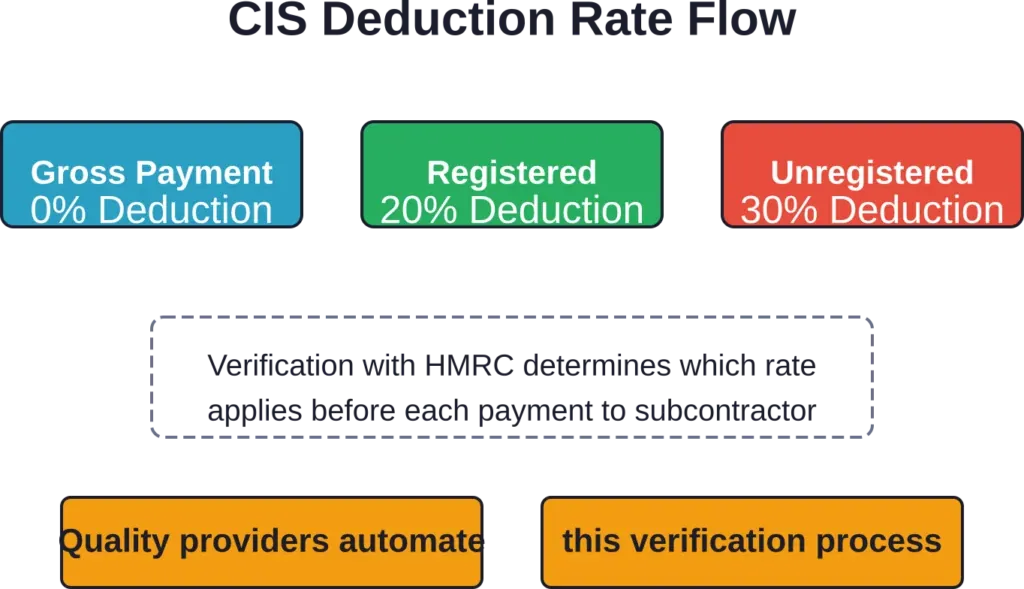
The deduction rates vary based on subcontractor registration status. Registered subcontractors face 20% deductions, unregistered subcontractors face 30% deductions, and those with gross payment status face 0% deductions. Getting these rates wrong triggers penalties and creates compliance headaches.
Who Must File CIS Returns
Contractors in the construction industry must register and file returns. That includes traditional construction companies, building firms, and government departments contracting construction work.
There's also a category called deemed contractors—businesses that aren't primarily construction-focused but spend more than £3 million on construction operations within any rolling 12-month period. These organizations must comply with CIS requirements despite construction being ancillary to their core business.
Subcontractors should register for CIS to receive the lower 20% deduction rate rather than the 30% rate applied to unregistered workers. Registration isn't mandatory for subcontractors, but the financial impact makes it practically essential.
Key Features of Quality CIS Return Services
The best CIS return services companies share specific characteristics that separate them from basic bookkeeping services or general accountants who merely tolerate CIS work.
HMRC Compliance Track Record
Look for providers with demonstrated expertise in Construction Industry Scheme regulations. Ask about their compliance history: How many clients have faced penalties under their management? What's their error rate on submitted returns?
Quality providers maintain zero-penalty track records for clients. They stay current with HMRC guidance updates and understand the nuances in CIS 340 guidance documents published by HMRC.
Best practice: any provider that's vague about their compliance record or can't provide specific examples of how they've resolved CIS issues may not be the specialist needed.
Subcontractor Verification Accuracy
Before paying any subcontractor, contractors must verify them with HMRC to determine the correct deduction rate. This verification process happens through HMRC's CIS online service or compatible commercial software.
A quality CIS return services provider handles this verification systematically. They maintain databases of verified subcontractors, track verification status, and ensure no payments occur before proper verification.
The verification determines whether deductions apply at 0%, 20%, or 30%—getting this wrong means incorrect tax deductions, which creates problems for both contractor and subcontractor. The right service provider makes verification a seamless part of the payment workflow.
Monthly Filing Reliability
CIS returns must be filed monthly, even if no payments were made to subcontractors during that period. The deadline is the 19th of each month following the tax month (which runs from the 6th of one month to the 5th of the next).
Missing this deadline triggers immediate penalties. A return submitted even one day late incurs a £100 fixed penalty. Two months late? Add another £200 penalty. Six months late? Add £300 or 5% of the CIS deductions, whichever is greater. For returns later than 12 months, you may be given an additional penalty of up to £3,000 or 100% of the CIS deductions on the return, whichever is higher.
Top CIS return services companies implement automated deadline tracking, client reminder systems, and internal quality checks that ensure returns file on time, every time. They don't wait for clients to provide information—they chase it down proactively.
Digital Record Keeping
HMRC increasingly emphasizes digital record-keeping and Making Tax Digital initiatives. While CIS returns aren't yet fully within the MTD framework, the direction is clear.
Forward-thinking CIS return services companies use cloud-based systems that integrate with contractors' existing accounting software. They maintain digital audit trails, store verification records electronically, and ensure all documentation is accessible if HMRC initiates a compliance check.
This digital approach also benefits contractors by providing real-time visibility into CIS liabilities, payment histories, and compliance status. The days of waiting for monthly paper reports should be over.
Evaluating CIS Service Providers
When comparing potential CIS return services companies, several practical evaluation criteria help identify the best fit.
Industry Specialization
Does the provider specialize in construction industry clients, or is CIS just one of many services they offer? Specialists understand construction business cycles, common subcontractor arrangements, and industry-specific challenges.
They're more likely to have worked with deemed contractors, navigated gross payment status applications, and dealt with complex multi-tier subcontracting arrangements. That experience translates to fewer errors and faster problem resolution.
Technology and Software
What platforms does the provider use? Do they integrate with HMRC's CIS online service directly, or do they use commercial software? Can their systems connect to existing accounting or payroll software?
The best providers use commercial CIS software that automates verification, calculates deductions accurately, and generates returns in the correct format for HMRC submission. Manual spreadsheet-based processes increase error risk.
Ask about data security certifications, backup procedures, and disaster recovery plans. CIS data includes sensitive tax information that requires proper protection.
Service Scope and Pricing
CIS return services pricing varies by provider, including per-return submissions, monthly retainers, or fees based on the number of subcontractors or transaction volume.
Understand exactly what's included in the quoted price. Does it cover unlimited subcontractor verifications? Are there extra charges for late information corrections or HMRC correspondence handling? What happens if a compliance check occurs?
Transparent pricing with clear service level agreements prevents surprise costs down the road. The cheapest provider isn't always the best value if they cut corners on compliance or charge extras for basic services.
Communication and Support
How accessible is the provider when questions arise or urgent verifications are needed? Do they offer dedicated account managers, or will contractors speak to different people each time?
Test their responsiveness during the evaluation process. How quickly do they reply to initial inquiries? Do they provide clear, jargon-free explanations? Are they proactive about flagging potential issues?
Good providers don't just process returns—they educate clients about CIS obligations, alert them to regulatory changes, and offer strategic advice about construction business tax planning.
File CIS Returns With Acumon
Choosing a CIS return services company means finding a provider that understands the monthly reporting duties contractors face. Acumon supports businesses with accounting, payroll, tax compliance, bookkeeping, and related financial administration services connected to contractor and subcontractor operations. This can help construction businesses keep payroll records, tax reporting, bookkeeping, and broader compliance processes organised alongside day-to-day financial administration.
Areas Acumon can support for contractor businesses:
- Tax compliance and accounting support
- Payroll and PAYE administration
- Bookkeeping and record keeping
- VAT returns and management accounts
- Statutory accounts support
- Audit and financial reporting services
👉Reach out to Acumon to discuss accounting and compliance support for contractor businesses.
Common CIS Return Mistakes to Avoid
Understanding what can go wrong with CIS returns helps in evaluating whether a potential provider has the expertise to prevent these issues.
Verification Failures
Paying subcontractors before verifying them with HMRC is surprisingly common. It leads to incorrect deduction rates, creates administrative headaches when corrections are needed, and can trigger penalties.
Some contractors verify subcontractors once and never reverify, but HMRC requires verification if a subcontractor hasn't appeared on a CIS return in the current or previous two tax years. Status changes—a subcontractor achieving gross payment status or losing it—won't be reflected without reverification.
Incorrect Deduction Calculations
Calculating the amount subject to CIS deductions requires subtracting material costs from gross payments. Materials supplied directly by subcontractors shouldn't have CIS deductions applied.
But what counts as materials versus labor? The distinction isn't always obvious. Quality CIS return services companies understand these nuances and prevent classification errors.
Late or Nil Return Failures
Contractors must file returns even in months with zero payments to subcontractors. Skipping a nil return because "nothing happened" still triggers the £100 late filing penalty.
Many contractors also misunderstand tax month dates. The CIS tax month runs from the 6th of one month to the 5th of the next, not calendar months. Returns for the tax month ending March 5th are due by April 19th.
Professional CIS return services track these dates automatically and file nil returns proactively.
Questions to Ask Potential Providers
Before committing to a CIS return services company, ask these specific questions to assess their capabilities:
| Question Category | Specific Questions to Ask |
|---|---|
| Experience | How many years handling CIS returns? How many construction industry clients? Any clients lost to penalties? |
| Process | What's the monthly workflow? When do you need information? How do you handle urgent verifications? |
| Technology | What software platforms? Integration options? Client portal access? Mobile capabilities? |
| Compliance | How do you stay current with HMRC changes? What's your quality control process? Audit support included? |
| Pricing | Exact fee structure? Additional charges? Payment terms? Service level guarantees? |
| Communication | Who's the direct contact? Response time commitments? How are issues escalated? |
The answers reveal whether the provider has mature processes or is learning on the job. Vague responses or inability to explain their methodology are red flags.
The True Value of Professional CIS Services
Some contractors view CIS return services as a grudge purchase—a regulatory compliance cost without tangible business value. That perspective misses the broader benefits.
Professional CIS management prevents penalties that start at £100 and escalate rapidly. It protects against HMRC compliance checks that can be time-consuming and disruptive. It ensures subcontractors receive correct deductions, maintaining those crucial business relationships.
But beyond risk mitigation, quality CIS services free contractors to focus on core business activities. The administrative burden of monthly returns, verification management, and record-keeping consumes time that could be spent on project management, business development, or strategic planning.
For deemed contractors—organizations outside the construction industry that trigger CIS obligations through high construction spending—professional services are often essential. They lack internal expertise and find CIS compliance particularly challenging.
Making the Final Decision
After researching providers and conducting evaluations, the selection decision should weigh several factors.
Compliance expertise and track record matter most. Pricing is important but secondary to avoiding penalties and ensuring accurate returns. The £100 late filing penalty for a single missed return can exceed months of service fees from a quality provider.
Industry specialization provides value through construction-specific knowledge and understanding of common scenarios. Providers who work primarily with construction clients speak the industry language and anticipate seasonal patterns, cash flow challenges, and subcontracting complexities.
Technology capabilities indicate whether the provider is investing in efficiency and client service or relying on outdated manual processes. Integration with existing systems reduces duplicate data entry and error risk.
Personal rapport and communication style influence the ongoing relationship. Contractors should feel comfortable asking questions and confident that the provider will be responsive when issues arise.
Most quality providers offer initial consultations at no charge. Use these meetings to assess expertise, ask specific questions about current CIS situations, and evaluate whether the provider's approach aligns with business needs.
Frequently Asked Questions
Look for qualified accountants or tax specialists with demonstrated Construction Industry Scheme expertise. Membership in professional bodies like ICAEW (Institute of Chartered Accountants in England and Wales) or CIPP (Chartered Institute of Payroll Professionals) indicates professional standards. However, practical CIS experience with construction clients often matters more than general accounting credentials. Ask about their construction industry client base and years handling CIS returns specifically.
Yes, contractors can file returns directly through HMRC's CIS online service without using a service provider. This works for businesses with simple subcontractor arrangements and strong internal administrative capabilities. However, many contractors find the verification requirements, monthly deadlines, deduction calculations, and record-keeping demands challenging to manage alongside running their construction business. The risk of penalties for errors or late filing often makes professional services cost-effective.
Pricing varies based on business size, transaction volume, and service scope. Some providers charge £50-£150 per monthly return for small contractors with few subcontractors. Others use monthly retainers of £100-£500 depending on complexity. High-volume contractors might negotiate custom pricing. Always clarify what's included—verification services, record-keeping, HMRC correspondence handling, and penalty protection should be part of the package. Cheap services that charge extras for routine tasks often cost more overall.
Reputable providers carry professional indemnity insurance covering errors and omissions. They should accept responsibility for mistakes they make and cover any resulting penalties. Review the service agreement carefully for liability clauses. Quality providers also have internal quality control processes that catch errors before submission. Ask potential providers about their error resolution process and whether they've ever had to cover client penalties due to their mistakes.
Many CIS specialists assist subcontractors applying for gross payment status, which eliminates the 20% deduction. The application requires demonstrating compliance with tax obligations, meeting turnover thresholds, and showing the business is UK-based. While this is technically a subcontractor concern, contractors benefit when subcontractors achieve gross status because it simplifies payment processing. Some CIS return services providers offer this as an additional service for subcontractor clients.
Most providers request subcontractor payment information by the 10th of the month for returns due on the 19th. This gives them time to verify any new subcontractors, calculate deductions correctly, prepare the return, and have clients review it before submission. Contractors who provide information earlier reduce stress and allow more time for resolving any issues. Establish clear information-sharing schedules with providers during the onboarding process.
Yes, specialist providers can help contractors catch up on overdue returns, though penalties for late filing will still apply based on how long returns have been outstanding. They'll work with HMRC to understand the penalty position, prepare and submit missing returns, and establish compliant processes going forward. Some providers specialize in CIS remediation for contractors with historical compliance issues. The sooner the situation is addressed, the lower the total penalty exposure.
Moving Forward with CIS Compliance
Choosing a CIS return services company shouldn't be rushed. The decision affects compliance risk, administrative burden, and ultimately business success in the UK construction industry.
Start by assessing internal capabilities and resources. Can the business handle CIS requirements internally with existing staff? Is there an appetite for maintaining expertise as regulations evolve? For many contractors, the answer is no—and that's where professional services deliver clear value.
Research multiple providers, checking their construction industry focus, HMRC compliance track record, technology platforms, and pricing transparency. Schedule consultations with top candidates to discuss specific business situations and evaluate their expertise and communication style.
The right CIS return services company becomes a trusted partner, not just a vendor. They protect against penalties, ensure accurate reporting, maintain crucial records, and free contractors to focus on building their businesses rather than navigating tax administration.
Construction Industry Scheme compliance isn't optional, and getting it wrong carries real financial consequences starting at £100 for a single late return and escalating from there. Professional CIS services transform this regulatory burden into a manageable, predictable business process.
Take the time to choose wisely. The investment in quality CIS return services pays dividends through avoided penalties, reduced administrative stress, and confidence that this critical compliance area is handled correctly every month.