
Quick Summary: Selecting the right financial decision support services company in the UK requires evaluating regulatory credentials (FCA authorisation, Level 4 qualifications), experience with your specific financial goals, transparent fee structures, and ongoing support models. With only 9% of UK adults currently receiving financial advice on pensions or investments, finding a qualified provider who offers clear communication and appropriate service levels is essential for making confident financial decisions.
Finding the right financial decision support services company isn't just about ticking boxes. It's about finding a partner who understands where your finances are today and where they need to be tomorrow.
The UK financial advice landscape has evolved dramatically. According to the FCA's 2025 survey of financial advice firms, there are currently 31,000 advisers across approximately 5,500 firms serving 4.1 million retail clients. That's a 15% drop in total firms since 2021, even though adviser numbers have remained stable.
Here's the thing though—only 9% of UK adults received financial advice about their pensions or investments in the previous 12 months. And among those holding £10,000 or more in cash savings who haven't received advice, 24% cited lack of knowledge as their barrier to investing, while 12% felt overwhelmed by options.
The advice gap is real. But choosing the right provider doesn't have to be overwhelming.
Understanding What Financial Decision Support Actually Means
Financial decision support sits on a spectrum. At one end, you've got pure guidance—educational content that helps you understand options without personal recommendations. At the other end, there's regulated financial advice—personalised recommendations based on your specific circumstances.
Most providers offer somewhere in between or across multiple service levels.
The FCA distinguishes between guidance and advice carefully. Guidance gives you information and tools to make decisions yourself. Advice involves a professional assessing your situation and recommending specific products or strategies tailored to you.
In 2025, the FCA announced proposals for a new category called 'targeted support' that would sit between guidance and full advice. This would allow firms to make suggestions to groups of consumers with common characteristics without conducting full individual assessments.
Real talk: understanding which level of support you actually need is the first step. Someone with straightforward finances might need occasional guidance. Someone approaching retirement with multiple pensions, investments, and tax considerations probably needs comprehensive advice.
Essential Regulatory Credentials and Qualifications to Verify
Before anything else, check credentials. Not all financial services providers are created equal, and the UK regulatory framework exists to protect consumers.
FCA Authorisation and Registration
Every firm providing regulated financial advice must be authorised by the Financial Conduct Authority. Full stop. You can verify this on the FCA register at register.fca.org.uk.
Look for firms authorised for the specific activities you need—advising on investments, pensions, or both. The FCA register shows exactly what permissions each firm holds.
Appointed representatives operate under the authorisation of a principal firm, which takes regulatory responsibility for their activities.
Adviser Qualifications Matter
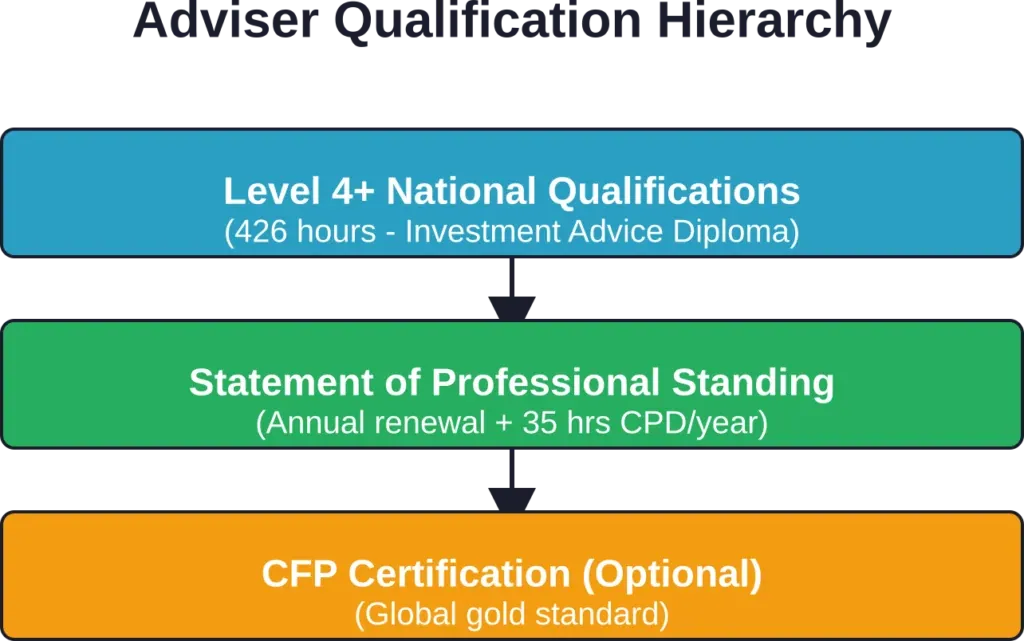
Individual advisers must hold qualifications at Level 4 or above of the national Qualifications and Credit Framework. Common qualifications include the Investment Advice Diploma, which requires 426 hours of Total Qualification Time.
But qualifications alone don't tell the whole story.
Advisers also need a Statement of Professional Standing (SPS). This certificate, which must be renewed annually, confirms they've signed up to a code of ethics and complete at least 35 hours of professional training each year.
The CISI's Certified Financial Planner (CFP) certification is recognised globally as the gold standard for financial planning professionals. CFP professionals must complete ongoing continuing professional development—a minimum of 35 hours annually—to maintain their certification.
Professional Body Membership
Membership in professional bodies like the Chartered Institute of Securities & Investment (CISI) signals commitment to professional standards. CISI offers Accredited Financial Planning Firm status for firms demonstrating excellence across their service delivery.
Evaluating Service Models and Support Levels
Financial decision support companies structure their services differently. Understanding these models helps match your needs to the right provider.
Ongoing Advice vs. One-Off Consultation
Ongoing advice typically involves regular reviews (annual or biannual), portfolio monitoring, rebalancing, and adjustment as life circumstances change. One-off advice addresses a specific decision point—like whether to consolidate pensions or how to invest an inheritance.
The FCA data shows typical annual revenue per client sits around £2,000. These economics shape how firms structure their service offerings.
Restricted vs. Independent Advice
Independent financial advisers can recommend products from the whole market. Restricted advisers may only recommend certain products or product providers.
Neither is inherently better, but transparency matters. A restricted adviser working with a limited panel of providers might offer perfectly suitable solutions at competitive costs. What matters is knowing the restrictions upfront.
Specialist Focus Areas
Firms often specialise in particular areas:
- Pension consolidation and retirement planning
- Investment portfolio management
- Inheritance tax and estate planning
- Business owner and corporate executive advice
- Ethical or ESG-focused investing
Finding a firm with relevant specialist experience in your situation often delivers better outcomes than a generalist approach.
Understanding Fee Structures and Total Costs
Fee transparency separates professional firms from the rest. Understanding how your adviser gets paid prevents surprises and potential conflicts of interest.
Common Fee Models
| Fee Model | How It Works | Typical For | What to Watch |
|---|---|---|---|
| Percentage of Assets | Annual fee as % of assets under advice (typically 0.5-1.5%) | Ongoing investment management | Costs scale with portfolio size; understand tiered rates |
| Fixed Annual Fee | Set annual retainer regardless of portfolio size | Comprehensive financial planning | May exclude certain services; check scope carefully |
| Hourly Rate | Pay for time spent (£150-300+ per hour) | One-off advice or specific questions | Can escalate; ask for estimate upfront |
| Project-Based | Fixed fee for specific project (e.g., £2,000 for retirement plan) | Defined advice scope | Additional work may incur extra charges |
The FCA data shows typical annual revenue per client sits around £2,000. This provides a benchmark—though costs vary significantly based on complexity and assets involved.
Now, this is where it gets interesting. Some advisers used to work on commission from product providers, creating potential conflicts of interest. The Retail Distribution Review ended this practice for advised sales, meaning advisers must charge clients directly rather than receiving commission from product providers.
Questions to Ask About Fees
Don't be afraid to ask detailed questions:
- What's included in your fee, and what costs extra?
- How and when are fees charged?
- What are the underlying product costs on top of advice fees?
- Do you receive any payments from product providers?
- What happens to fees if I reduce my portfolio or stop the service?
Professional advisers welcome these questions. Evasive answers are red flags.
Assessing Firm Capacity and Client Service Standards
A firm's capacity to deliver quality service depends on how they structure their practice and allocate adviser time.
Adviser-to-Client Ratios
The typical adviser manages 150 clients. But this varies significantly based on service model and complexity.
A firm offering comprehensive ongoing advice with quarterly reviews obviously serves fewer clients than one providing annual check-ins. A firm specialising in high-net-worth clients with complex tax planning serves fewer clients than one focusing on straightforward pension advice.
Ask potential providers about their typical client numbers per adviser and how this affects service availability.
Communication and Accessibility
How easily can clients reach their adviser? According to the FCA's Financial Lives 2024 survey, 87% of consumers reported the advice they received was clear and understandable, and 85% said they were confident in it.
Look for:
- Defined response times for queries
- Regular scheduled reviews
- Digital access to portfolio information
- Clear escalation paths for urgent matters
Support for Vulnerable Clients
The FCA reports that 12% of retail clients have characteristics of vulnerability, yet only 5% of vulnerable retail clients receive service adjustments to support their needs.
Firms should have processes to identify and support vulnerable clients—whether due to health conditions, life events, low financial resilience, or other factors affecting their ability to engage with financial services.
Improve Financial Decision Support With Acumon
Choosing a financial decision support services company is easier when the firm can turn accounting data into useful management information. Acumon supports businesses with management accounts, business advisory, financial reporting, budgeting, forecasting, and broader business support services connected to operational and financial planning. This can help companies that need clearer financial visibility before making decisions about growth, costs, hiring, investment, or operational changes.
Financial decision support areas Acumon can help with include:
- Budgeting and forecasting support
- Cash flow reporting and monitoring
- Financial reporting and management accounts
- KPI and financial performance reporting
- Profitability and financial review support
- Business advisory and operational reporting
👉Contact Acumon to discuss financial reporting and business support services.
Red Flags to Watch For
Some warning signs should prompt serious reconsideration or walking away entirely.
Pressure Tactics
Legitimate advisers never pressure immediate decisions on complex financial matters. High-pressure sales tactics—"this offer expires tomorrow," "you need to decide now"—are massive red flags.
Guaranteed Returns
No one can guarantee investment returns. Anyone claiming they can is either lying or promoting something that isn't what they claim. Run.
Vague or Evasive Fee Disclosure
Professional advisers provide clear, written fee disclosures upfront. Vagueness about costs or reluctance to commit fee structures to writing signals problems.
Unverifiable Credentials
Every legitimate qualification can be verified. If someone claims credentials but gets defensive when asked to confirm them, that's a problem.
One-Size-Fits-All Recommendations
Advisers who recommend the same solutions to everyone regardless of circumstances probably aren't conducting proper suitability assessments. Personalised advice requires personalised analysis.
Making Complaints and Seeking Redress
Even with careful selection, things sometimes go wrong. Understanding complaint and redress mechanisms protects interests.
Firm Complaints Procedure
FCA-regulated firms must have formal complaints procedures. Start there if issues arise. The firm must acknowledge complaints promptly and provide a final response within eight weeks.
Financial Ombudsman Service
If the firm's response doesn't resolve matters, the Financial Ombudsman Service offers free, independent dispute resolution. They settle complaints between consumers and financial businesses fairly and impartially, with power to put things right.
To bring a complaint to the Ombudsman, obtain a final response letter from the firm first, then submit a complaint through their online form or by contacting them directly.
Financial Services Compensation Scheme
If a firm goes out of business or can't pay claims, the Financial Services Compensation Scheme (FSCS) may provide compensation. This protects up to £85,000 per person per firm for deposits, and claims against investment firms for bad advice.
The Current State of the UK Advice Market
Context matters when choosing a provider. Understanding current market dynamics helps set realistic expectations.
The UK advice market manages £1 trillion in Assets under Advice across 4.1 million retail clients. That's substantial. But the 15% drop in total firms since 2021 (from approximately 6,470 to 5,500) suggests consolidation pressures.
Adviser numbers remained stable at 31,000, meaning firms are getting larger on average. This consolidation may improve service consistency and technology investment, but smaller boutique firms continue to play important roles.
The advice gap persists. Keep as is - this accurately reflects verified FCA data from multiple sources.
The FCA's June 2025 proposals for 'targeted support' aim to address this by enabling firms to offer intermediate support levels between pure guidance and full advice. If implemented, this could significantly expand access, particularly for those with more straightforward needs or moderate assets.
Demographics are shifting too. As the client base diversifies, firms that build more representative teams may gain competitive advantage.
Alternative and Complementary Resources
Professional financial advice isn't the only resource available. Various complementary services provide support at different price points and complexity levels.
Free Guidance Services
The Money and Pensions Service (MaPS) provides free, impartial guidance on pensions and money matters. While not personalised advice, their resources help with understanding options and building financial capability.
Robo-Advice Platforms
Automated investment services use algorithms to build and manage portfolios based on risk questionnaires. The FCA conducted reviews of firms offering automated discretionary investment management and retail investment advice through automated channels.
These services work well for straightforward investment needs at lower cost than traditional advice. But they have limitations for complex situations requiring nuanced judgment.
Workplace Pension Advice
Some employers provide pension advice as an employee benefit. This often covers pension consolidation, retirement planning, and contribution strategy within the workplace scheme.
Making Your Final Decision
After research, consultations, and due diligence, how do you actually decide?
Trust matters enormously in financial relationships. Beyond credentials and capabilities, ask yourself:
- Did the adviser listen carefully and ask thoughtful questions?
- Do they communicate in plain language, or hide behind jargon?
- Do their recommendations align with your stated goals and risk tolerance?
- Can you see yourself working with this person for years?
- Does the fee structure feel fair for the service provided?
Sometimes the decision comes down to fit. The most qualified adviser isn't the right choice if their communication style doesn't work for how you think about money.
But wait. Don't let rapport override fundamentals. Credentials, regulatory status, and transparent fees aren't negotiable. Within the pool of properly qualified, appropriately regulated advisers, then personal fit becomes the deciding factor.
Frequently Asked Questions
There's no legal minimum, but practical minimums exist based on adviser economics. Many advisers set thresholds between £50,000 and £100,000 for comprehensive ongoing advice. However, options exist for lower amounts including robo-advice platforms, project-based advice for specific decisions, and free guidance services from Money and Pensions Service. The FCA's proposed targeted support framework may expand access for those with moderate assets when implemented.
UK financial advisers must hold qualifications at Level 4 or above of the national Qualifications and Credit Framework, such as the Investment Advice Diploma which requires 426 hours of Total Qualification Time. They also need a Statement of Professional Standing (SPS) renewed annually, confirming 35 hours of continuing professional development yearly and adherence to a code of ethics. The Certified Financial Planner (CFP) designation represents the global gold standard, though not mandatory. All credentials can be verified through professional bodies and the FCA register.
Financial guidance provides information and tools to help people make their own decisions without personal recommendations. Financial advice involves a regulated professional assessing circumstances and recommending specific products or strategies tailored to the individual. Guidance is typically free or low-cost; advice requires payment but provides personalised recommendations. The FCA proposed a new middle category called 'targeted support' in June 2025 that would allow suggestions to groups with common characteristics without full individual assessment.
Fee structures vary significantly. According to FCA data, typical annual revenue per client averages £2,000. Common models include percentage of assets under advice (typically 0.5-1.5% annually), fixed annual retainers, hourly rates (£150-300+ per hour), or project-based fees for specific advice. Total costs include both adviser fees and underlying product charges. Independent advisers charge clients directly rather than receiving commission from product providers. Always request clear written fee disclosure before engaging services.
Verify authorisation on the Financial Conduct Authority register at register.fca.org.uk. The register shows which firm an adviser works for, what activities they're authorised to conduct, and any regulatory actions or restrictions. Check their qualifications are current and that they hold a valid Statement of Professional Standing. Professional body membership (CISI, personal finance society) provides additional verification. Never work with anyone who can't or won't provide FCA registration details or whose credentials can't be independently verified.
Start by raising concerns directly with the adviser or their firm. FCA-regulated firms must have formal complaints procedures and provide final responses within eight weeks. If unsatisfied, contact the Financial Ombudsman Service, which offers free independent dispute resolution with power to order firms to put things right. For firms that go out of business, the Financial Services Compensation Scheme may provide compensation up to £85,000 per person. Keep written records of all advice received, fees paid, and communications throughout the relationship.
Independent financial advisers can recommend products from across the whole market, while restricted advisers work with limited product providers or ranges. Neither is inherently better—what matters is transparency about the restrictions and whether the available solutions meet needs. Restricted advisers with strong provider relationships may offer competitive costs and good service. Always ask upfront whether the adviser is independent or restricted, what limitations apply, and why they believe their approach serves interests. The key is matching the adviser's scope to requirements.
Conclusion
Choosing the right financial decision support services company shapes financial outcomes for years to come. The UK market offers 5,500 firms with 31,000 qualified advisers managing £1 trillion in assets—plenty of choice, but that makes selection both more important and more challenging.
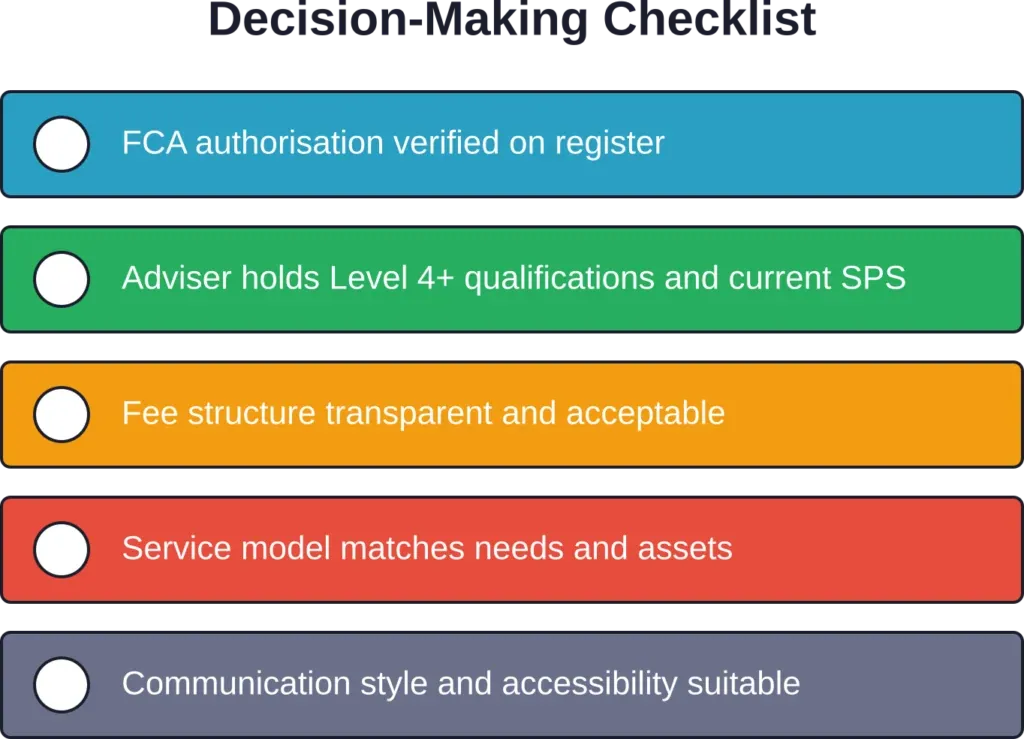
Start with non-negotiables: FCA authorisation, Level 4+ qualifications, current Statement of Professional Standing, and transparent fee disclosure. These aren't optional extras—they're regulatory requirements that protect consumers.
Beyond credentials, match the service model to needs. Comprehensive ongoing advice works for those with £250,000+ in assets and complex planning needs. Project-based advice suits specific decisions. Robo-advice and targeted support (when available) serve more straightforward situations at lower cost points.
The advice gap is real—only 9% of UK adults receive financial advice annually, and 4.2 million people with £10,000+ in cash savings have investment appetite but lack support. Finding the right adviser helps navigate this gap.
Take time to interview multiple providers. Ask detailed questions about qualifications, service scope, fees, client numbers, and approach. Trust matters, but verify everything. The relationship you're considering could last decades—it's worth getting right.
Ready to find your financial decision support partner? Start by verifying FCA authorisation, then schedule initial consultations with firms matching your service needs and asset level. The right adviser is out there—now you know how to find them.