
Quick Summary: Choosing the right commercial risk assessment services company in the UK requires verifying accreditations (BAFE, NSI, ISO 31000), confirming sector-specific expertise, and ensuring comprehensive service delivery including implementation support. Look for providers with transparent pricing, qualified assessors holding IRM or NEBOSH certifications, and proven experience in your industry while meeting the Management of Health and Safety at Work Regulations 1999.
UK businesses lost over £1 billion to fire incidents last year, with compliance failures often at the heart of the damage. That's not just a financial hit – it's reputational harm, legal penalties, and operational chaos rolled into one.
Under the Management of Health and Safety at Work Regulations 1999, employers must make a 'suitable and sufficient assessment' of risks to employees and others affected by their work. But here's the thing – not all risk assessment companies are created equal.
With over 100 regulatory bodies involved in UK regulation, selecting the right partner matters more than ever. This guide walks through exactly what to look for when choosing commercial risk assessment services in 2026.
Understanding Commercial Risk Assessment Requirements in the UK
Risk assessment isn't optional. It's a legal requirement that sits at the foundation of workplace safety and business continuity.
The Health and Safety Executive (HSE) mandates that employers identify what could cause injury or illness (hazards), decide how likely harm is and how serious (the risk), and take action to eliminate the hazard or control the risk. That's the baseline.
But commercial risk assessment extends well beyond basic workplace safety. Depending on the sector, businesses must address:
- Fire safety risk assessments for commercial premises
- Financial crime and money laundering risk assessments (We surveyed 303 corporate finance firms (CFFs) not currently required to submit financial crime data returns to the FCA, of which 270 (89%) responded)
- Enterprise risk management across operations, supply chains, and strategic objectives
- Climate financial risk as outlined by the Climate Financial Risk Forum
- Sector-specific regulatory compliance requirements
The Institute of Risk Management (IRM) defines Enterprise Risk Management as an integrated and joined-up approach to managing risk across an organisation and its extended networks. That's the modern standard businesses should aim for.
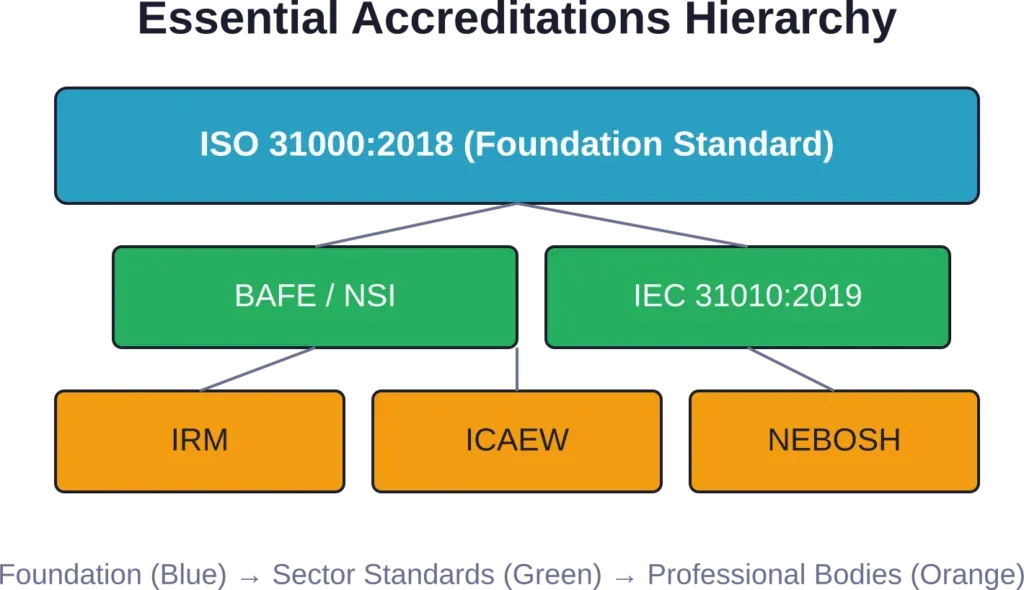
Key Accreditations and Standards to Verify
Accreditations aren't just letters after a company name. They're proof of competence, insurance coverage, and adherence to recognised standards.
When evaluating commercial risk assessment services, look for these essential credentials:
ISO 31000:2018 – Risk Management Guidelines
ISO 31000:2018, published in 2018 and last reviewed in 2023, provides comprehensive guidelines for risk management frameworks. Companies aligned with this standard follow internationally recognised principles for identifying, evaluating, and controlling risks.
The ISO 31000 family helps organisations account for the unexpected while optimizing processes and protecting assets. It's the gold standard for systematic risk management.
IEC 31010:2019 – Risk Assessment Techniques
This companion standard to ISO 31000 outlines specific techniques for risk assessment. Providers should demonstrate familiarity with these methodologies and apply them appropriately to different business contexts.
BAFE and NSI Accreditations
For fire risk assessments specifically, BAFE (British Approvals for Fire Equipment) and NSI (National Security Inspectorate) accreditations are crucial. These confirm that assessors have been independently verified for competence and maintain appropriate insurance.
Professional Body Memberships
Look for assessors who hold qualifications from recognised bodies such as:
- Institute of Risk Management (IRM): The leading body for professional risk management with globally recognised qualifications
- ICAEW (Institute of Chartered Accountants in England and Wales): Particularly relevant for financial and enterprise risk
- NEBOSH (National Examination Board in Occupational Safety and Health): Essential for health and safety risk assessments
These memberships indicate ongoing professional development and adherence to ethical standards.
Evaluating Service Scope and Delivery Models
Commercial risk assessment services vary dramatically in scope. Some providers offer standalone assessments – they visit, document hazards, produce a report, and leave. Others deliver end-to-end risk management solutions.
The Pareto principle applies here: 80% of risk can be identified and assessed with 20% of the potential effort required. But that doesn't mean taking shortcuts – it means focusing assessment resources where they matter most.
Comprehensive vs. Basic Assessment Services
Basic services typically include:
- Site visits and hazard identification
- Written risk assessment documentation
- Compliance verification against regulations
Comprehensive services extend to:
- Risk assessment framework development
- Implementation support and action planning
- Staff training and competency development
- Ongoing review and update cycles
- Integration with business performance management systems
The ICAEW risk assessment framework template emphasizes that risk assessment should be a working document, part of overall business performance management. Look for providers who treat risk assessment as an ongoing process, not a one-off compliance tick-box.
Sector-Specific Expertise
Generic risk assessment rarely delivers value. The hazards facing a chemical manufacturer differ entirely from those affecting a retail chain or financial services firm.
Verify that prospective providers have demonstrable experience in the specific sector. Ask for case studies, client references, and examples of previous work in similar environments. A provider with deep healthcare experience won't necessarily understand construction site risks.
Pricing Models and Cost Transparency
Pricing for commercial risk assessment services varies significantly based on premises size, complexity, and service scope. Understanding pricing structures upfront prevents surprises.
Common pricing models include:
| Pricing Model | Best For | Considerations |
|---|---|---|
| Fixed Rate Per Site | Standard commercial premises with straightforward risk profiles | Transparent and predictable; ensure scope is clearly defined |
| Bespoke Quotation | Large facilities, complex operations, or multi-site assessments | Reflects actual requirements but requires detailed scoping |
| Retainer/Subscription | Ongoing risk management support with regular reviews | Spreads cost; ensures continuous compliance but requires commitment |
| Hourly/Day Rate | Consultancy-style engagements for enterprise risk frameworks | Flexible but can escalate; set clear boundaries |
According to competitor analysis, fire risk assessment companies in the UK offer fixed rates starting from a few hundred pounds for small premises. However, comprehensive enterprise risk management services commanding bespoke pricing can reach thousands depending on organisational complexity.
Transparency matters. Reputable providers should offer clear quotations with itemized services. Be wary of unusually low quotes – they often indicate inadequate assessment depth or unqualified assessors.
Assessing Assessor Qualifications and Experience
The quality of a risk assessment depends entirely on the competence of the person conducting it. Credentials matter, but so does practical experience.
What to Ask About Assessor Qualifications
Request detailed information about:
- Professional qualifications (IRM, NEBOSH, specific technical certifications)
- Years of experience in risk assessment roles
- Sector-specific knowledge and previous projects
- Continuing professional development (CPD) records
- Professional indemnity insurance coverage
The Institute of Risk Management offers Awards and qualifications specifically designed for risk professionals. Assessors holding these credentials demonstrate commitment to professional standards and ongoing learning.
Case Studies and References
Don't just take marketing materials at face value. Request specific case studies that match the business context and ask to speak with previous clients.
Real talk: if a provider hesitates to provide references or only offers generic testimonials, that's a red flag. Established firms with strong track records will readily connect prospective clients with satisfied customers.
Assess Commercial Risk With Acumon
Choosing a commercial risk assessment services company is important when a business needs a clearer view before a transaction, investment, or strategic decision. Acumon provides advisory, due diligence, risk management, and business review services that can support organisations evaluating operational, financial, and strategic risks. This type of support can be useful for buyers, sellers, and management teams that need a broader understanding of business performance, governance, financial reporting, and operational considerations connected to commercial decisions.
Acumon can help through:
- Due diligence support
- Business and operational reviews
- Risk management assessment
- Governance and control reviews
- Financial and reporting review support
- Strategic advisory services
👉Contact Acumon to discuss commercial risk and advisory support.
The Risk-Based Approach and Regulatory Alignment
The UK government emphasizes a risk-based approach to carrying out compulsory risk assessments. This methodology focuses resources on areas of highest risk rather than applying blanket procedures.
For businesses supervised for money laundering regulations, the risk-based approach means assessing where the business could be used for money laundering or terrorist financing, then deciding which areas need detailed assessment.
This principle extends across all commercial risk assessment types. A risk-based approach:
- Identifies specific hazards relevant to the business
- Evaluates likelihood and severity of harm
- Prioritizes controls based on risk level
- Allocates resources efficiently
- Documents decisions with clear rationale
Quality risk assessment services providers should articulate how they apply risk-based methodology to the specific business context. Generic checklists don't cut it.
Integration with Business Operations
Risk assessment shouldn't exist in isolation from business strategy and operations. The most effective assessments integrate seamlessly with existing management systems.
The ICAEW risk assessment framework emphasizes that risk assessment should be a working document within overall business performance management. For each strategic objective, potential risks are identified using an objective-by-objective approach.
When evaluating providers, consider how they'll integrate risk assessment outputs with:
- Strategic planning and objective setting
- Operational procedures and work instructions
- Training programmes and competency frameworks
- Performance monitoring and KPI dashboards
- Continuous improvement cycles
A risk assessment that produces a thick binder gathering dust on a shelf delivers zero value. Look for providers who emphasize implementation, embedding, and ongoing review.
Red Flags to Watch For
Some warning signs should immediately raise concerns when selecting commercial risk assessment services:
| Red Flag | Why It Matters | What to Do |
|---|---|---|
| No verifiable accreditations | Indicates lack of professional standards and potentially inadequate insurance | Request proof of certifications; verify with issuing bodies |
| Unusually low pricing | Often reflects rushed assessments or unqualified assessors | Compare quotes; understand what's included |
| Generic templates only | Shows lack of sector knowledge and risk-based approach | Ask about customization and methodology |
| No implementation support | Leaves businesses with reports but no action plan | Clarify what happens after assessment delivery |
| Reluctance to provide references | Suggests limited track record or dissatisfied clients | Insist on speaking with previous clients |
Trust instincts here. If something feels off during initial consultations, it probably is. The relationship with a risk assessment provider should feel collaborative, not transactional.
Making the Final Selection Decision
After narrowing down options, the final decision should weigh multiple factors systematically.
Create a simple scoring matrix covering:
- Accreditations and professional standards (weight: 25%)
- Sector experience and relevant case studies (weight: 25%)
- Service scope and implementation support (weight: 20%)
- Pricing transparency and value (weight: 15%)
- Assessor qualifications and track record (weight: 15%)
This structured approach prevents decisions based solely on price or subjective impressions. It forces consideration of what genuinely matters for long-term compliance and risk management effectiveness.
Remember the regulatory context. With over 100 regulatory bodies involved in UK regulation, and according to 2023/24 annual reports, the 17 regulators to whom the Prime Minister wrote in December 2024 collectively employed regulators (specific FTE count varies by regulator), businesses face intense compliance pressure.
The right commercial risk assessment services provider becomes a strategic partner in navigating that complexity, not just a vendor delivering a compliance document.
Frequently Asked Questions
Commercial risk assessors should hold qualifications from recognized bodies such as the Institute of Risk Management (IRM), NEBOSH for health and safety assessments, or ICAEW for financial risk. Sector-specific certifications matter – fire risk assessors need BAFE or NSI accreditation. Verify that assessors maintain continuing professional development and hold appropriate professional indemnity insurance.
Pricing varies significantly based on premises size, complexity, and service scope. Basic fire risk assessments for small commercial premises may start from a few hundred pounds with fixed-rate pricing. Comprehensive enterprise risk management services with ongoing support can reach several thousand pounds through bespoke quotations. Always request itemized quotes and clarify what's included before committing.
The Management of Health and Safety at Work Regulations 1999 require risk assessments to remain 'suitable and sufficient'. Best practice suggests annual reviews as a minimum, with immediate updates following significant changes such as new equipment, processes, personnel, or after incidents. Ongoing service agreements typically include scheduled review cycles to maintain compliance.
ISO 31000:2018 provides overarching guidelines for risk management frameworks applicable across all industries. Sector-specific standards like BAFE for fire safety or FCA requirements for financial services address particular regulatory obligations and technical hazards. Quality providers should demonstrate alignment with both ISO 31000 principles and relevant sector standards for the business context.
Businesses can conduct internal risk assessments if they have suitably qualified and competent staff. However, the Health and Safety Executive emphasizes assessments must be 'suitable and sufficient'. External providers offer independent expertise, professional indemnity insurance, and specialized knowledge that internal teams may lack. Many organizations use a hybrid approach – external assessment combined with internal implementation.
Failing to conduct required risk assessments can result in significant penalties including fines up to £5,000 or imprisonment for up to two years for serious breaches. Beyond legal consequences, inadequate risk assessment exposes businesses to preventable incidents, insurance claim rejections, and reputational damage. Local fire authorities and HSE inspectors have enforcement powers to mandate compliance.
Comprehensive risk assessment services should include training as part of implementation support. Risk assessments identify hazards and controls, but staff must understand and apply those controls in daily operations. Training ensures competency, embeds risk awareness in workplace culture, and meets regulatory requirements for employee information and instruction. Verify whether training is included or available as an additional service.
Taking the Next Step
Selecting commercial risk assessment services isn't about finding the cheapest provider or ticking a compliance box. It's about partnering with qualified professionals who understand the business context, apply recognized methodologies, and deliver actionable insights that genuinely reduce risk.
Start with verifying accreditations – ISO 31000, BAFE, NSI, and relevant professional body memberships. Confirm sector-specific experience through case studies and references. Evaluate service scope to ensure implementation support, not just report delivery. And scrutinize pricing models for transparency and value.
The regulatory burden on UK businesses continues to intensify. The right risk assessment partner transforms that burden from a compliance headache into a strategic advantage – identifying vulnerabilities before they become incidents, protecting people and assets, and building resilience into operations.
Don't wait for an incident to expose gaps in risk management. Take action now to identify qualified providers, request detailed proposals, and establish robust risk assessment processes that meet legal requirements while supporting business objectives. The investment in proper risk assessment services pays dividends through prevented losses, maintained compliance, and organizational peace of mind.