
IFRS advisory services help organizations navigate complex international financial reporting standards through expert consulting on implementation, compliance, and transition. These services include technical accounting guidance, audit readiness support, and strategic planning for adopting IFRS frameworks, particularly crucial for cross-border businesses and organizations subject to international regulatory requirements.
International Financial Reporting Standards have become the global language of business finance. But here's the thing—implementing these standards isn't straightforward. Organizations face technical complexities, regulatory requirements, and strategic decisions that can significantly impact financial statements and business operations.
IFRS advisory services bridge this gap. Professional consultants provide specialized expertise that transforms compliance from a regulatory burden into a strategic advantage.
What IFRS Advisory Services Actually Cover
Advisory services extend far beyond basic accounting compliance. According to the IFRS Foundation, organizations require comprehensive support across multiple dimensions of financial reporting transformation.
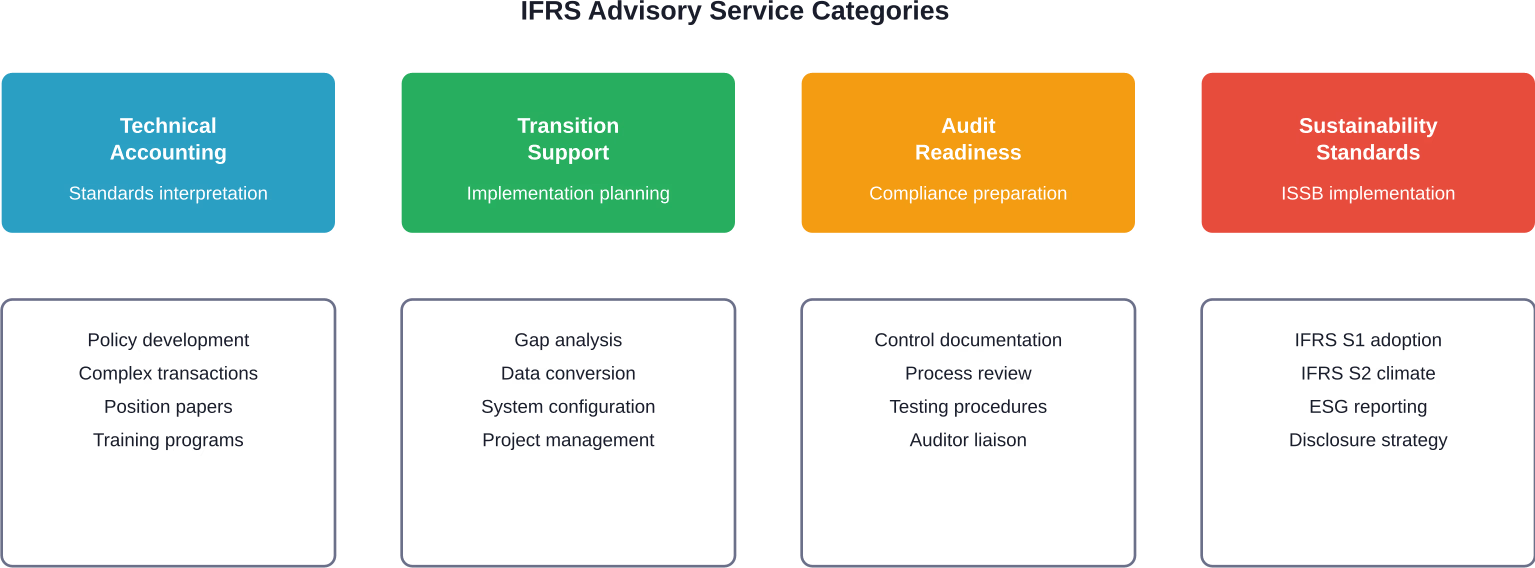
Technical accounting guidance forms the foundation. Specialists interpret complex standards, analyze specific transaction scenarios, and provide detailed implementation roadmaps. This becomes particularly critical with evolving standards—the recent introduction of IFRS 19 for subsidiaries without public accountability demonstrates how regulatory frameworks continuously adapt.
Transition support represents another crucial component. Organizations moving from national GAAP to IFRS face significant operational challenges. Advisors design conversion strategies, manage data migration, and ensure audit readiness throughout the process.
The Sustainability Reporting Evolution
The International Sustainability Standards Board has fundamentally expanded the IFRS landscape. Organizations now confront dual reporting requirements—traditional financial statements and sustainability disclosures.
IFRS S1 and IFRS S2 establish comprehensive frameworks for sustainability-related financial information. Advisory services now incorporate climate-related disclosures, ESG metrics, and integrated reporting strategies. According to the IFRS Foundation's Adoption Guide, jurisdictional implementation requires careful planning and stakeholder coordination.
This evolution creates complexity. Financial teams traditionally focused on accounting suddenly need expertise in environmental metrics, social impact assessment, and governance frameworks. Professional advisors bridge this knowledge gap.
Why Organizations Engage IFRS Advisors
Cross-border operations drive demand for advisory services. Companies operating in multiple jurisdictions face varying regulatory requirements. Over 160 jurisdictions apply IFRS, yet the SEC accepts IFRS financial statements from foreign private issuers without reconciliation to U.S. GAAP—but implementation details matter significantly.
| Challenge Area | Advisory Solution | Business Impact |
|---|---|---|
| Complex transactions | Technical accounting analysis | Accurate financial reporting |
| Standard updates | Implementation guidance | Timely compliance |
| Resource constraints | Specialized expertise | Cost-effective solutions |
| Audit concerns | Readiness preparation | Smooth audit process |
| Regulatory changes | Strategic planning | Proactive adaptation |
Resource optimization represents another key driver. Building internal IFRS expertise requires significant investment in training, systems, and personnel. Advisory services provide flexible access to specialists without permanent headcount expansion.
Selecting the Right Advisory Partner
Not all advisory services deliver equivalent value. Organizations should evaluate several critical factors when selecting partners.
Industry-specific experience matters tremendously. IFRS 17 for insurance contracts, for example, presents unique challenges requiring specialized knowledge. Generic accounting expertise doesn't translate effectively across all sectors.
Technical depth separates competent advisors from exceptional ones. Teams should demonstrate current knowledge of standards, practical implementation experience, and relationships with standard-setting bodies like the IFRS Foundation and IFAC.
Geographic reach becomes crucial for multinational organizations. Advisors must understand local regulatory requirements, jurisdictional variations, and cross-border reporting complexities.

Fix Your IFRS Reporting Before It Gets Flagged
IFRS reporting is often linked to international group structures, where multiple entities need to be audited and reported consistently. Acumon is a London-based, ICAEW-registered audit firm providing statutory audit, accounts and advisory services for UK companies, charities and international subsidiaries. The firm also holds audit licences in Jersey and the Isle of Man and supports group audit work across multiple jurisdictions.
Get Clear Support on International Reporting
Acumon supports organisations with:
- Statutory audit for UK entities and international subsidiaries
- Accounts preparation and financial reporting
- Work across group structures and multiple jurisdictions
- Advisory services alongside audit and compliance work
Contact Acumon to discuss your reporting and audit requirements.
The Strategic Value Proposition
Forward-thinking organizations view IFRS advisory services as strategic investments rather than compliance expenses. Quality financial reporting enhances capital market access, improves stakeholder confidence, and supports informed decision-making.
Professional advisors help organizations leverage reporting frameworks competitively. Clear, comparable financial information attracts investors. Robust sustainability disclosures appeal to ESG-focused stakeholders. Efficient processes reduce reporting cycle times.
The regulatory landscape continues evolving. The IFRS Foundation's 2025 Annual Report emphasizes ongoing standard development and jurisdictional adoption initiatives. Organizations working with experienced advisors adapt more effectively to these changes.
Moving Forward with Confidence
International financial reporting continues to grow more complex. Sustainability standards, evolving regulations, and stakeholder expectations create challenges that demand specialized expertise.
IFRS advisory services transform these challenges into opportunities. Professional guidance ensures compliance, optimizes processes, and positions organizations for success in global capital markets.
Organizations serious about financial reporting excellence should evaluate their current capabilities honestly. Where gaps exist, experienced advisors provide the knowledge and support necessary for confident navigation of the IFRS landscape.
Frequently Asked Questions
Services typically encompass technical accounting guidance, standard interpretation, implementation planning, audit readiness support, training programs, and sustainability reporting assistance. Scope varies based on organizational needs and complexity.
Organizations benefit from advisory support during initial IFRS adoption, major standard changes, complex transactions, pre-audit preparation, system implementations, and sustainability reporting initiatives. Early engagement prevents costly corrections.
Advisory services provide proactive guidance and implementation support, while audit services offer independent verification of financial statements. Many organizations engage separate firms for each function to maintain audit independence.
Look for professional accounting credentials, demonstrated IFRS expertise, industry-specific experience, current knowledge of standard updates, and practical implementation track records. Large projects often require multidisciplinary teams.
Absolutely. Professional advisors now provide comprehensive support for IFRS S1 and S2 implementation, including materiality assessments, disclosure development, data collection processes, and integrated reporting strategies.
Pricing varies significantly based on project scope, organizational complexity, geographic reach, and engagement duration. Check with service providers for current pricing structures tailored to specific requirements.
Organizations of all sizes benefit from expert guidance, though service scope differs. IFRS 19 specifically addresses subsidiaries without public accountability, demonstrating that standard-setters recognize diverse organizational needs requiring appropriate advisory support.