
Quick Summary: Choosing the right regulatory compliance services company in the UK requires evaluating industry expertise, regulatory track record, scalability, and technology capabilities. The best providers offer comprehensive support from initial authorisation through ongoing reporting, with deep knowledge of FCA, SRA, and sector-specific requirements. Look for firms with proven experience in your industry, transparent pricing, and robust data security standards.
Navigating the UK's regulatory landscape isn't getting any simpler. From FCA authorisations to ongoing compliance obligations, businesses face mounting pressure to stay aligned with evolving standards.
That's where regulatory compliance services companies come in. But here's the thing—not all providers are created equal. Some specialise in financial services, others in legal sectors, and many offer generic solutions that don't quite fit.
So how do you pick the right partner? This guide breaks down exactly what to evaluate when choosing a regulatory compliance services company in the UK.
Why Regulatory Compliance Expertise Matters
The regulatory framework in the UK is layered. Financial services firms need FCA approval, law firms must satisfy SRA requirements, and healthcare organisations face CQC scrutiny.
Working with a compliance provider that understands your specific sector isn't optional—it's essential. Generic compliance support might tick boxes, but specialised expertise prevents costly missteps.
According to FCA guidance, heads of compliance and money laundering reporting officers (MLROs) are important roles at financial services firms, with many firms required to have FCA-approved senior management function (SMF) holders. Getting this process right prevents operational delays and ensures regulatory alignment.
Industry-specific knowledge also matters for ongoing reporting. Financial services firms face quarterly regulatory reporting obligations, while law firms need continuous AML monitoring and file reviews.
Key Services to Expect from Compliance Providers
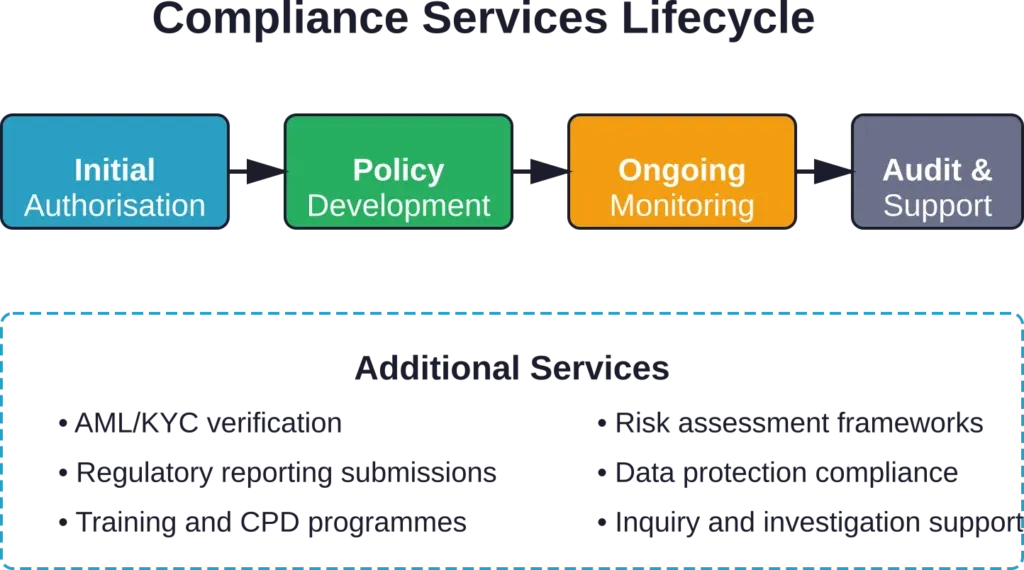
A comprehensive regulatory compliance services company should cover the full lifecycle—not just initial setup.
Initial Regulatory Applications and Authorisations
Getting authorised by the FCA or registered with other regulatory bodies is often the first hurdle. The process involves detailed applications, background checks on key individuals, and demonstrating robust compliance frameworks.
Based on FCA guidance (last updated 03/03/2026), firms seeking authorisation must demonstrate their compliance capabilities and understand the authorisation process. The right provider guides this process, prepares documentation, and liaises with regulators.
Ongoing Compliance Monitoring and Reporting
Compliance isn't a one-off task. Firms need continuous monitoring, quarterly or annual reporting submissions, and regular policy updates as regulations evolve.
Look for providers that offer automated risk rating, interactive dashboards, and alerts for upcoming deadlines. Digital compliance platforms can monitor data from surveys, inspections, and re-inspection programmes while automating much of the manual work.
AML and KYC Services
Anti-money laundering (AML) and Know Your Customer (KYC) requirements are particularly stringent in financial services and legal sectors. Compliance providers should offer client verification, transaction monitoring, and suspicious activity reporting support.
For cryptoasset firms, the FCA's rules are especially strict. According to FCA guidance from August 2024, ordinary retail consumers are limited to investing a maximum of 10% of their net assets in high-risk investments including cryptoassets. Compliance with these client categorisation rules requires robust systems.
Policy Development and Regulatory Examination Support
When regulators come knocking, having well-documented policies and procedures is critical. Compliance providers should help develop governance frameworks, conduct internal audits, and provide support during regulatory examinations or inquiries.
Questions to Ask When Evaluating Compliance Providers
Now, this is where it gets interesting. Asking the right questions separates capable providers from those that over-promise and under-deliver.
Do They Support Your Specific Regulatory Framework?
Not all compliance providers work across every sector. Financial services compliance differs vastly from healthcare or legal sector requirements.
Ask directly: What proportion of your clients operate in my industry? Can you demonstrate experience with my specific regulator (FCA, SRA, CQC, etc.)?
What Is Their Track Record with Regulatory Applications?
Firms that handle FCA authorisation applications regularly should have high success rates and established relationships with regulators.
Request case studies or references from similar businesses. How long do their applications typically take? What's their approval rate?
How Do They Handle Data Security and Compliance?
Compliance providers handle sensitive data—client information, transaction records, internal policies. Data security isn't negotiable.
According to information from digital compliance service providers, data-in-transit protection should use industry-standard encryption protocols such as TLS version 1.2 or above. Ask providers to demonstrate their security certifications and protocols.
Are Their Services Scalable?
Startups have different needs than established firms with hundreds of employees. The right provider grows with the business.
Can they support both initial setup and long-term compliance? Do they offer tiered pricing as the firm expands?
What Technology Platforms Do They Use?
Modern compliance relies on technology—automated alerts, digital dashboards, cloud-based document storage.
Modern compliance platforms may offer interactive dashboards, automated risk rating, and real-time compliance status tracking as part of their technology capabilities. Ask for a demo of their systems.
How Do They Communicate and Report?
Compliance isn't set-and-forget. Regular communication, proactive updates on regulatory changes, and clear reporting are essential.
What's their typical response time? How often do they provide status updates? Will there be a dedicated account manager?
Manage Regulatory Compliance Through Acumon
Choosing a regulatory compliance services company usually means looking for a firm that understands audit, reporting, governance, tax, and internal control requirements. Acumon is a UK firm of chartered accountants, auditors, and advisors that provides audit, tax, risk, advisory, payroll, company secretarial, and compliance-related services. This makes Acumon relevant for organisations that need compliance support connected to financial reporting, governance, statutory obligations, and internal controls.
Acumon can support:
- Statutory audit and assurance
- Accounts preparation and compliance
- Tax compliance and advisory
- Internal audit and governance support
- Risk and technology assurance
- Payroll and company secretarial services
👉Contact Acumon to discuss regulatory compliance support for your organisation.
Understanding Compliance Services Costs
Pricing varies widely based on services required, firm size, and regulatory complexity.
The Law Society's Risk and Compliance Accreditation involves application fees and membership charges; specific current fees should be verified directly with The Law Society.
Corporate compliance services typically involve monthly retainer fees or project-based pricing. Initial authorization applications often carry higher one-off costs, while ongoing monitoring operates on subscription models.
Real talk: cheap compliance support often leads to expensive problems down the line. Investing in quality expertise prevents regulatory fines and operational disruptions.
| Service Type | Typical Pricing Model | Cost Considerations |
|---|---|---|
| Initial FCA Authorisation | Fixed project fee | Complexity of business model, number of permissions required |
| Ongoing Compliance Monitoring | Monthly retainer | Firm size, reporting frequency, systems integration |
| AML/KYC Services | Per-client or monthly | Transaction volume, risk profile of clients |
| Regulatory Reporting | Per submission or annual | Number of reports, data complexity |
| Policy Development | Fixed project fee | Number of policies, customisation level |
Red Flags to Watch For
Some warning signs indicate a provider might not deliver.
Generic solutions marketed to all industries rarely work well. If the provider can't articulate specific experience in the sector, look elsewhere.
Vague pricing or hidden fees are another concern. Reputable firms provide transparent quotes with clear scope definitions.
And watch out for providers that promise unrealistically fast regulatory approvals. The FCA and other regulators work to their own timelines—no one can guarantee rapid turnarounds.
The Role of Professional Accreditation
For individuals working in compliance roles, professional accreditation adds credibility.
ICAEW offers support for firms accredited to provide probate and legal services, while The Law Society provides Risk and Compliance Accreditation for legal professionals.
According to compliance training providers such as Apex Learning, a score of 60% is required to pass CPD-accredited compliance certificates and earn the certification. These qualifications signal professional competence and commitment to ongoing development.
When evaluating corporate providers, check if their staff hold relevant professional qualifications and memberships.
Industry-Specific Considerations
Financial Services Firms
FCA-regulated businesses need providers with deep knowledge of FSMA requirements, regulatory reporting systems, and prudential standards.
The FCA's evolving expectations around compliance culture—emphasised in speeches by senior officials—mean firms must demonstrate proactive rather than tick-box compliance.
Law Firms
SRA compliance involves AML controls, client file reviews, accounts rules, and professional indemnity insurance requirements.
Providers specialising in legal sector compliance understand the nuances of solicitor obligations and can help firms avoid SRA investigations.
Cryptoasset Businesses
FCA oversight of cryptoasset promotions has tightened considerably. Compliance with back-end financial promotions rules requires careful consumer categorisation and investment limit controls.
Providers must understand the 10% net assets limit for ordinary retail consumers and the declaration requirements for self-certification.
Making the Final Decision
After evaluating multiple providers, narrow down to two or three finalists and request detailed proposals.
The proposal should outline specific deliverables, timelines, pricing breakdowns, and key personnel assigned to the account.
Schedule meetings with the teams that would actually handle the work—not just the sales staff. Chemistry matters. The compliance relationship is long-term, so working with people who communicate clearly and understand the business is vital.
Check references thoroughly. Speak to current clients about responsiveness, quality of work, and how the provider handles challenges.
And remember: the cheapest option rarely delivers the best value. Regulatory mistakes are expensive. Investing in competent, experienced compliance support protects the business and enables growth.
Frequently Asked Questions
Look for providers whose staff hold relevant professional qualifications such as FCA-approved person status, Law Society accreditations, ICAEW memberships, or recognised compliance certifications. Corporate accreditations and memberships in professional bodies indicate commitment to standards.
FCA authorisation timelines vary based on application complexity and the regulator's current workload. With a competent provider handling the application, the process typically takes between three to six months, though more complex cases can extend beyond that. No provider can guarantee specific timelines as the FCA controls the approval process.
Many UK compliance providers offer multi-jurisdiction support, particularly for financial services firms operating across Europe or globally. This requires a deep understanding of local regulatory frameworks alongside UK requirements. Always verify the provider's specific experience in relevant jurisdictions before engaging them.
Compliance consulting typically involves advisory services, policy development, and project-based work such as authorisation applications. Outsourced compliance means the provider acts as the firm's compliance function on an ongoing basis, handling day-to-day monitoring, reporting, and regulatory liaison. Many providers offer both models.
Regulatory requirements evolve constantly. Best practice involves formal policy reviews at least annually, with interim updates whenever significant regulatory changes occur. The right compliance provider monitors regulatory developments proactively and flags when policy updates are needed rather than waiting for annual cycles.
Even small regulated firms face the same fundamental regulatory obligations as larger ones. The complexity doesn't disappear with size—if anything, smaller firms lack the internal resources to manage compliance effectively. Professional compliance support helps small firms meet obligations without hiring full-time compliance staff, making it particularly cost-effective.
Reputable compliance providers carry professional indemnity insurance to cover errors and omissions. Before engaging a provider, verify their insurance coverage and understand liability terms in the contract. Clear documentation of scope, responsibilities, and deliverables protects both parties if issues arise.
Conclusion
Choosing a regulatory compliance services company in the UK isn't a decision to rush. The right provider becomes a strategic partner, protecting the business from regulatory risk while enabling growth.
Focus on industry-specific expertise, proven track records, robust technology, and transparent communication. Ask hard questions about security, scalability, and costs.
And remember—compliance done properly isn't a cost centre. It's an investment in operational stability and regulatory confidence.
Start evaluating potential providers today. Request proposals, check references, and find the partner that understands both the regulatory landscape and the specific business needs.