
Quick Summary: Choosing a governance and compliance services company in the UK requires evaluating expertise in relevant regulations (UK GDPR, FCA, Cyber Essentials), support models (24/7 availability, response times under 1 hour for critical issues), and pricing transparency (daily rates ranging £390–£2,106 according to NTT Data on the Digital Marketplace). Businesses should prioritize firms offering customized frameworks, risk assessment capabilities, and proven track records with compliance audits and certifications.
The UK regulatory environment doesn't stand still. Between FCA operational resilience requirements, UK GDPR obligations under the Data (Use and Access) Act, and mounting pressure from cyber threats—according to the UK government, 43% of UK businesses identified a cyber security breach or attack in the previous 12 months—companies need governance and compliance support that actually works.
But here's the thing: not all governance and compliance services companies operate the same way. Some focus on broad frameworks for listed corporations, others specialize in financial services or data protection, and a growing number build tech-enabled platforms for continuous monitoring.
This guide walks through what matters when choosing a provider—no rankings, no fluff. Just the practical factors that determine whether a compliance partnership delivers value or becomes another cost center.
Understanding What Governance and Compliance Services Actually Cover
Governance and compliance services span a wide territory. At the core, these companies help organizations establish frameworks for decision-making, risk management, and regulatory adherence. But the execution varies dramatically.
Some firms provide strategic advisory—building governance frameworks from scratch, defining risk appetites, and establishing board-level reporting structures. Others deliver operational support: conducting audits, managing policy documentation, or serving as interim compliance officers.
Technology-focused providers offer platforms that automate evidence collection, track control effectiveness, and generate audit reports. These tools increasingly integrate with existing systems to capture compliance data in real time rather than relying on manual spreadsheets.
The Financial Conduct Authority's review of technology change management found that over 90% of surveyed FS firms rely on legacy technology in some form to deliver their services. That legacy creates compliance complexity—more touchpoints to audit, more controls to validate, more documentation to maintain.
Real talk: the right service model depends on where your organization sits. Early-stage companies often need foundational framework design. Mature businesses with established governance might require specialized support for specific regulations or technology-enabled continuous monitoring.
Key Regulatory Domains UK Companies Navigate
Different industries face different regulatory pressures. Financial services firms must comply with FCA rules on operational resilience, algorithmic trading controls (under MiFID RTS 6), and conduct standards. The FCA reviewed a sample of principal trading firms to assess their compliance with these technical standards and identified significant weaknesses in algorithmic control frameworks.
Data protection obligations apply across sectors. The Information Commissioner's Office guidance on accountability and governance—updated in February 2026 following the Data (Use and Access) Act—establishes clear requirements for data protection impact assessments, records of processing activities, and security measures.
Organizations processing sensitive personal data at scale must appoint data protection officers. The ICO specifies that DPOs assist in monitoring internal compliance, inform and advise on data protection obligations, and provide guidance on data protection impact assessments.
Cyber security frameworks like Cyber Essentials and ISO 27001 certification create additional compliance layers. ISO 27001 readiness for a 50-person startup typically costs $10K–$39K according to data from OneTrust, with ongoing certification maintenance adding further expense.
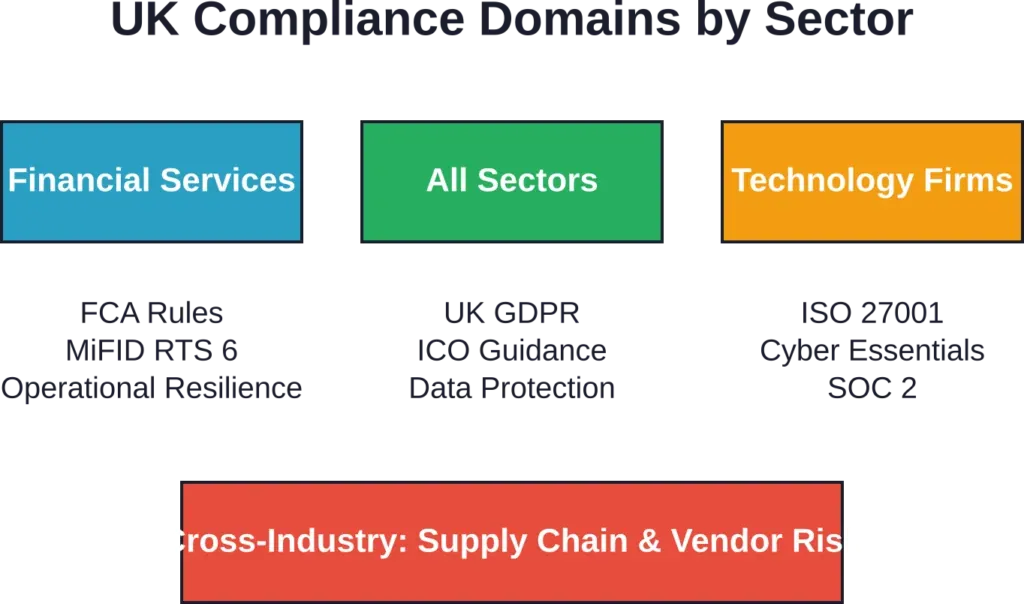
Supply chain and vendor management create additional governance obligations. Industry guidance from ISACA emphasizes that vendor management is fundamentally critical—it impacts operational success, efficiency, reputation, and risk exposure. Organizations remain accountable for vendor-related risks even when work is delegated.
Service Delivery Models and Support Structures
How a governance and compliance company delivers its services matters as much as what it delivers. Three primary models dominate the UK market.
Advisory and Consultancy
Traditional consulting firms provide subject matter experts who assess current state, design frameworks, and guide implementation. These engagements typically operate on day-rate pricing models. NTT Data's GRC services on the Digital Marketplace range from £390 to £2,106 per unit per day depending on seniority and specialization.
Consulting works well for organizations facing complex transformations—mergers requiring governance integration, new regulatory mandates needing interpretation, or board-level strategic planning. The limitation? Consultants eventually leave, and maintaining frameworks requires ongoing internal capability.
Managed Services
Managed service providers operate ongoing compliance functions on behalf of clients. This might include continuous control monitoring, policy updates as regulations change, audit coordination, or serving as outsourced compliance officers.
Managed services typically involve fixed monthly fees or retainer arrangements. Support levels vary significantly—Cognizant offers 24/7 phone and web chat support with 1-hour response times for P1 incidents. Credera commits to 30-minute response times for P1 and P2 issues with 24/7 phone availability.
Goaco achieves above 99.99% availability across its managed services and offers three tiers: break-fix support where customers contact as needed, proactive monitoring with regular check-ins, or fully managed services with embedded team members.
Technology Platforms
Compliance platforms replace spreadsheets and disconnected tools with structured systems for evidence collection, control testing, policy management, and audit preparation. These tools increasingly automate evidence gathering from existing systems rather than requiring manual uploads.
Platform approaches work particularly well for companies managing multiple frameworks simultaneously—ISO 27001, SOC 2, Cyber Essentials, and UK GDPR often share overlapping controls. Purpose-built compliance software maps these relationships and eliminates duplicate work.
That said: platforms require configuration, control design, and ongoing maintenance. They don't replace compliance expertise—they make existing expertise more efficient.
Critical Evaluation Criteria
Sound familiar? A provider promises comprehensive coverage, but when implementation starts, gaps emerge between what was sold and what gets delivered. Preventing that requires evaluating specific capabilities upfront.
Regulatory Expertise and Track Record
Does the provider demonstrate deep knowledge of the specific regulations your business faces? Generic governance frameworks don't address sector-specific requirements—FCA operational resilience rules differ materially from general corporate governance codes.
Ask for case studies or references from similar organizations. If you're a financial services firm, providers with retail or manufacturing case studies might lack relevant expertise. The regulatory nuances matter.
Check for relevant certifications. Cognizant's Governance Risk and Compliance Services and Credera's Cloud Governance offerings both appear on the UK Government's Digital Marketplace—a signal of vetted capability for public sector work, though not a guarantee of private sector fit.
Technology Integration Capabilities
Can the provider integrate with your existing technology stack? Compliance increasingly depends on automated evidence collection from cloud platforms, HR systems, access control tools, and development pipelines.
Credera's cloud governance service uses frameworks like STAR from Cloud Security Alliance and conducts regular audits with detailed reporting. Their approach emphasizes developing and implementing cloud control frameworks rather than bolting on generic templates.
Legacy technology creates specific challenges. The FCA found that over 90% of surveyed FS firms rely on legacy technology in some form to deliver their services. Effective compliance providers understand how to assess and document controls in heterogeneous technology environments.
| Integration Type | Purpose | Typical Data Sources |
|---|---|---|
| Identity and Access | Control validation | Active Directory, Okta, Azure AD |
| Cloud Infrastructure | Configuration monitoring | AWS, Azure, GCP audit logs |
| Development Tools | Change management evidence | GitHub, GitLab, Jira |
| Security Tools | Vulnerability and incident tracking | EDR platforms, SIEM systems |
Customization vs. Standardization
Some providers offer highly customized frameworks tailored to organizational needs. NTT Data emphasizes customized GRC frameworks aligned with organizational objectives. Others deliver standardized methodologies with limited flexibility.
Neither approach is inherently better. Standardized frameworks deploy faster and cost less but might not address unique business models or risk profiles. Customized approaches fit better but require longer implementation and higher investment.
The right balance depends on organizational maturity and complexity. Early-stage companies often benefit from proven standard frameworks. Large enterprises with complex group structures, multiple jurisdictions, or unusual risk profiles need customization.
Support and Response Times
What happens when urgent compliance issues arise? Regulatory inquiries, audit findings requiring immediate remediation, or security incidents with compliance implications demand rapid response.
Look at contractual service level agreements. Credera commits to 30-minute response times for P1 and P2 incidents. Cognizant offers 1-hour response for P1 issues and 8-hour response for P4 matters, with 24/7 availability.
But wait—response time commitments mean nothing without context. What qualifies as P1 vs. P2? Who determines priority? Can customers escalate? These details matter during actual incidents.
Strengthen Governance and Compliance With Acumon
A good governance and compliance services company should understand how reporting duties, internal controls, audit requirements, and statutory obligations connect inside an organisation. Acumon supports UK companies, charities, regulated entities, and international groups with audit, assurance, risk, company secretarial, and compliance-related work. This makes Acumon a useful fit for organisations that need structure around governance, not just one-off admin.
Areas Acumon can help with:
- Corporate governance reviews
- Internal audit and risk assurance
- Company secretarial services
- Statutory filings and compliance support
- Audit and assurance services
- Regulatory and financial reporting support
Reach out to Acumon to discuss governance, audit, and compliance support for your organisation.
Pricing Models and Hidden Costs
Governance and compliance services pricing varies dramatically based on scope, delivery model, and provider positioning. Understanding total cost of ownership requires looking beyond headline rates.
Day Rate Consulting
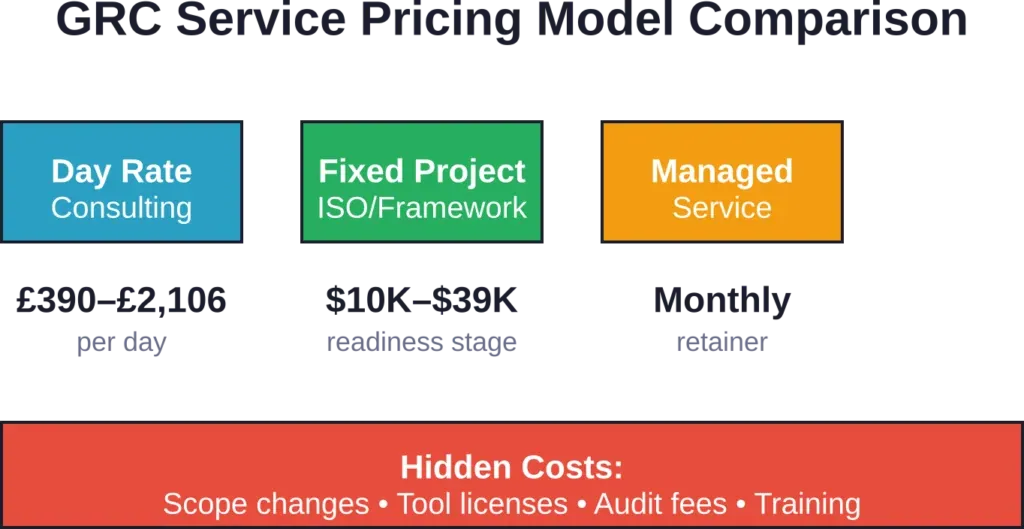
Traditional consulting operates on daily or hourly rates. According to the Digital Marketplace data, GRC services from established firms range from £390 to £2,106 per day depending on consultant seniority.
Day rate models provide flexibility but can escalate quickly. A three-month framework design engagement with two consultants at £1,200 per day reaches £144,000 before expenses. Scope creep compounds costs.
Fixed Project Fees
Some providers quote fixed fees for defined deliverables—implementing ISO 27001, conducting a GDPR gap assessment, or building a risk register. Fixed pricing creates budget certainty but requires clear scope definition upfront.
The challenge? Compliance projects rarely follow linear paths. Regulatory interpretation questions arise, control testing reveals gaps requiring additional work, or organizational changes shift requirements mid-project. Fixed fees need robust change control processes.
Subscription and Retainer Models
Managed services and platform providers typically charge monthly or annual subscriptions. These models spread costs predictably but require longer commitments.
Watch for usage-based pricing tiers—some platforms charge per user, per framework, or per integrated system. A platform priced reasonably for managing one certification can become expensive when scaling to multiple standards.
Hidden Costs to Account For
Beyond base fees, budget for tool licenses (GRC platforms, security scanning tools), third-party audit costs, internal staff time for coordination, and training. Effective governance requires significant ongoing investment in change management and related activities.
Vendor Due Diligence Questions
Before committing to a governance and compliance provider, conduct thorough due diligence. ISACA guidance on vendor management emphasizes that organizations remain accountable for vendor-related risks regardless of contractual terms.
Ask these questions during evaluation:
- What specific regulations and standards does the provider specialize in? Request client references in similar sectors.
- How does the provider stay current with regulatory changes? UK regulations evolve constantly—the Data (Use and Access) Act came into law on 19 June 2025, requiring ICO guidance updates.
- What happens if key personnel leave mid-engagement? Continuity planning matters for long-term compliance programs.
- How does the provider measure success? Look for outcome-based metrics beyond activity tracking.
- What security and data protection measures protect your compliance data? Providers handle sensitive information about control weaknesses and risks.
- Can the provider demonstrate their own compliance? Providers should practice what they preach—check for ISO certifications, SOC 2 reports, and Cyber Essentials.
Building vs. Buying Compliance Capability
Organizations face a fundamental choice: build internal compliance capability or rely on external providers. Most adopt a hybrid approach—core strategic governance remains in-house while specialized or tactical compliance work gets outsourced.
Internal teams offer institutional knowledge and cultural alignment but require ongoing investment in training and tools. External providers bring specialized expertise and cross-industry perspective but might lack deep understanding of specific business contexts.
The right split depends on organizational scale and compliance complexity. Small companies often lack resources for dedicated compliance staff and benefit from external support. Large enterprises with substantial regulatory exposure typically maintain internal governance functions supplemented by external specialists for particular domains.
Red Flags to Watch For
Certain warning signs suggest a provider might not deliver expected value. Generic proposals that don't reference specific regulations or industry context often indicate copy-paste approaches rather than tailored solutions.
Providers promising quick certification without assessing current state should raise concerns. Legitimate compliance work requires gap analysis, control design, implementation time, and evidence collection before audits.
Lack of transparency around methodology or reluctance to explain frameworks suggests potential issues. Effective compliance providers clearly articulate their approaches and educate clients rather than mystifying the process.
Look: if a provider can't clearly explain how they'll address your specific regulatory requirements, keep looking. Compliance isn't one-size-fits-all.
Making the Final Decision
Choosing a governance and compliance services company ultimately requires balancing multiple factors: regulatory expertise, service delivery model, pricing structure, support quality, and cultural fit. Here is what to do:
- Start by defining clear requirements: What regulations must you comply with? What governance maturity level does your organization currently operate at? What specific outcomes do you need—framework design, audit readiness, continuous monitoring, or all three?
- Request detailed proposals from multiple providers: Compare not just pricing but scope definition, deliverables, timelines, and success metrics. The lowest cost proposal often becomes the most expensive if scope gaps emerge later.
- Conduct pilot projects when possible: A limited-scope engagement—perhaps a gap assessment or control testing for one framework—provides insight into working style, communication quality, and deliverable standards before committing to larger contracts.
- Check references thoroughly: Speak with current and former clients about responsiveness, quality, flexibility when requirements change, and ultimate business impact. References chosen by providers will be positive, so probe for specific examples and challenges encountered.
Frequently Asked Questions
Governance services focus on decision-making frameworks, risk oversight, and organizational structures—how boards and management establish direction and accountability. Compliance services address specific regulatory requirements and standards—ensuring the organization meets mandatory obligations. Most providers offer both since effective governance supports sustainable compliance.
Costs vary significantly by scope and delivery model. According to Digital Marketplace data, day-rate GRC consulting ranges from £390 to £2,106 per day. Fixed project fees for ISO 27001 readiness typically run $10K–$39K for small organizations. Managed services operate on monthly retainers that depend on organization size and complexity. Always request detailed proposals covering full scope to compare accurately.
Yes, though requirements differ from large enterprises. Small businesses still face UK GDPR obligations, cyber security threats, and increasingly customer due diligence requirements. Many small firms benefit from fractional compliance support—periodic advisory rather than full-time staff or expensive managed services. The ICO provides specific guidance for small businesses through their small business web hub.
Leading providers offer 24/7 support with 30-minute to 1-hour response times for critical (P1) incidents. Cognizant commits to 1-hour P1 response with 24/7 phone and web chat availability. Credera offers 30-minute responses for P1 and P2 issues. Less urgent matters typically receive responses within 1-8 hours. Ensure SLAs clearly define priority levels and response commitments in contracts.
Depends on organizational needs. Generalist providers work well for companies managing common frameworks (ISO 27001, UK GDPR, Cyber Essentials) without sector-specific requirements. Specialist providers better serve regulated industries—financial services firms benefit from FCA-focused specialists, healthcare organizations need NHS and care quality commission expertise. If facing unusual compliance combinations or emerging regulations, specialists offer deeper knowledge.
Timelines vary by framework complexity and organizational readiness. ISO 27001 readiness phases typically run several months, with additional time for audit and certification. Comprehensive GRC framework design for larger organizations can take 6-12 months including gap assessment, control design, implementation, testing, and documentation. Technology-enabled implementations often move faster than manual processes.
Not entirely. Platforms automate evidence collection, control testing, and reporting—making existing compliance work more efficient. However, platforms still require initial configuration, control framework design, policy development, and ongoing interpretation of regulatory changes. Most organizations benefit from combining platform technology with consulting expertise for framework design and periodic reviews, then using platforms for day-to-day execution.
Conclusion
Selecting the right governance and compliance services company comes down to matching provider capabilities with organizational needs. The UK regulatory landscape—spanning UK GDPR, sector-specific requirements like FCA rules, and cyber security standards—demands expertise that generic offerings can't deliver.
Evaluate providers on regulatory depth, not breadth of marketing claims. Scrutinize support models and response commitments. Understand total costs including hidden fees. Conduct thorough due diligence including reference checks and pilot engagements where feasible.
Remember: compliance isn't a one-time project. Choose providers positioned to support evolving requirements as regulations change, organizational complexity grows, and technology stacks modernize. The firms achieving 99.99% availability and 30-minute incident response times demonstrate operational maturity that matters when urgent issues arise.
Start by defining specific requirements, request detailed proposals from multiple providers, and make decisions based on demonstrated capability rather than promises. Effective governance and compliance partnerships deliver measurable risk reduction and operational confidence—not just documentation that sits unused.
Ready to evaluate governance and compliance providers? Begin with a clear assessment of your current compliance maturity, identify regulatory gaps, and prioritize requirements before starting vendor discussions.