
Quick Summary: Selecting the right forensic accounting services company in the UK requires verifying professional credentials (ICAEW membership, CFF or CFE certification), assessing industry-specific experience in your case type, evaluating litigation support capabilities, and confirming transparent pricing models. The ideal firm combines technical expertise with strong investigative skills and a proven track record in fraud detection, dispute resolution, or asset tracing relevant to your needs.
Financial discrepancies don't announce themselves with alarm bells. Sometimes it's a ledger entry that doesn't quite add up. Other times, it's assets that vanish during a commercial dispute.
When facing suspected fraud, shareholder disagreements, or complex litigation, forensic accounting services become essential. But with dozens of firms offering similar-sounding expertise across the UK, how do businesses actually choose the right partner?
The stakes are high. Poor financial investigation can cost organizations millions—and years of litigation.
Here's what matters when selecting a forensic accounting firm that will strengthen your case rather than drain your resources.
Verify Professional Credentials and Certifications
Not all accountants possess forensic training. The distinction matters.
Start with baseline qualifications. Look for firms whose practitioners hold ACA (Associate Chartered Accountant) or ACCA (Association of Chartered Certified Accountants) qualifications as the foundation. These credentials confirm general UK accounting and auditing competence.
But forensic work demands specialized credentials. The CFF (Certified in Financial Forensics) designation, issued by AICPA, requires candidates to pass a rigorous examination and demonstrate a minimum of 1,000 hours of business experience in forensic accounting within five years. Similarly, the CFE (Certified Fraud Examiner) credential from ACFE focuses specifically on fraud examination and prevention.
In the UK context, ICAEW membership carries significant weight. According to ICAEW guidance, forensic accountants assist clients with preventing financial losses, recovering stolen assets, and providing expert witness testimony in legal proceedings. ICAEW's Forensic Accountant Accreditation scheme closed in 2016, though the register remains available. The organisation maintains a partnership with The Academy of Experts' Register of Accredited Accountant Expert Witnesses—a rigorous vetting process spanning nearly 25 years of standard-setting.
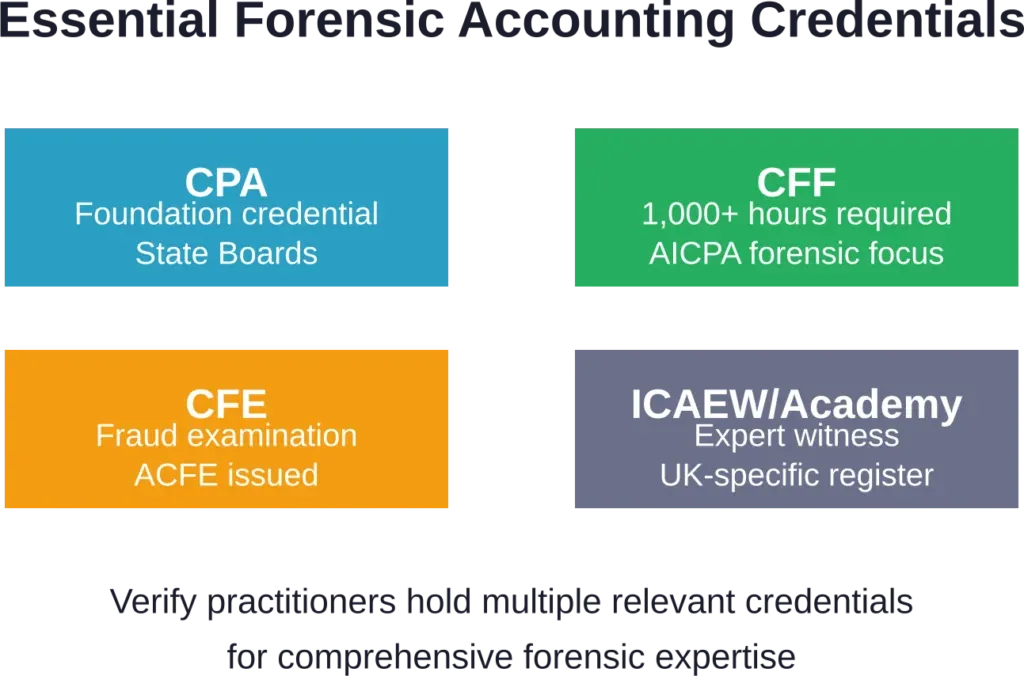
Ask potential firms directly: Which team members hold CFF or CFE credentials? How many practitioners are ICAEW members? These questions separate genuine forensic specialists from general accountants offering investigative services as a side offering.
Assess Industry-Specific Experience
Forensic accounting isn't monolithic. The skills required for healthcare fraud differ dramatically from those needed for commercial dispute resolution or asset tracing in divorce proceedings.
According to industry analysis, forensic accountants work across diverse case types—financial fraud, business valuations, shareholder disputes, intellectual property damage calculations, and regulatory investigations. Each demands different technical knowledge and investigative approaches.
When evaluating firms, request case studies matching your specific situation. Commercial disputes between trading partners require understanding of supply chain finance and revenue recognition. Fraud investigations in digital businesses demand cryptocurrency tracing capabilities and cybersecurity forensics expertise.
Real talk: a firm with 20 years of experience in insurance fraud won't necessarily excel at uncovering financial misstatements in manufacturing operations. Depth in your industry sector matters more than breadth across unrelated fields.
Evaluate Litigation Support Capabilities
Many forensic accounting engagements eventually reach courtrooms or arbitration proceedings. The transition from investigation to expert witness testimony requires distinct skills.
According to ICAEW guidance, forensic accountants frequently serve as expert witnesses, providing testimony that can determine case outcomes. This role demands not just technical accuracy but communication skills—the ability to explain complex financial concepts to judges, juries, and attorneys without financial backgrounds.
Ask prospective firms about their litigation support track record. How many times have their practitioners testified as expert witnesses? In which courts? What was the case win rate when their evidence was presented?
But wait—there's another dimension. Investigate whether the firm maintains connections with legal counsel experienced in your case type. Forensic accountants work alongside solicitors and barristers throughout investigations. Firms with established legal networks can facilitate smoother collaboration and avoid common procedural mistakes that undermine evidence admissibility.
Compare Service Scope and Pricing Models
Forensic accounting services span a wide spectrum. Some firms offer comprehensive packages; others specialize narrowly.
| Service Type | What It Includes | When You Need It |
|---|---|---|
| Fraud Investigation | Detection, evidence gathering, loss quantification | Suspected embezzlement, financial statement fraud |
| Litigation Support | Expert witness testimony, damage calculations, case strategy | Commercial disputes, shareholder conflicts |
| Asset Tracing | Locating hidden assets, recovery assistance | Divorce proceedings, debt collection, fraud recovery |
| Business Valuation | Company worth assessment for disputes | Partnership dissolutions, acquisition disputes |
| Regulatory Compliance | FCA investigation support, remediation | Financial services regulatory matters |
Pricing structures vary significantly. Some firms charge hourly rates; others offer fixed-fee arrangements for defined scopes. To avoid unexpected costs, request detailed fee estimates upfront and clarify what triggers additional charges.
Check References and Case Outcomes
Past performance doesn't guarantee future results, but patterns emerge across multiple engagements.
Request client references from matters similar to yours. Speak directly with those references—don't rely solely on written testimonials. Ask specific questions: Did the firm deliver on promised timelines? Were final costs aligned with initial estimates? How effectively did practitioners communicate complex findings?
Look for red flags in reference conversations. Evasive answers about outcomes, complaints about communication lapses, or concerns about billing transparency should prompt reconsideration.
Also examine the firm's regulatory standing. Check for disciplinary actions or complaints filed with professional bodies. The FCA and ICAEW maintain public records of sanctions against members—these databases provide crucial due diligence information.
Investigate Financial Issues With Acumon
Choosing a forensic accounting services company is about finding a firm that can follow the numbers clearly and prepare findings that may be used in disputes, investigations, legal proceedings, or regulatory matters. Acumon provides forensic audit and forensic accounting services focused on financial discrepancies, fraud, financial misconduct, asset tracing, and evidence-led reporting.
This can be useful when a business, investor, employer, or party in a dispute needs a structured review of what happened to funds or assets. Acumon’s forensic work can help trace the flow of funds or assets, review accounting records, identify control weaknesses, and build a clearer picture of how financial issues occurred.
Acumon can assist with:
- Fraud and financial misconduct investigations
- Asset tracing and recovery support
- Review of financial discrepancies
- Forensic audit work
- Evidence preparation for legal or regulatory matters
- Financial investigation reporting
- Review of business controls and processes
👉Contact Acumon to discuss forensic audit and forensic accounting support.
Final Questions to Ask Before Hiring
Here's the thing though—credentials and experience mean little if the engagement structure doesn't fit your needs. Before finalizing any agreement, ask these questions:
- Which specific practitioners will work on my case, and what are their qualifications?
- How many cases matching my situation have you handled in the past three years?
- What is your success rate in achieving client objectives for similar matters?
- How do you communicate progress updates, and at what frequency?
- What technology and investigative tools do you employ?
- Do you maintain professional indemnity insurance, and at what coverage levels?
Firms that hesitate to answer these questions directly probably lack the experience or transparency needed for complex forensic engagements.

Frequently Asked Questions
Regular accountants focus on financial reporting, tax compliance, and statutory audits. Forensic accountants specialize in investigating financial discrepancies, uncovering fraud, tracing assets, and providing litigation support. According to ICAEW guidance, forensic accountants require specialized training in investigative techniques, evidence gathering, and expert witness testimony—skills not typically covered in general accounting practice.
Pricing varies significantly based on case complexity, firm reputation, and practitioner experience. Hourly rates typically fall within a range from moderate to premium depending on seniority levels, with fixed-fee arrangements also available for defined scopes. Request detailed estimates upfront and clarify what triggers additional charges to avoid unexpected costs during engagements.
That depends on the financial complexity and stakes involved. For straightforward matters with clear documentation, standard accounting review might suffice. But when disputes involve suspected fraud, hidden assets, complex financial structures, or litigation, forensic expertise becomes essential. The cost of forensic services often proves minimal compared to potential losses from inadequate investigation.
Timelines vary dramatically based on case complexity, available documentation, and cooperation from involved parties. Simple fraud investigations might conclude in 4-8 weeks. Complex commercial disputes involving multiple entities, international transactions, or extensive document review can extend 6-12 months or longer. Discuss realistic timelines with prospective firms based on your specific circumstances.
No reputable forensic accountant guarantees specific investigation outcomes. Professional standards prohibit such promises because findings depend on available evidence, document preservation, and investigation circumstances. Quality forensic accountants provide honest assessments of likelihood based on initial case review—but outcomes remain uncertain until investigation concludes.
Start with ACA certification as the baseline, then look for specialized credentials including CFF (Certified in Financial Forensics) or CFE (Certified Fraud Examiner). In the UK, ICAEW membership and registration with The Academy of Experts' Accredited Accountant Expert Witnesses scheme signal serious forensic capabilities. Multiple relevant credentials typically indicate deeper expertise than single certifications.
That depends on whether your matter proceeds to trial or settles beforehand. Many forensic accounting engagements never reach courtroom testimony—the investigation findings often facilitate settlement negotiations. However, select a firm with proven expert witness experience regardless, because testimony capability strengthens negotiating position even if actual testimony never occurs. According to ICAEW, expert witness work constitutes a significant portion of forensic accounting practice.
Protect Your Financial Position
Choosing forensic accounting services resembles selecting a surgeon—credentials, experience, and specialization determine outcomes when stakes are high.
The right forensic accounting partner brings more than number-crunching skills. They provide investigative expertise, litigation support, and the credibility that influences judges, arbitrators, and opposing counsel. Demand for specialized forensic services continues rising as financial crimes grow more sophisticated.
Start with verified credentials. Prioritize industry-specific experience. Evaluate litigation capabilities. Compare transparent pricing models. Check references thoroughly. And ask tough questions before signing engagement letters.
Financial discrepancies won't resolve themselves. The investigation quality you commission today shapes outcomes you'll live with for years. Choose forensic accounting services that match the complexity of your case—and the importance of getting answers right.