
Quick Summary: Choosing the right estate tax planning services company in the UK requires checking for specialist qualifications (STEP, ACTAPS), understanding fee structures, and confirming cross-border expertise if you hold international assets. With pension assets now facing Inheritance Tax from April 2027—potentially adding £34,000 to the average estate's IHT bill—professional guidance helps families navigate complex thresholds, trusts, and tax-efficient gifting strategies to preserve more wealth for beneficiaries.
Estate tax planning in the UK has become increasingly complex—and increasingly urgent. Recent legislative changes mean pension funds will become subject to Inheritance Tax (IHT) from April 2027. According to government estimates, approximately 38,500 estates will pay more Inheritance Tax than previously, with the average liability increasing by around £34,000 when pension assets are included.
That's a significant chunk of wealth families stand to lose without proper planning. But here's the challenge: estate planning sits at the intersection of tax law, trusts, property ownership, pensions, and sometimes international regulations. Getting it wrong can cost your beneficiaries hundreds of thousands of pounds.
Choosing the right estate tax planning services company isn't just about finding someone who can draft a will. It's about finding advisors who understand the full picture of your financial life and can design strategies that preserve your legacy while staying compliant with HM Revenue & Customs regulations.
This guide walks through exactly what to look for, which questions to ask, and how to assess whether a firm has the expertise your estate needs.
What Estate Tax Planning Actually Covers in the UK
Before evaluating service providers, it helps to understand what comprehensive estate planning involves. Many families assume estate planning means writing a will and calling it done. That's part of it—but only a small part.
Estate planning in the UK addresses how assets transfer when you die, how much tax those transfers trigger, and how to structure ownership during your lifetime to reduce that tax burden. Your estate includes cash, investments, property, savings, pensions, and life insurance policies.
The primary tax concern is Inheritance Tax, charged at 40% on the value of your taxable assets exceeding the £325,000 nil-rate band. If you leave at least 10% of your estate's net value to charity, that rate drops to 36%. Meanwhile, the residence nil-rate band can add up to £175,000 in additional relief when transferring your home to direct descendants—including foster, adopted, and stepchildren.
But tax planning goes beyond basic thresholds. Trusts, gifting strategies, business property relief, and asset restructuring all play roles. International estates add layers of complexity, especially for expats or individuals with overseas property.
A capable estate planning firm designs strategies across all these dimensions, not just one or two.
Why Professional Guidance Matters More Than Ever
The inclusion of pension assets in IHT calculations represents one of the most significant changes to estate taxation in decades. Government data shows an estimated 213,000 estates annually hold inherited pension wealth. Of those, a portion of estates will become newly liable for Inheritance Tax where previously they faced none.
Personal representatives (PRs) of the estate will be liable for reporting and paying Inheritance Tax on any unused pension funds and death benefits from 6 April 2027. Families unprepared for this shift could face liquidity crises, forced asset sales, or disputes among beneficiaries.
Here's the thing though—the detailed Inheritance Tax returns (IHT400 forms) are complex documents requiring expertise to complete accurately. The forms involve sophisticated valuations and calculations, and mistakes trigger penalties or investigations.
According to the FCA's Financial Lives 2024 survey, just 9% of adults received financial advice about their pensions or investments in the previous 12 months. That gap leaves millions of families exposed to unnecessary tax liabilities. The right advisor closes that gap.
Key Qualifications and Accreditations to Look For
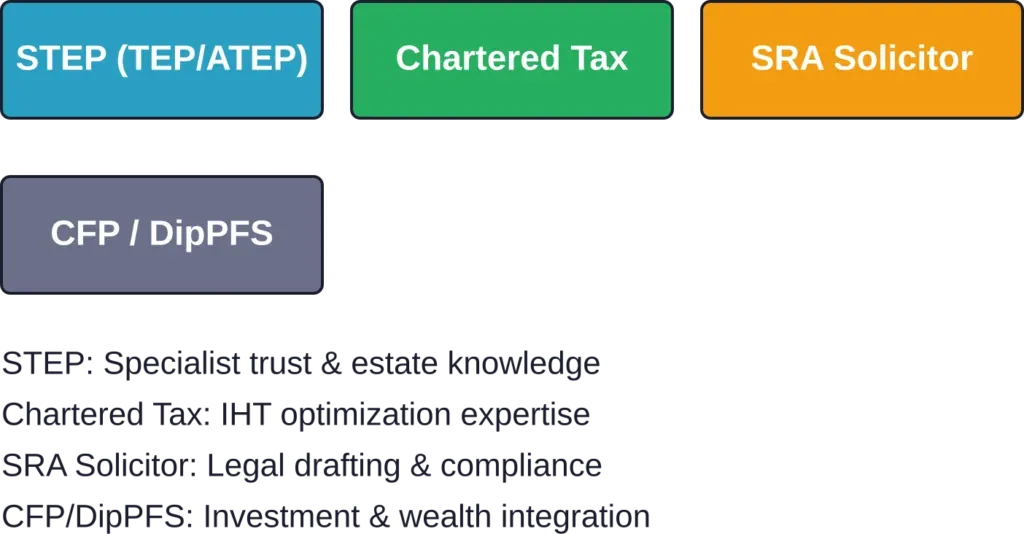
Not all estate planners hold the same credentials. Some come from legal backgrounds, others from accounting or financial planning. The best firms bring multi-disciplinary teams together, but certain qualifications signal serious expertise.
STEP (Society of Trust and Estate Practitioners)
STEP represents the gold standard for estate planning professionals. Members must pass rigorous exams covering trusts, estates, succession planning, and tax law across multiple jurisdictions. A STEP qualification (TEP or ATEP designation) indicates someone specializes in this field, not just dabbles in it alongside other services.
When evaluating firms, ask how many STEP-qualified professionals they employ and whether your case would be handled directly by one.
Chartered Tax Advisers (CIOT, ATT)
The Chartered Institute of Taxation (CIOT) and Association of Taxation Technicians (ATT) credentials demonstrate deep tax knowledge. Estate planning intersects with income tax, capital gains tax, and inheritance tax—so tax expertise matters.
Firms with Chartered Tax Advisers can model tax scenarios, quantify relief opportunities, and structure transactions to optimize outcomes.
Solicitors and Legal Expertise
Trusts, wills, and lasting powers of attorney require legal drafting. The Solicitors Regulation Authority (SRA) regulates solicitors in England and Wales, and firms must meet professional standards for estate administration work.
Check whether the firm employs qualified solicitors or partners with law firms. Some estate planners offer financial advice but refer legal work elsewhere—that's fine, as long as the hand-off is seamless.
Financial Planning Credentials (CFP, DipPFS)
If your estate includes substantial investments or pension assets, Certified Financial Planner (CFP) or Diploma in Financial Planning (DipPFS) qualifications indicate the advisor can integrate estate planning with broader wealth management.
Look for firms authorized and regulated by the Financial Conduct Authority (FCA) if investment advice is part of the service.
Plan Estate Tax Matters With Acumon
Choosing an estate tax planning services company often comes down to clarity. Acumon provides estate and probate support, including estate planning, probate administration, tax planning, and estate-related compliance support. Their work can be useful for families, executors, and business owners who want estate tax matters handled carefully and without unnecessary confusion.
Acumon can assist with:
- Estate planning support
- Probate and estate administration
- Estate accounts preparation
- HMRC estate reporting support
- Tax planning related to estates
- Estate-related compliance support
Contact Acumon to discuss estate planning and probate support.
Understanding Fee Structures and Pricing Models
Estate planning fees vary widely—from a few hundred pounds for basic will writing to tens of thousands for complex multi-jurisdictional estates. Understanding how firms charge helps avoid surprises.
Hourly Rates vs. Fixed Fees
Some firms charge by the hour, with rates ranging from £150 to £500+ depending on seniority and location. Hourly billing works if the scope is unpredictable, but it introduces uncertainty about total cost.
Fixed-fee packages offer clarity. Many firms quote set prices for defined services: will preparation, trust setup, IHT calculations, or full estate plans. Ask for a detailed breakdown of what's included.
Percentage of Estate Value
A few firms charge a percentage of estate value—typically 0.5% to 2%. This model aligns advisor incentives with estate growth, but it can become expensive for high-net-worth families. Run the numbers before committing.
Ongoing Advisory Retainers
Estate planning isn't a one-time transaction. Tax laws change, family circumstances evolve, and asset values fluctuate. Some firms offer annual retainers for ongoing reviews and updates, typically £1,000 to £5,000 per year.
Retainers make sense for complex estates or families with active wealth management needs. For simpler estates, periodic reviews every three to five years may suffice.
Red Flags in Pricing
Be wary of firms that bundle estate planning with product sales—like pushing life insurance policies or investment products that earn them commissions. Independent advisors paid directly by clients avoid conflicts of interest.
Also watch for vague quotes. A professional firm provides written fee agreements before work begins, detailing services, timelines, and costs.
Assessing Cross-Border and International Expertise
If you hold assets outside the UK, own property abroad, or have beneficiaries in other countries, cross-border estate planning becomes critical. Tax treaties, foreign inheritance laws, and international trusts introduce layers of complexity.
Ask potential advisors about their experience with your specific jurisdictions. Do they work with overseas tax advisors? Can they coordinate filings across multiple countries? Have they handled estates involving double taxation issues?
International estate planning often requires partnerships between UK advisors and foreign specialists. The firm should demonstrate established networks and a track record of multi-jurisdictional work.
What Questions to Ask During Initial Consultations
Most reputable firms offer initial consultations, either free or at nominal cost. Use that time strategically. Here are essential questions to cover:
- What qualifications do the advisors working on my case hold? Don't accept vague answers. Ask for specific credentials and years of experience in estate tax planning.
- How many estates similar to mine have you handled? Look for demonstrated experience with estates of comparable size, complexity, and asset types.
- What's your approach to Inheritance Tax mitigation? A good advisor explains strategies clearly and quantifies potential savings. Be skeptical of anyone promising to eliminate IHT entirely—aggressive schemes attract HMRC scrutiny.
- How do you handle changes in tax law? Given the pension IHT changes coming in 2027, ask how the firm stays current and proactively updates client plans.
- Who will actually work on my case? Some firms use junior staff for execution while partners handle sales. Clarify who does what.
- What's your process and timeline? Understand the steps involved, how long each takes, and what input you'll need to provide.
- Can you provide client references or case studies? Established firms can share anonymized examples or connect you with satisfied clients (with permission).
- How do you charge, and what's the total estimated cost? Get this in writing before proceeding.
Core Services a Comprehensive Firm Should Offer
Estate planning isn't just one service—it's a suite of interconnected strategies. Here's what a full-service firm should provide:
| Service | What It Involves |
|---|---|
| Will Drafting | Legally valid wills that reflect your wishes, appoint executors and guardians, and structure bequests tax-efficiently |
| Trust Creation | Setting up discretionary trusts, life interest trusts, or bare trusts to protect assets and reduce IHT exposure |
| Lasting Powers of Attorney | Legal documents authorizing trusted individuals to manage finances or health decisions if you lose capacity |
| IHT Calculations | Detailed modeling of current and projected IHT liabilities, identifying relief opportunities and planning strategies |
| Gifting Strategies | Structuring lifetime gifts to use annual exemptions, potentially exempt transfers, and taper relief |
| Business Property Relief | Leveraging relief for qualifying business assets, including AIM-listed investments and trading companies |
| Pension Planning Integration | Coordinating pension death benefits, beneficiary nominations, and IHT implications post-2027 |
| Property Ownership Structuring | Advising on joint tenancy vs. tenants in common, overseas property, and residence nil-rate band maximization |
Not every estate needs every service, but the firm should demonstrate capability across the spectrum.
Red Flags That Should Make You Walk Away
Some warning signs indicate a firm isn't the right choice—or worse, might cause more harm than good.
Pushy Sales Tactics
Estate planning requires thoughtful decision-making, not high-pressure sales. If a firm rushes you toward decisions or creates artificial urgency, that's a problem.
Lack of Transparency
Advisors should explain strategies in plain language and answer questions patiently. If they dodge questions, use jargon to confuse, or refuse to provide written fee agreements, move on.
Promises That Sound Too Good to Be True
No legitimate advisor can promise to eliminate Inheritance Tax or guarantee specific outcomes. Tax planning involves reasonable strategies within legal boundaries. Aggressive schemes that "beat the system" often collapse under HMRC scrutiny, leaving families facing penalties and back taxes.
No Professional Indemnity Insurance
Regulated professionals carry insurance to protect clients if errors occur. Ask about coverage limits and confirm the firm is properly insured.
Poor Reviews or Regulatory Issues
Check online reviews, but also search the SRA's and FCA's public registers for disciplinary history. The Solicitors Regulation Authority publishes regulatory outcomes and agreements involving misconduct.
The Importance of Ongoing Relationship and Reviews
Estate planning isn't a set-it-and-forget-it exercise. Life changes—marriages, divorces, births, deaths, property purchases, business ventures—all affect your estate plan. Tax laws evolve too, as the 2027 pension changes demonstrate.
A strong advisory relationship includes scheduled reviews, typically every three to five years or after major life events. The firm should proactively reach out when relevant law changes occur, not wait for clients to ask.
Ask how the firm manages ongoing client relationships. Do they assign dedicated contacts? Offer annual check-ins? Provide updates on legislative changes?
Real talk: the best estate plan in 2026 might become outdated by 2030 if never revisited. The right firm ensures that doesn't happen.
Special Considerations for High-Net-Worth and Complex Estates
Estates exceeding £2 million in value, or those involving business interests, agricultural property, or international assets, require specialized expertise. The strategies available—and stakes involved—differ significantly from standard planning.
Business Property Relief (BPR)
Trading businesses and certain unlisted shares qualify for 100% or 50% relief from IHT. Structuring ownership and succession to preserve this relief requires sophisticated planning. The wrong approach can disqualify relief entirely.
Agricultural Property Relief (APR)
Working farms and agricultural land qualify for APR, but conditions apply. Advisors must understand land tenure, occupation requirements, and how to maintain relief through succession.
Multi-Generational Planning
High-net-worth families often plan across generations, using trusts to protect wealth for grandchildren and great-grandchildren. These structures involve complex tax rules around relevant property trusts, ten-year anniversary charges, and exit charges.
Look for firms with demonstrable experience in these areas, not just general estate planning.
How Technology and Data Security Factor In
Modern estate planning involves sensitive financial data, legal documents, and personal information. The firm should demonstrate robust data security practices.
Ask about encryption, secure document portals, and compliance with UK data protection regulations (GDPR). How do they store information? Who has access? What happens to data if you terminate the relationship?
Technology can streamline planning—digital tools for document sharing, scenario modeling, and collaboration between advisors. But convenience shouldn't compromise security.
Making Your Final Decision
After consultations, credential checks, and fee reviews, the decision comes down to trust and fit. Estate planning requires sharing intimate financial details and making decisions that affect loved ones for decades. The advisor should demonstrate not just technical competence but also empathy, patience, and clear communication.
Consider these final decision factors:
- Communication style: Do explanations make sense? Do they listen to your concerns?
- Responsiveness: How quickly do they reply to emails or calls during the consultation phase? That pattern likely continues.
- Team stability: High staff turnover disrupts continuity. Ask about team tenure.
- Client testimonials: What do current clients say about their experience?
- Gut feeling: Sometimes intuition matters. If something feels off, it probably is.
Once you've selected a firm, get everything in writing: services, timelines, costs, and deliverables. Review documents carefully before signing.
What Happens After You Engage a Firm
Understanding the typical process helps set expectations and ensures smooth collaboration.
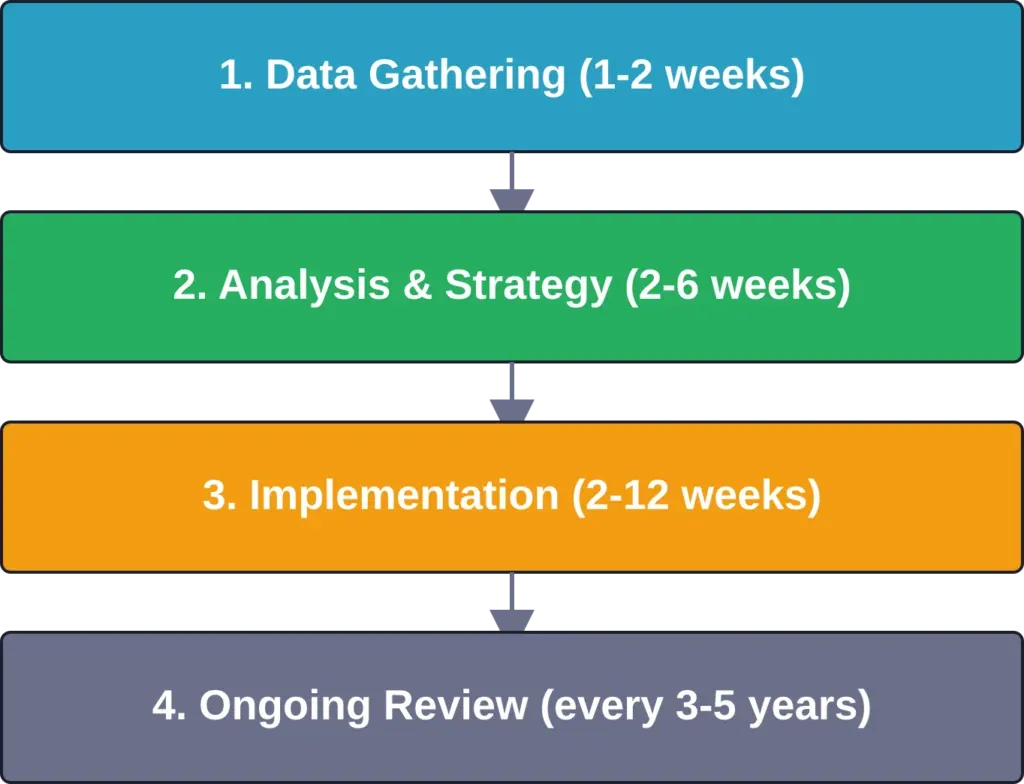
Initial Data Gathering
The firm will request detailed information: asset lists, property deeds, pension statements, existing wills, trust documents, and details about beneficiaries. Organize this before the first working meeting to accelerate progress.
Analysis and Strategy Development
Advisors analyze your situation, model tax liabilities, and develop recommendations. This phase typically takes two to six weeks depending on complexity. Expect a formal presentation of findings and proposed strategies.
Implementation
Once you approve strategies, the firm drafts legal documents, sets up trusts, coordinates with other professionals (accountants, investment managers), and executes the plan. Implementation timelines vary—simple wills might complete in days, while complex trusts can take months.
Documentation and Review
Receive copies of all executed documents. Store originals securely and inform executors and attorneys where to find them. Schedule the first review date.
Frequently Asked Questions
Costs vary widely based on estate complexity. Basic will preparation starts around £100 to £300. Comprehensive estate planning including trusts, IHT calculations, and ongoing advisory services can range from £2,000 to £10,000+ for initial setup, with annual review fees of £1,000 to £5,000. High-net-worth estates with international elements may exceed £20,000. Always request detailed written quotes before engaging services.
Yes. Even estates below the IHT threshold benefit from planning. Wills ensure assets distribute according to your wishes rather than intestacy rules. Lasting powers of attorney protect you if you lose capacity. And estate values can grow—property appreciation or inheritance might push you above thresholds later. Planning now prevents complications.
Will writers focus narrowly on drafting wills—often at low cost but without comprehensive tax advice. Estate planners take a holistic approach, analyzing your entire financial situation, modeling tax implications, and designing strategies involving trusts, gifting, and asset restructuring. For estates approaching or exceeding IHT thresholds, estate planners offer significantly more value.
From April 2027, unused pension funds and death benefits become part of your taxable estate for IHT purposes. Government data shows that a portion of estates will become newly liable for IHT where previously they faced none. Review pension beneficiary nominations and consider whether spending down pensions during retirement or restructuring other assets makes sense for your situation.
Rarely. Legitimate strategies can significantly reduce IHT—through exemptions, reliefs, trusts, and gifting—but complete elimination usually isn't possible without giving away assets entirely or dying with an estate below thresholds. Be skeptical of advisors promising zero IHT. Aggressive avoidance schemes attract HMRC scrutiny and can backfire, leaving families with penalties and legal costs.
Generally every three to five years, or sooner if major life events occur: marriage, divorce, births, deaths, property purchases, business changes, significant wealth increases, or relocation abroad. Also review when tax laws change—like the 2027 pension rules. Regular reviews ensure the plan remains aligned with your circumstances and current legislation.
Prioritize STEP qualifications (TEP or ATEP) for specialist trust and estate knowledge. Chartered Tax Advisers (CIOT, ATT) bring critical tax expertise. For legal drafting, ensure the firm employs SRA-regulated solicitors. If your estate includes significant investments, look for CFP or DipPFS credentials. Multi-disciplinary teams or partnerships often provide the most comprehensive service.
Conclusion: Protecting Your Legacy Starts with the Right Partner
Choosing estate tax planning services in the UK isn't a decision to rush. The right firm brings together specialist qualifications, transparent pricing, proven experience, and a commitment to ongoing partnership. They help families navigate complex IHT rules, structure assets efficiently, and preserve more wealth for the people and causes that matter.
With pension IHT changes taking effect in 2027 and planning becoming more urgent as wealth accumulates and age advances, strategic preparation offers significant benefits. But it's never too early—or too late—to start.
Take the time to interview multiple firms, check credentials thoroughly, and trust your judgment. The investment in proper planning pays dividends for generations.
Ready to protect your legacy? Start by scheduling consultations with STEP-qualified advisors, preparing a complete asset inventory, and asking the tough questions outlined in this guide. Your family's financial future depends on the choices made today.