
Quick Summary: Choosing a Construction Industry Scheme (CIS) services company in the UK requires verifying HMRC registration, checking compliance expertise, comparing software capabilities, and evaluating industry experience. Look for providers offering real-time verification, automated monthly returns, gross payment status support, and penalties avoidance features. The right partner ensures deductions are calculated correctly at 20% or 30% rates, records are maintained properly, and your business remains compliant with all CIS obligations.
The UK construction industry employs around 2.1 million people according to the Chartered Institute of Building (CIOB). Whether you're a contractor spending more than £3 million on construction within the previous 12 month period or a subcontractor navigating tax deductions, choosing the right CIS services provider can save thousands in penalties and compliance headaches.
But here's the thing—not all CIS service companies offer the same level of expertise or technology. Some merely tick boxes, whilst others genuinely understand the nuances of contractor obligations and subcontractor verification.
This guide walks through exactly what to look for when selecting a CIS services partner in 2026.
Understanding What CIS Services Companies Actually Do
Before evaluating providers, it's worth understanding precisely what CIS services entail.
Under the Construction Industry Scheme, contractors must deduct money from subcontractor payments and pass it to HMRC. These deductions count as advance payments toward tax and National Insurance contributions.
Core Services CIS Providers Handle
A proper CIS services company manages several critical functions:
- Subcontractor verification with HMRC before first payment
- Calculating correct deduction rates (0%, 20%, or 30%)
- Preparing and submitting monthly CIS returns
- Maintaining compliant payment and deduction records
- Managing gross payment status applications
- Handling penalty disputes and compliance issues
The verification process determines whether subcontractors are registered and what deduction rate applies. Registered subcontractors face 20% deductions (net payment status), whilst unregistered subcontractors face 30% deductions. Those with gross payment status receive full payment with 0% deducted.
Real talk: verification isn't optional. HMRC requires it for every new subcontractor and for any subcontractor not included on a return in the current or previous two tax years.
Key Criteria for Evaluating CIS Service Companies
Now, this is where it gets interesting. The market offers dozens of CIS providers, but quality varies dramatically.
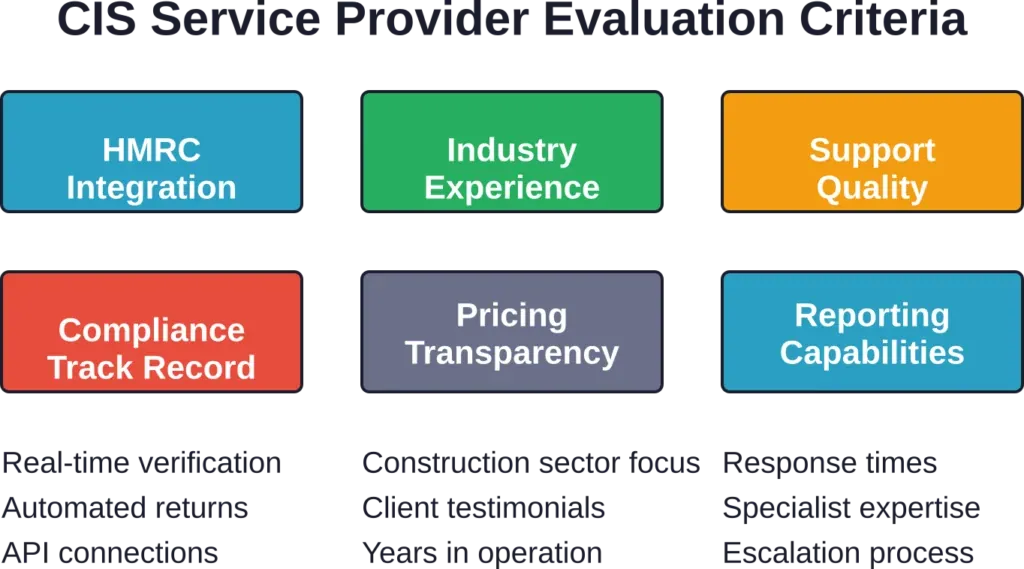
HMRC Integration and Software Capabilities
The foundation of any CIS service is reliable HMRC integration. Look for providers offering:
- Real-time subcontractor verification through HMRC systems
- Automated monthly return submission
- Direct connection to HMRC's CIS online portal
- Immediate status updates when subcontractor details change
Manual verification and paper submissions still technically work, but they're painfully slow and error-prone. Modern software completes verification in seconds and flags issues before they become penalties.
Compliance Expertise and Track Record
CIS penalties escalate quickly. Late filing can trigger penalties including a first fixed penalty of £100, a second fixed penalty of £200 after 2 months, and tax-geared penalties at 6 months (minimum £300 or 5% of liability). HMRC may assess the business for a CIS charge equal to 20% of the payment made, or the value of an incorrect CIS credit claimed, with a penalty of 30% of that assessment.
Ask potential providers:
- How many CIS-related penalties have their clients received in the past year?
- What's their process for staying current with HMRC rule changes?
- Do they carry professional indemnity insurance covering compliance errors?
- Can they provide references from construction clients?
A provider with genuine expertise won't hesitate to share their compliance record. Vague answers or reluctance to discuss penalty history should raise red flags.
Construction Industry Specialisation
Here's the thing though—general accountancy firms often treat CIS as an add-on service. Dedicated construction industry specialists bring a deeper understanding of sector-specific challenges.
Specialist providers understand:
- The £3 million threshold that triggers deemed contractor status for non-construction businesses
- Which construction operations fall under CIS versus those that don't
- How to handle complex subcontractor chains
- Gross payment status application requirements and success factors
That specialisation matters when dealing with edge cases or HMRC queries.
Handle CIS Requirements With Acumon
Choosing a construction industry scheme services company is about finding a firm that understands CIS registration, monthly returns, deductions, and HMRC compliance. Acumon supports businesses with accounting, payroll, tax compliance, bookkeeping, and related financial administration services that can assist contractor and subcontractor operations. This can help construction businesses keep subcontractor records, payroll administration, tax reporting, and broader compliance processes organised alongside day-to-day financial management.
Areas where Acumon can support contractor businesses:
- Tax compliance and accounting support
- Payroll and PAYE administration
- Bookkeeping and financial record keeping
- VAT returns and management accounts
- Statutory accounts support
- Audit and financial reporting services
Contact Acumon to discuss accounting and compliance support for contractor businesses.
Comparing CIS Deduction Rates and Payment Statuses
Understanding deduction rates helps evaluate whether providers calculate payments correctly.
| Payment Status | Deduction Rate | Requirements |
|---|---|---|
| Gross Payment Status | 0% | Meet compliance tests, turnover thresholds, and business checks set by HMRC |
| Registered Subcontractor | 20% | Registered for CIS with HMRC |
| Unregistered Subcontractor | 30% | Not registered for CIS |
The 10-percentage-point difference between registered and unregistered status adds up fast on large projects. A capable CIS provider ensures subcontractors are properly registered and helps them maintain that status.
For subcontractors seeking gross payment status, providers should offer application support and ongoing compliance monitoring to maintain that advantageous position.
Monthly Returns and Record-Keeping Requirements
Contractors must submit monthly CIS returns to HMRC even when no payments were made to subcontractors. Missing the submission deadline (19th of each month for online returns) triggers automatic penalties.
Look for providers offering:
- Automated deadline reminders
- Pre-populated return data from verified payments
- Nil return submission when appropriate
- Archive access to previous returns
- Audit-ready documentation
Sound familiar? Many contractors get caught by the nil return requirement, assuming they only need to file when making payments. That assumption costs £100 for the first missed return, £200 after two months, and a tax-geared penalty of at least £300 or 5% of liability at six months.
Software Integration and Business System Compatibility
Most construction businesses use accounting software, project management tools, or payroll systems. The right CIS provider integrates seamlessly rather than creating duplicate data entry.
Check whether potential providers connect with:
- Xero, QuickBooks, Sage, and other accounting platforms
- Construction-specific project management software
- Payroll systems if subcontractors are also employees
- Your existing document management setup
Integration saves hours each month and dramatically reduces transcription errors that trigger compliance issues.
Data Security and Confidentiality Standards
CIS services involve sensitive financial information about contractors and subcontractors. Providers should demonstrate:
- ISO 27001 certification or equivalent information security standards
- Encrypted data transmission and storage
- Regular security audits and penetration testing
- Clear data processing agreements compliant with UK GDPR
- Disaster recovery and backup procedures
But wait. Don't just accept marketing claims—ask for evidence of certifications and review their data processing agreement before signing.
Pricing Models and Hidden Costs
CIS service pricing varies widely. Some providers charge per subcontractor, others per monthly return, and some use fixed monthly fees regardless of transaction volume.
| Pricing Model | Best For | Watch Out For |
|---|---|---|
| Per subcontractor | Businesses with consistent subcontractor numbers | Rapid cost increases during busy periods |
| Per return | Contractors with fluctuating activity | Nil return fees that still apply |
| Fixed monthly | Large contractors with many subcontractors | Volume limits that trigger surcharges |
| Percentage of payments | Small contractors just starting | Costs scaling faster than complexity |
Always clarify:
- What's included in the base price versus additional charges
- Costs for verification, returns submission, and record storage
- Fees for gross payment status applications
- Charges for HMRC correspondence and penalty disputes
- Setup fees and minimum contract terms
The cheapest option rarely delivers the best value when compliance failures trigger penalties far exceeding service fees.
Support Accessibility and Expertise Depth
CIS questions don't arise on convenient schedules. Payment runs happen on tight deadlines, and HMRC queries require prompt responses.
Evaluate support offerings:
- Available hours (office hours only versus extended support)
- Response time commitments
- Support channels (phone, email, chat, client portal)
- Dedicated account manager versus shared support pool
- Escalation process for urgent issues
Test their responsiveness before committing. Send a complex question during the trial or consultation phase and note how quickly you receive a substantive answer.
Training and Educational Resources
The best CIS providers don't just process returns—they help clients understand obligations and improve processes. Look for:
- Online knowledge bases and documentation
- Webinars covering CIS changes and best practices
- Training for internal staff handling CIS processes
- Regular updates about HMRC guidance changes
This educational component proves particularly valuable for growing businesses adding construction activity or crossing the £3 million deemed contractor threshold.
Red Flags to Avoid When Choosing Providers
Certain warning signs indicate providers to avoid:
- Reluctance to discuss compliance track records or client references
- Lack of professional indemnity insurance
- No direct HMRC system integration, relying on manual processes
- Pressure to sign long-term contracts without trial periods
- Unclear pricing with vague terms about additional charges
- Poor online reviews mentioning missed deadlines or penalties
- General accountants without construction industry specialisation
Trust matters enormously in this relationship. HMRC holds contractors responsible for CIS compliance regardless of what service providers do or don't do.
Questions to Ask During Provider Consultations
Schedule consultations with shortlisted providers and ask pointed questions:
- How many construction clients do you currently serve?
- What's your average client retention rate?
- How many CIS penalties have your clients received in the past 12 months?
- What happens if you miss a filing deadline or make a calculation error?
- How do you stay current with HMRC guidance changes?
- What's your typical response time for urgent queries?
- Can you provide three references from construction clients similar to our business?
- What reports do you provide, and how often?
Their answers reveal competence, confidence, and whether they genuinely understand construction industry needs.
Making Your Final Decision
After evaluating options, compare providers across weighted criteria:

Prioritise compliance expertise and technology over price alone. The cost difference between providers is negligible compared to penalty exposure or time wasted on manual processes.
Request trial periods or pilot projects before committing to long-term contracts. This tests their responsiveness, accuracy, and cultural fit with your business.
Frequently Asked Questions
Not necessarily. Contractors spending more than £3 million on construction operations in a 12-month period must register for CIS and handle deductions. Many engage specialist CIS providers because the compliance burden is substantial, but it's technically possible to manage in-house with proper software and expertise. Subcontractors don't need to register but face higher 30% deduction rates if they don't, versus 20% when registered.
Gross payment status allows subcontractors to receive full payment without any tax deductions (0% rate). Standard registered status means 20% is deducted, whilst unregistered subcontractors face 30% deductions. Gross payment status requires meeting specific compliance tests, turnover thresholds, and business checks set by HMRC. Most subcontractors don't qualify initially and must build a compliance track record first.
Pricing varies based on business size, transaction volume, and service scope. Small contractors might pay £50-150 monthly for basic return submission, whilst larger operations with many subcontractors could pay £300-800 monthly for comprehensive services. Per-transaction pricing typically ranges from £5-15 per subcontractor verification or payment processed. Always clarify what's included before committing.
Yes, contractors can change CIS service providers at any time. However, ensure proper handover of records, verify all returns through the transition date were submitted, and confirm the new provider has access to historical data needed for HMRC compliance. The best switching time is at tax year-end (5 April) to minimise complexity, though it's not mandatory.
HMRC holds contractors responsible for CIS compliance regardless of whether errors stem from service provider mistakes. That's why professional indemnity insurance matters—it should cover penalties and assessments resulting from provider errors. Review contracts carefully to understand liability terms and ensure adequate insurance coverage exists. Providers refusing to discuss insurance or liability should be avoided.
Many construction businesses operate as both—contracting some projects whilst subcontracting on others. You'll need CIS services covering both roles: verification and deduction obligations as a contractor, plus registration and status management as a subcontractor. Look for providers experienced in dual-status situations, as they present unique compliance considerations.
Conduct formal reviews at least annually, checking compliance metrics, penalty avoidance, response times, and cost-effectiveness. However, monitor ongoing performance monthly through return submission accuracy and timeliness. If penalty notices arrive or HMRC queries increase, investigate immediately rather than waiting for scheduled reviews. Strong provider relationships involve regular communication, not just annual assessments.
Conclusion
Choosing the right Construction Industry Scheme services company protects your business from costly penalties whilst reducing administrative burden. Focus on compliance expertise, proven track records, robust technology integration, and responsive support rather than price alone.
The UK construction sector's complexity—with its 2.1 million workers, £3 million deemed contractor thresholds, and escalating penalty structures—demands specialist knowledge. Generic accountancy firms rarely provide the depth required for construction-specific compliance challenges.
Verify credentials thoroughly, ask pointed questions during consultations, and request trial periods before long-term commitments. The right CIS partner becomes a genuine business asset, not just a compliance cost centre.
Ready to find your ideal CIS services provider? Use the evaluation criteria and questions outlined here to compare options systematically. Your construction business deserves a partner who understands the industry's unique demands and keeps you compliant without constant stress.