
Quick Summary: Choosing the right company secretarial services provider in the UK requires evaluating expertise in Companies Act 2006 compliance, regulatory filing capabilities, corporate governance experience, and whether the firm offers tailored support for your business structure. Top providers handle everything from annual confirmations to board support, enabling directors to focus on strategy while maintaining legal compliance with Companies House and other regulatory bodies.
Regulatory compliance isn't optional for UK companies. Directors are legally responsible for running the company and ensuring information reaches Companies House on time—including confirmation statements and annual accounts, even when a company remains dormant.
The complexity of compliance paperwork drives many businesses to outsource. But choosing the wrong provider creates more problems than it solves. Here's how to identify a company secretarial services partner that genuinely adds value.
Understanding What Company Secretarial Services Actually Cover
Company secretarial services exist to manage the administrative and legal obligations every UK-registered company faces under the Companies Act 2006. These aren't just nice-to-have support functions—they're legal necessities.
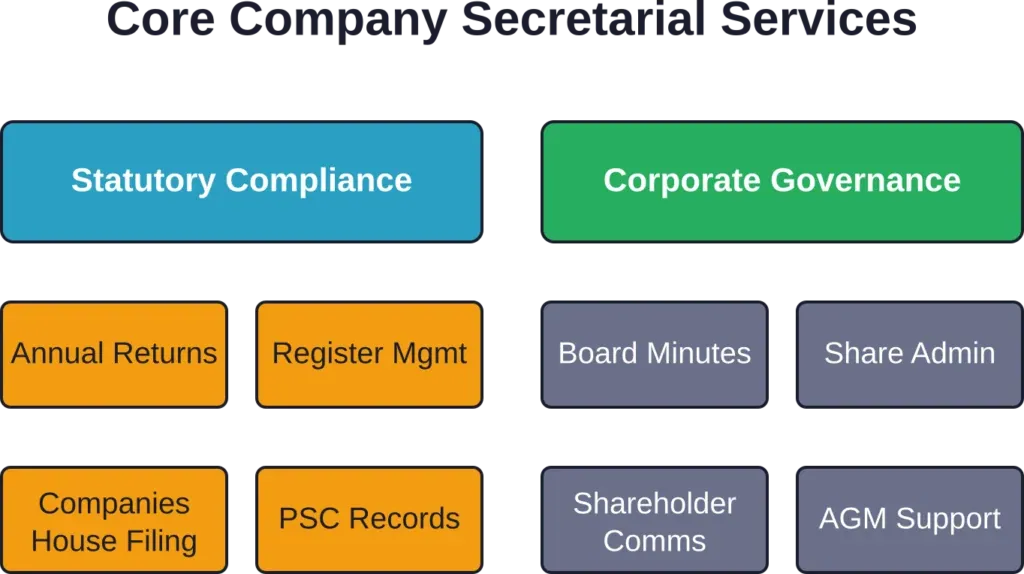
Core services typically include maintaining statutory registers, filing confirmation statements, submitting annual accounts, and managing changes to company officers or registered addresses. Providers handle communications with Companies House and ensure deadlines don't slip.
More comprehensive packages extend into corporate governance—preparing board minutes, managing shareholder communications, administering share allotments, and advising on compliance with specific rules like the Listing and Disclosure Rules or AIM Rules for quoted companies.
Key Criteria When Evaluating Service Providers
Regulatory Expertise and Track Record
Look for providers with demonstrated expertise in UK company law. The Companies Act 2006 governs all UK-registered companies, but additional rules apply depending on structure—quoted companies face Listing Rules, while private equity-backed businesses may need specific governance frameworks.
Ask how many companies they currently administer. Established providers typically handle hundreds of entities. Check whether they support both UK and international clients, which indicates depth of cross-border knowledge.
Experience with your specific business type matters. A startup needs different support than an international group managing subsidiary companies. Providers that work across size scales bring valuable perspective but should still tailor services appropriately.
Service Scope and Flexibility
Standard packages typically cover statutory minimums—filing confirmation statements, maintaining registers, and submitting accounts. But does the provider offer flexible add-ons?
Consider whether the firm provides board support beyond basic compliance. This includes preparing meeting agendas, drafting resolutions, recording minutes, and advising on governance best practices.
| Service Type | Standard Package | Enhanced Package |
|---|---|---|
| Companies House filing | ✓ | ✓ |
| Statutory register maintenance | ✓ | ✓ |
| PSC identification (25% threshold) | ✓ | ✓ |
| Board meeting preparation | – | ✓ |
| Share scheme administration | – | ✓ |
| Corporate governance advisory | – | ✓ |
Flexibility becomes critical during growth phases. When appointing new directors, changing registered office addresses, or restructuring share capital, the provider should handle these efficiently without inflated fees for every minor update.
Technology and Communication
Modern providers use digital systems for document storage and filing management. This beats physical registers stored in filing cabinets—especially when directors need quick access to corporate records.
The WebFiling service from Companies House operates 24 hours a day, 7 days a week, with an annual fee of £50 for companies submitting their confirmation statement. Professional providers leverage this and similar platforms to ensure timely submissions.
But technology shouldn't replace human accessibility. The best providers assign dedicated contacts rather than routing queries through generic helpdesks. Response times matter when dealing with time-sensitive compliance issues.
Keep Company Secretarial Work Compliant With Acumon
Choosing a company secretarial services company is about making sure statutory duties are handled correctly and on time. Acumon provides company secretarial support for UK companies, including Companies House filings, statutory compliance, corporate governance, and company administration. This can help businesses keep company records, filings, and governance processes in better order.
Company secretarial services Acumon provides:
- Companies House filings
- Statutory compliance
- Corporate governance support
- Company administration
- Maintenance of company records
- Compliance with Companies Act requirements
👉Get in touch with Acumon to discuss company secretarial support for your business.
Cost Structures and Value Assessment
Pricing models vary significantly across the market. Some firms charge flat annual fees covering core compliance. Others use modular pricing where each service component carries its own cost.
Filing fees remain modest—but penalties for late filing can be significant for directors. A provider that prevents these penalties pays for itself quickly.

Evaluate what's included in quoted prices. Does the base fee cover routine filings throughout the year, or only annual compliance? Are officer changes, address updates, and ad-hoc advice billed separately?
Hidden costs emerge when providers charge hourly rates for every email or phone consultation. Transparent pricing with clear scope prevents budget surprises.
Red Flags to Avoid
Some warning signs indicate a provider won't deliver quality service:
- Vague service descriptions: If the provider can't clearly articulate what they'll do, expect confusion later.
- Offshore-only operations: UK company law requires deep local expertise that remote providers often lack.
- No qualified professionals: Look for teams with relevant qualifications in company secretarial practice, law, or accountancy.
- Poor client references: Established providers should readily offer testimonials or case studies.
- Inflexible contracts: Business needs change; avoid providers requiring multi-year commitments with no exit terms.
Check whether the firm carries professional indemnity insurance. This protects clients if errors in compliance filings create legal problems.
Making the Final Decision
Shortlist three to five providers that meet your basic criteria. Request detailed proposals outlining scope, pricing, and team structure.
Schedule consultation calls with each finalist. Ask specific questions about their experience with companies similar to yours. How do they handle urgent compliance issues? What's their track record on filing deadlines?
Request client references and follow up. Direct feedback from current clients reveals far more than marketing materials ever will.
Consider the relationship as long-term. Company secretarial services work best when the provider develops deep familiarity with business operations, governance style, and strategic direction. Switching providers creates administrative headaches and knowledge gaps.
The right choice balances expertise, service scope, cost, and cultural fit. Take time to evaluate properly—this isn't a decision to rush.
Frequently Asked Questions
No. Private limited companies in the UK are not legally required to appoint a company secretary, though they may choose to do so. Public limited companies must have a company secretary. However, directors remain legally responsible for all compliance obligations whether or not they appoint a secretary, which is why many outsource these functions to professional providers.
Look for providers with qualified professionals holding relevant credentials in company secretarial practice, law, or accountancy. Many practitioners hold certifications from bodies like the Institute of Company Secretaries, though specific qualifications vary. Experience administering companies similar to yours matters more than any single qualification.
For routine compliance, interaction may be quarterly or annual—confirmation statements, accounts filing, and register updates. Active businesses with frequent officer changes, share transactions, or board meetings require more regular contact. Enhanced service packages typically include ongoing advisory support accessible as needed.
Yes, experienced providers regularly manage group structures including parent companies and multiple subsidiaries. This requires coordinating compliance across entities, managing inter-company transactions, and ensuring consolidated reporting meets requirements. Confirm the provider has specific experience with group structures before engaging them for complex arrangements.
Directors remain ultimately responsible for timely filing, even when outsourcing. Late filing can result in significant fines and may lead to director disqualification in serious cases. Professional providers should carry indemnity insurance covering errors, but prevention through reliable systems matters most. Check the provider's track record and ask about their deadline management processes.
Integrated providers offering both accounting and secretarial services can streamline coordination, particularly around annual accounts preparation. However, specialist secretarial firms may offer deeper governance expertise. Consider which matters more for your business—convenience of a single provider or depth of specialisation in complex governance matters.
Switching costs typically involve knowledge transfer time rather than direct fees. The new provider needs to familiarise themselves with company structure, history, and registers. Some providers charge onboarding fees for taking over from another firm. Plan transitions carefully around compliance deadlines to avoid gaps in coverage that could result in missed filings.
Conclusion
Selecting company secretarial services shouldn't be about finding the cheapest option. It's about partnering with professionals who ensure compliance, reduce director liability, and enable focus on actual business growth.
Evaluate providers on regulatory expertise, service flexibility, communication quality, and transparent pricing. Check references, avoid red flags, and choose partners for the long term.
The right company secretarial provider becomes an extension of the management team—handling complexity while directors concentrate on strategy. Take time to choose wisely.