
Quick Summary: Choosing the right CIS compliance services company in the UK requires evaluating technical expertise, certifications, and regulatory alignment. Look for NCSC-assured consultancies with proven CIS Controls and Benchmarks implementation experience, transparent pricing models, and comprehensive support frameworks. Verify credentials through the UK Government Digital Marketplace and validate security assessment methodologies.
The landscape of cybersecurity compliance has transformed dramatically over the past few years. With regulations tightening and threats evolving, organisations across the UK face mounting pressure to implement robust security frameworks.
CIS compliance stands at the centre of this shift. But here's the thing—choosing the right services company isn't straightforward.
The market's flooded with consultancies claiming expertise. Some deliver genuine value. Others? Not so much.
This guide walks through the essential factors that separate credible CIS compliance providers from the rest. From credentials to pricing structures, the focus remains on practical decision-making criteria that protect organisations against both security risks and vendor pitfalls.
Understanding CIS Compliance and Why It Matters
CIS compliance refers to implementing configuration baselines and best practices established by the Center for Internet Security. These benchmarks provide prescriptive recommendations for securing systems, software, and networks against evolving cyber threats.
The framework encompasses 18 CIS Controls—consensus-based security measures developed by cybersecurity experts globally. Organisations adopting these controls can mitigate common security risks more effectively and enhance their overall cyber defence capabilities.
Real talk: compliance isn't just about ticking boxes. Consider a Scottish oil company that paid significant penalties for failing to comply with security standards. That's a costly lesson.
Beyond avoiding penalties, CIS compliance offers tangible security benefits. The benchmarks address fundamental vulnerabilities that attackers routinely exploit. Implementing them strengthens an organisation's security posture systematically rather than through ad-hoc measures.
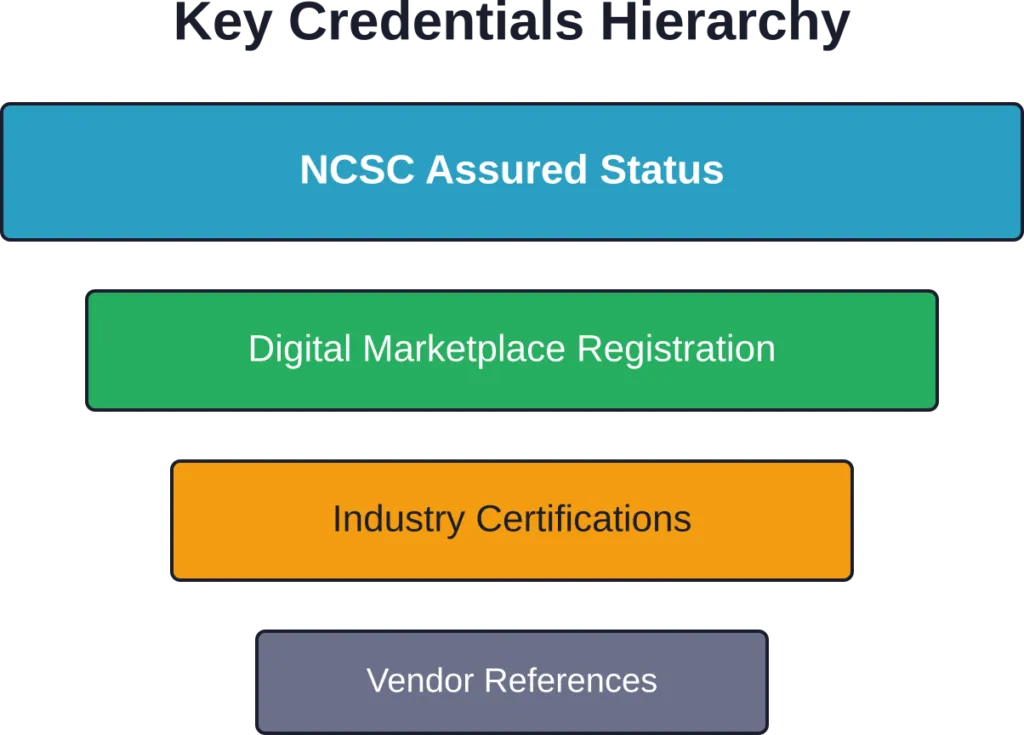
Essential Credentials to Verify
Not all compliance consultancies possess equal capabilities. Certain credentials indicate genuine expertise and regulatory alignment.
NCSC Assured Status
The National Cyber Security Centre operates an assurance scheme for cyber consultancies. NCSC-assured providers have demonstrated technical competence through rigorous evaluation.
This credential matters. The NCSC publishes specific guidance on vendor security assessment and supply chain security—consultancies with assured status align their methodologies with these frameworks.
Look for explicit NCSC Assured Cyber Consultancy designation when evaluating providers. This status confirms the company meets recognised standards for delivering cybersecurity services.
Digital Marketplace Registration
The UK Government Digital Marketplace hosts vetted suppliers for public sector organisations. Registration here requires meeting specific criteria around service delivery, security, and financial stability.
Consultancies listed on the Digital Marketplace have undergone verification processes. Their service descriptions, pricing, and capabilities are documented in standardised formats that facilitate comparison.
Pricing for technical procurement and vendor management services on the Digital Marketplace is £595 per unit per day, according to current listings.
Industry Certifications
Beyond government assurance schemes, professional certifications indicate specialised knowledge. Relevant credentials include:
- ISO 27001 Lead Auditor certification
- NIST Cybersecurity Framework expertise
- COBIT governance framework knowledge
- CIS Controls v8 implementation experience
These certifications demonstrate that consultants understand multiple compliance frameworks—not just CIS in isolation. This broader perspective helps organisations navigate overlapping regulatory requirements more efficiently.
Technical Capabilities That Actually Matter
Credentials establish baseline credibility. Technical capabilities determine whether a consultancy can deliver practical results.
CIS Controls Implementation Experience
The 18 CIS Controls range from basic inventory management to advanced incident response. Not every organisation needs to implement all controls immediately.
Effective consultancies assess which controls address an organisation's specific risk profile. They prioritise implementation based on threat landscape, industry sector, and existing security maturity.
Ask potential providers about their implementation methodology. Do they conduct gap analysis against current configurations? How do they sequence control deployment? What metrics do they use to measure effectiveness?
Benchmarking Capabilities
CIS Benchmarks provide configuration standards for specific technologies—Windows servers, Linux distributions, cloud platforms, network devices, and more. The Center for Internet Security publishes benchmarks for more than 25 vendor product families.
Consultancies should demonstrate expertise with the specific systems an organisation operates. A provider skilled in AWS benchmarking might lack equivalent Azure or Google Cloud knowledge.
Verify that the consultancy maintains current knowledge of benchmark versions. These recommendations evolve as threats change and vendors release updates.
Assessment Methodologies
Compliance assessment requires both automated scanning and manual analysis. Automated tools identify configuration deviations quickly. Manual review provides context around business requirements and compensating controls.
According to services listed on the UK Digital Marketplace, comprehensive cyber security benchmark assessments may combine automated infrastructure scans with in-depth manual evaluation to identify vulnerabilities, weaknesses, and compliance gaps.
The assessment process should cover:
- Review of existing cybersecurity policies and procedures
- Technical infrastructure scanning against CIS Benchmarks
- Gap analysis between current state and target compliance
- Risk prioritisation based on threat likelihood and impact
- Remediation roadmap with phased implementation plan
Service Delivery Models and Support
How a consultancy structures its services affects both costs and outcomes. Different models suit different organisational needs.
Project-Based vs Ongoing Services
Project-based engagements work well for initial compliance assessment and implementation. The consultancy conducts evaluation, recommends changes, and assists with deployment over a defined timeframe.
Ongoing services provide continuous monitoring and adjustment. As systems change and new threats emerge, compliance requirements shift. Retainer arrangements ensure consistent attention to configuration management.
Many organisations benefit from hybrid approaches—initial project implementation followed by periodic reassessment or on-call advisory support.
Training and Knowledge Transfer
Effective compliance isn't outsourced entirely. Internal teams need sufficient knowledge to maintain configurations and respond to incidents.
Quality consultancies include training as part of their service delivery. This might involve workshops on CIS Controls interpretation, hands-on configuration sessions, or documentation of organisation-specific implementation decisions.
According to Digital Marketplace listings, training services typically cover how to use specific compliance tools, interpret assessment reports, and maintain security configurations over time.
Support Response Times
When compliance issues arise, response speed matters. Standard support response times for compliance services on the UK Digital Marketplace typically fall within 24 hours for general queries.
For lower-priority issues or change requests, response times extend to approximately 2 working days. Critical security incidents should receive faster attention—verify that support agreements define clear escalation procedures.
Weekend coverage varies by provider. Some consultancies offer slower response times over weekends, while others maintain consistent availability. Match support levels to operational requirements.
Pricing Structures and Hidden Costs
Compliance services pricing varies significantly based on scope, organisation size, and service model. Understanding cost structures prevents budget surprises.
Day Rate Models
Many consultancies charge daily rates for professional services. On the UK Government Digital Marketplace, rates for technical compliance services start around £595 per unit per day.
Day rate arrangements provide transparency—organisations know exactly what each day of consultancy costs. However, total project costs depend on how many days the engagement requires.
Request detailed estimates that break down anticipated effort across assessment, implementation, and knowledge transfer phases. Vague "it depends" responses indicate insufficient project scoping.
Fixed-Price Packages
Some providers offer fixed-price packages for standard compliance assessments. These work well when the scope is clearly defined—for example, CIS Benchmark assessment for a specific number of servers running particular operating systems.
Fixed pricing reduces uncertainty but may lack flexibility. If the assessment uncovers additional systems or unexpected configurations, supplemental charges might apply.
Retainer and Subscription Models
Ongoing compliance monitoring often uses monthly or annual retainers. These cover regular configuration audits, security updates, and advisory support.
Subscription models provide predictable costs and ensure continuous attention to compliance posture. They're particularly valuable for organisations in rapidly changing environments or those lacking internal security expertise.
Additional Cost Considerations
Beyond consultant fees, factor in related expenses:
- Compliance software licences for automated scanning and monitoring
- Remediation costs for infrastructure changes or updates
- Training programmes for internal staff
- Documentation and reporting tools
For organisations requiring data protection registration with the Information Commission (which replaced the Information Commissioner's Office, ICO, on 30 September 2026), most companies pay £52 or £78 annually. Large organisations with more than 250 staff or annual turnover exceeding £36 million pay £3,763 per year. These regulatory fees sit alongside compliance consultancy costs.
Evaluating Track Record and References
Past performance indicates future results more reliably than marketing claims. Thorough reference checking reveals how consultancies actually deliver.
Sector-Specific Experience
Different industries face distinct regulatory requirements and threat profiles. Healthcare organisations navigate patient data protection. Financial services deal with transaction security. Critical infrastructure providers face national security considerations.
Consultancies with relevant sector experience understand these nuances. They know which controls matter most for specific industries and how regulators interpret compliance requirements.
Ask for case studies or references from organisations in similar sectors. What compliance challenges did they address? How did the consultancy's approach align with industry-specific needs?
Client References and Testimonials
Request contact information for current clients—particularly those with similar organisational size and complexity. Direct conversations reveal more than polished testimonials on marketing websites.
Questions to ask references include:
- How responsive was the consultancy during implementation?
- Did the project stay within estimated timelines and budgets?
- How effective was knowledge transfer to internal teams?
- Would they engage the same provider for future compliance needs?
NCSC and ICO Alignment
The National Cyber Security Centre publishes extensive guidance on supply chain security and vendor assessment. The Information Commission provides frameworks for data protection compliance.
Quality consultancies align their methodologies with NCSC principles and Information Commission requirements. They should articulate how their CIS compliance approach integrates with broader UK regulatory expectations.
According to NCSC guidance published on their website, supplier assurance questionnaires should cover security governance, incident management, network protection, data security, and independent testing. Verify that potential consultancies address these areas comprehensively.
Review CIS Controls Readiness With Acumon
Choosing a cybersecurity compliance and risk assurance company is not only about technical checklists. It also means finding a team that can review IT risk, internal controls, cybersecurity oversight, governance, and compliance in a way business leaders can actually use. Acumon provides Risk & Tech Assurance services, including technology risk assessment, cybersecurity, data protection, system controls, IT governance, internal audit, and risk management support. This makes Acumon more relevant for organisations that need broader assurance around internal controls, governance, technology risk, and compliance processes connected to cybersecurity readiness.
Technology risk and governance areas Acumon can review:
- IT risk and cybersecurity assurance
- System controls assessment
- IT governance reviews
- Internal audit linked to technology risk
- Risk management framework assessment
- Compliance and control reporting support
Contact Acumon to discuss technology risk assurance and governance support for your organisation.
Red Flags to Watch For
Certain warning signs indicate consultancies that may underdeliver or create additional problems.
Vague Methodologies
Consultancies that can't clearly explain their assessment process likely lack robust methodologies. Effective compliance work follows structured approaches—gap analysis, prioritisation, implementation planning, validation.
If a provider offers only high-level descriptions without detailing specific steps, that's a red flag. Quality consultancies document their methods and can walk through them in detail.
Unrealistic Timelines
Comprehensive CIS compliance implementation takes time. Consultancies promising full compliance in unrealistically short periods probably cut corners.
Configuration changes require testing. Documentation needs development. Staff need training. Legitimate providers set achievable timelines with clear milestones.
Lack of Transparency
Consultancies should provide clear information about:
- Who will actually perform the work
- What qualifications team members hold
- How they calculate pricing
- What deliverables organisations will receive
Reluctance to share this information suggests the provider has something to hide. Transparency builds trust and sets realistic expectations.
Over-Reliance on Automation
Automated scanning tools are valuable for configuration assessment. But they can't replace human expertise in interpreting results and recommending appropriate remediation.
Providers that emphasise tools over consulting expertise may deliver reports without actionable guidance. The best approach combines automation for efficiency with manual analysis for context.
| Evaluation Factor | Green Flag | Red Flag |
|---|---|---|
| Credentials | NCSC assured, Digital Marketplace listed | No verifiable certifications or registrations |
| Methodology | Detailed, documented assessment process | Vague descriptions, no structured approach |
| Pricing | Transparent rates with detailed scope breakdown | Unclear costs, reluctance to provide estimates |
| Timeline | Realistic schedule with defined milestones | Promises of rapid compliance without proper planning |
| References | Willing to provide current client contacts | Only offers testimonials, no direct references |
| Expertise | Specific sector experience and case studies | Claims universal expertise across all industries |
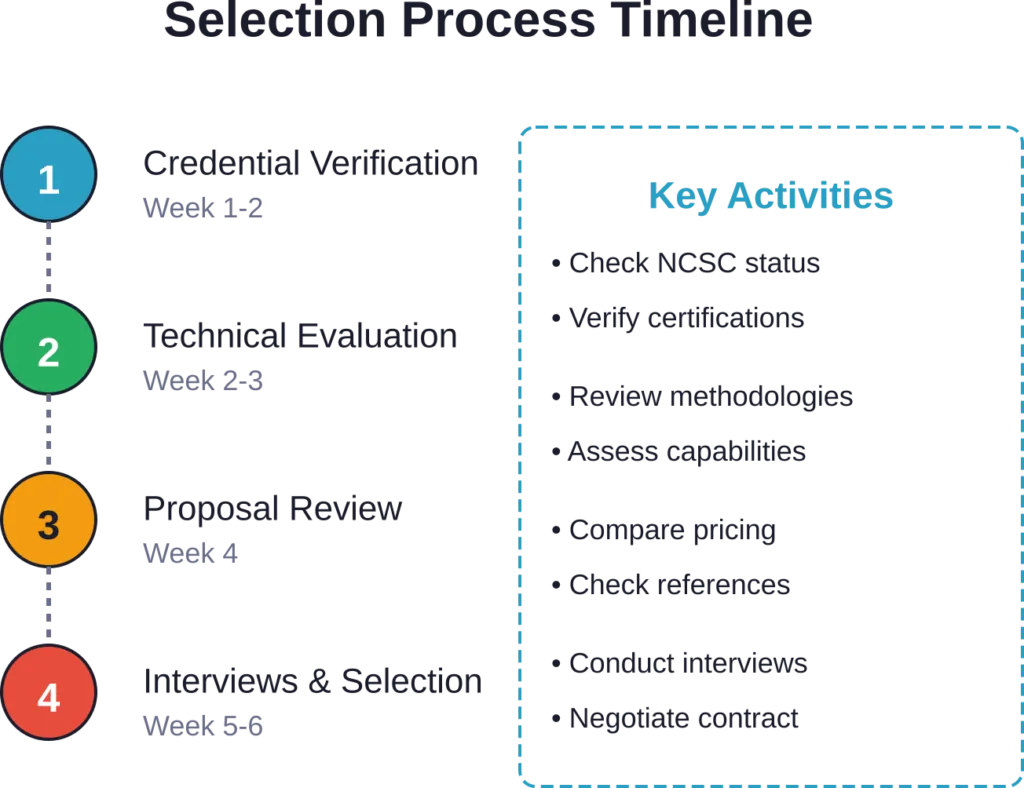
Making the Final Selection
With evaluation complete, the selection process comes down to balancing multiple factors against organisational priorities.
Conducting Consultancy Interviews
Shortlist three to five candidates based on credentials, experience, and initial proposals. Schedule detailed interviews with each.
These conversations should cover technical approach, team composition, and service delivery logistics. Pay attention to communication style—organisations will work closely with their chosen provider.
Request that the specific consultants who will perform the work participate in interviews. Chemistry and communication effectiveness matter for successful engagements.
Proposal Comparison
Evaluate proposals across consistent criteria:
- Technical approach and methodology
- Timeline and project phases
- Total cost including all anticipated expenses
- Team qualifications and assigned personnel
- Deliverables and success metrics
- Support arrangements post-implementation
Create a scoring matrix to compare proposals objectively. This reduces the influence of presentation quality over substance.
Pilot or Proof-of-Concept Options
For large-scale implementations, consider starting with a limited pilot. This allows organisations to evaluate the consultancy's work quality before committing to comprehensive engagement.
A pilot might focus on CIS Benchmark assessment for a subset of systems or implementation of specific controls in one department. Success in the pilot builds confidence for broader rollout.
Contract Considerations
Final contracts should clearly define:
- Scope of work and specific deliverables
- Timeline with milestone dates
- Payment terms and schedule
- Roles and responsibilities for both parties
- Confidentiality and data handling requirements
- Exit provisions and knowledge transfer obligations
Legal review is advisable, particularly for ongoing retainer arrangements or engagements involving sensitive systems.
Post-Selection Best Practices
Choosing a consultancy is just the beginning. Effective collaboration determines implementation success.
Establishing Clear Communication
Set up regular check-ins at appropriate intervals—weekly during active implementation, monthly for ongoing monitoring arrangements. These meetings provide status updates, address emerging issues, and adjust plans as needed.
Define primary contacts on both sides. Avoid situations where multiple stakeholders send conflicting requests to consultants or where organisations don't know whom to contact with questions.
Measuring Progress
Establish metrics to track compliance improvement. These might include:
- Percentage of systems meeting CIS Benchmark configurations
- Number of critical vulnerabilities remediated
- Time to detect and respond to configuration drift
- Staff trained on security best practices
Regular reporting against these metrics keeps implementation on track and demonstrates value to organisational leadership.
Planning for Sustainability
Compliance is not a one-time achievement. Configurations drift over time. New systems get deployed. Threats evolve.
Work with the consultancy to develop processes for maintaining compliance after initial implementation. This includes change management procedures, periodic reassessment schedules, and escalation protocols for security incidents.
Documentation is essential. The consultancy should provide comprehensive records of configuration decisions, implementation rationale, and maintenance procedures. This knowledge remains with the organisation even if the consultancy relationship ends.
rationale, and maintenance procedures. This knowledge remains with the organisation even if the consultancy relationship ends.
Frequently Asked Questions
CIS Controls are 18 high-level cybersecurity best practices that organisations should implement to protect against common threats. CIS Benchmarks are detailed configuration guidelines for specific technologies—operating systems, cloud platforms, network devices, and applications. Controls define what to do; Benchmarks specify exactly how to configure particular systems.
Implementation timelines vary based on organisational size, existing security maturity, and scope. Initial assessment typically requires 2-4 weeks. Implementing priority controls across infrastructure might take 3-6 months. Comprehensive implementation of all 18 controls can extend 12-18 months for larger organisations. Pilot programmes or limited scope implementations naturally take less time.
CIS compliance benefits organisations of all sizes, though smaller businesses might implement controls differently than enterprises. Small businesses with limited security expertise particularly benefit from consultancy guidance. The framework is scalable—smaller organisations can focus on foundational controls first and expand as resources permit. Cyber threats don't discriminate by company size.
Technically yes, if internal teams possess sufficient expertise, time, and resources. CIS publishes Benchmarks and Controls documentation publicly. However, most organisations lack specialised knowledge to interpret guidelines effectively or identify appropriate implementation priorities. Consultancies provide efficiency and expertise that typically outweigh their costs through faster implementation and better security outcomes.
CIS compliance complements rather than replaces other requirements. The NCSC Cyber Assessment Framework references similar security principles. ICO data protection guidance emphasises security measures aligned with CIS Controls. Industry-specific regulations like NIS Regulations or telecommunications security standards often overlap with CIS recommendations. Implementing CIS provides a strong foundation for meeting multiple regulatory obligations.
Beyond initial implementation, budget for periodic reassessment (annually or bi-annually), configuration monitoring tools, security update management, and staff training. Organisations using retainer services should plan for ongoing monthly fees. Additional costs arise when infrastructure changes—new systems, cloud migrations, or major application deployments require compliance evaluation. Typical ongoing costs range from 20-30% of initial implementation expenses annually.
Request validation through independent testing. Third-party penetration testing or security audits confirm whether implemented controls actually protect against threats. Compare before-and-after vulnerability assessments to quantify risk reduction. Monitor security incident frequency and severity—effective compliance should reduce both. Ensure consultancies provide evidence-based reporting, not just configuration checklists.
Conclusion
Selecting the right CIS compliance services company requires methodical evaluation across credentials, capabilities, pricing, and track record. NCSC-assured consultancies with Digital Marketplace registration provide baseline credibility. Technical expertise in CIS Controls and Benchmarks ensures practical implementation.
But credentials alone don't guarantee success. Communication style, service delivery approach, and cultural fit matter for productive long-term relationships.
Start with clear requirements. What systems need securing? What regulatory obligations apply? What internal capabilities exist? Answering these questions focuses the selection process on providers who match specific needs.
Verify credentials thoroughly. Check references carefully. Compare proposals objectively.
The right consultancy becomes a strategic partner in cybersecurity—not just a vendor checking compliance boxes. That relationship strengthens organisational resilience against evolving threats while satisfying regulatory requirements.
Ready to strengthen your organisation's security posture? Begin by verifying potential consultancies against the criteria outlined here. Download the NCSC's vendor assessment guidance and review the UK Government Digital Marketplace to identify NCSC-assured providers. Your compliance journey starts with choosing the right partner.