
College internal audit services provide independent evaluation of higher education institutions' risk management, financial controls, and compliance frameworks. Over 170 colleges and universities partner with organizations like The IIA through academic alliances to strengthen audit practices, while many institutions share audit resources through consortiums or outsource to specialized firms to address talent shortages and complex regulatory demands.
Higher education institutions face mounting pressure to demonstrate accountability across increasingly complex operational landscapes. From student records and financial data to cutting-edge research, colleges hold sensitive information that demands protection from unauthorized access and breaches.
Internal audit plays a critical role in this process. It helps institutions identify risks, strengthen security posture, and prepare for compliance obligations.
But here's the thing—traditional internal audit operating models struggle to keep pace. Universities are more integrated, more interdependent, and more diverse than ever. Internal audit teams are tasked with doing more with less.
What College Internal Audit Services Actually Do
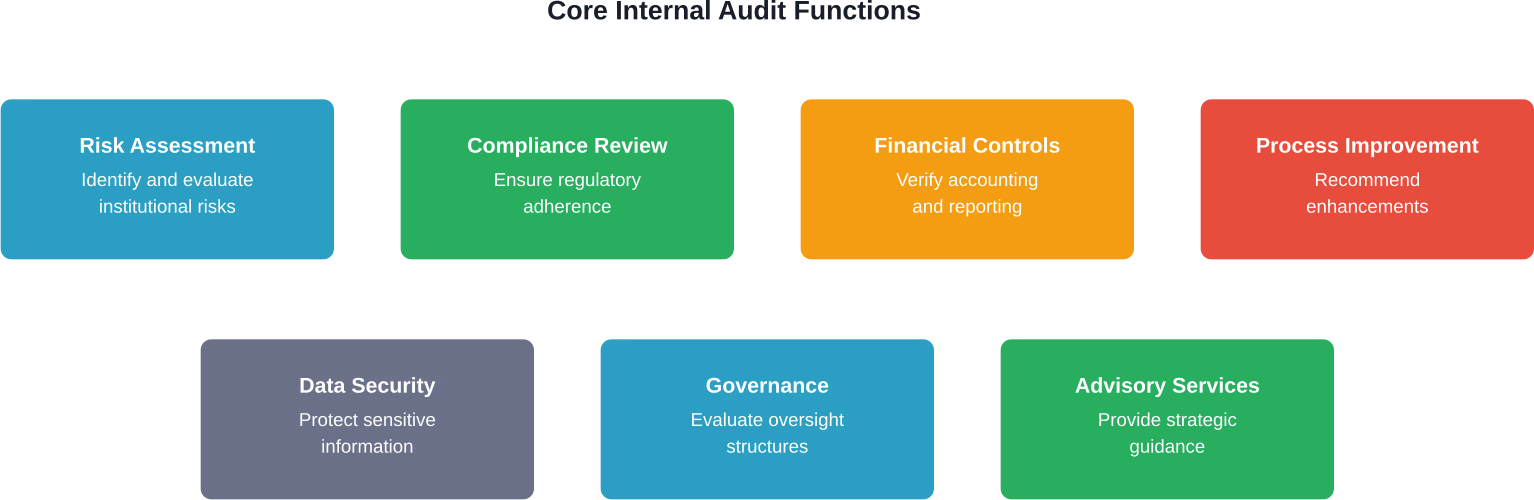
Internal audit serves as an independent function that reviews and evaluates university activities. The service operates as a resource for management and the Audit Committee of the Board of Trustees.
According to The IIA, internal audit provides objective assurance and consulting designed to add value and improve operations. The function helps organizations accomplish objectives by bringing systematic discipline to evaluate and improve risk management, control, and governance processes.
Real talk: internal audit isn't just about checking boxes.
The scope extends across multiple functional areas. Academic affairs, advancement and development, finance and administration, general counsel and compliance, human resources, information technology, sponsored research, and student affairs all fall under the audit umbrella.
NACUBO's Financial Risk and Audit practice supports higher education institutions through comprehensive and structured audit processes. The approach uses widely recognized risk matrices conducted in workshop-style formats with key institutional staff.
The Academic Alliance Model
The IIA's Academic Alliance program connects over 170 colleges and universities worldwide. These institutions partner with The IIA and the Internal Audit Foundation through global academic partnership programs.
The alliance advances internal audit education through multiple program levels:
- Principles: Foundational partnership tier
- Foundation: Expanded resource access
- Comprehensive: Full engagement model
- Center for Excellence: Premier partnership status
DePaul University's Driehaus College of Business maintains Comprehensive status in Chicago, Illinois. The program level determines access to valuable resources and funding opportunities.
Participating schools showcase commitment to internal audit education. They strengthen industry connections and solidify reputations as leaders in preparing future practitioners.
Students considering internal audit careers benefit from these partnerships. Educators training future auditors gain access to current methodologies and industry standards.
Shared Audit Services: The Consortium Approach
Now, this is where it gets interesting.
The Boston Consortium for Higher Education pioneered a shared internal audit initiative in 2005. Member schools Babson, Brandeis, Berklee, Olin, Wellesley, and Wheaton selected an outside firm as their collaborative service provider.
Seed money from the Mellon Foundation provided stimulus for the inaugural year. Each participating school contributed to the shared cost structure.
The shared model addresses a fundamental challenge: not every institution maintains an internal audit department. Smaller colleges can't always justify full-time audit staff. Resource constraints limit what individual institutions can accomplish.
According to NACUBO, the Association of College and University Auditors (ACUA) offers public tools and articles useful for institutions without dedicated audit departments. The quarterly College & University Audit Journal organizes content by topics including leadership, risk and governance, technology, and compliance.
The shared approach pools resources. Multiple institutions benefit from professional audit services at reduced individual cost.
Talent Pipeline Challenges
Internal audit education addresses a significant talent shortage. The IIA's podcast "Internal Audit Education in Action" highlights how academic programs inspire the next generation of auditors.
Dennis Applegate discussed trends in demographic data showing pipeline decline. Universities implement practical approaches to attract students to internal audit careers.
Students gain hands-on experience with risk assessments and mock audit plans. The experiential learning model proves more effective than theoretical instruction alone.
Meeting management's expectations in this dynamic environment requires a new mindset. The need to respond to latest headlines, attacks, and case studies necessitates agility.
According to University of North Carolina Charlotte, the development process should use workshops, conferences, classroom-based and online training, personal readings, and networking. The time allotted to learning should exceed the traditional 40 hours a year.
Developing an innovative mindset requires personal investment of time, high energy, and drive.
Co-Sourcing and Outsourcing Models
Internal audit delivery models vary significantly. Understanding the differences helps institutions select appropriate approaches.
| Model Type | Description | Best For |
|---|---|---|
| In-House | Full-time staff dedicated to institution | Large universities with complex operations |
| Outsourced | External firm provides all audit services | Smaller colleges without dedicated staff |
| Co-Sourced | Internal team supplemented by external experts | Mid-size institutions needing specialized skills |
| Shared Services | Consortium of institutions sharing resources | Regional college groups seeking cost efficiency |
Baker Tilly and other specialized firms offer internal audit resources specifically designed for higher education. These firms understand the unique risk landscape colleges navigate.
The co-sourcing model combines internal institutional knowledge with external specialized expertise. An internal audit director coordinates with consulting partners who bring specific technical capabilities.

Fix Internal Audit in Your College
Colleges don’t just deal with internal processes – they operate under funding rules, governance expectations, and external scrutiny. That makes internal audit harder to coordinate, especially when multiple entities, reporting lines, or oversight bodies are involved. Acumon is a London-founded firm of chartered accountants and registered auditors with international audit licences and experience supporting organisations where audit, reporting, and governance need to stay aligned across structures.
Make Internal Audit Stand Up to Scrutiny
Acumon works with colleges to bring internal audit into a clearer and more structured position:
- Internal audit delivered as part of wider governance and risk work
- Support for governing bodies and audit committees
- Experience with organisations operating across multiple entities
- Input aimed at improving oversight and internal control frameworks
If your internal audit wouldn’t hold up under real scrutiny, contact Acumon and deal with it now.
Key Risk Areas for College Audits
Higher education institutions face distinct risk categories that demand audit attention.
Cybersecurity and Data Protection
Student records and financial data require protection from unauthorized access. According to the University of Maryland, institutions must safeguard information from misuse and breaches.
Cybersecurity audits verify technical controls, assess vulnerability management, and evaluate incident response capabilities. Privacy standards including FERPA compliance demand ongoing monitoring.
Financial Aid Compliance
Federal Student Aid enforcement priorities related to audited financial statement requirements under §668.23(d)(1) were published on March 20, 2026. The Department of Education amended regulations related to financial responsibility and administrative capability.
Cohort default rates, audit standards, and limitations all fall under internal audit review. Proper verification and disbursement procedures require systematic evaluation.
Sponsored Research Administration
Grant management presents complex compliance challenges. Federal sponsors impose strict requirements for allowable costs, effort reporting, and sub-recipient monitoring.
Internal audit reviews research administration controls to ensure compliance with uniform guidance and sponsor-specific terms.
Technology Solutions for Audit Management
Modern audit operations rely on specialized software platforms. TeamMate by Wolters Kluwer provides purpose-built solutions for colleges and universities.
The platform helps audit and GRC (Governance, Risk, and Compliance) teams streamline workflows, enhance collaboration, and deliver insights that uphold institutional integrity.
Common technology challenges in higher education audit include:
- Managing risk across complex operational landscapes
- Ensuring compliance with multiple regulatory frameworks
- Demonstrating accountability to boards and stakeholders
- Coordinating between distributed teams and departments
Audit management systems centralize documentation, automate workflow routing, and provide analytics capabilities that manual processes can't match.
ACUA: The Professional Organization
The Association of College and University Auditors (ACUA) advances excellence in higher education auditing. The organization connects auditors worldwide to inspire growth and innovation.
ACUA's AuditCon conference brings practitioners together annually. The 2026 event runs September 27 through October 1, providing opportunities to find innovative solutions that elevate audit practice.
Member resources strengthen audit practice through shared knowledge. Access to tools developed by practitioners for practitioners proves invaluable.
James Ponce, associate vice president of internal audit at Wake Forest University, serves as ACUA's liaison to NACUBO's Accounting Principles Council. This collaboration ensures alignment between audit practice and accounting standards.
Establishing Effective Internal Controls
The University of Florida's Office of Internal Audit emphasizes that good internal controls form the foundation of effective operations.
Controls serve multiple purposes:
- Safeguard assets from loss, theft, or misuse
- Ensure accuracy and reliability of financial data
- Promote operational efficiency
- Encourage adherence to policies and regulations
Management owns responsibility for designing and maintaining internal controls. Internal audit evaluates whether controls function as intended.
The segregation of duties principle prevents any single individual from controlling all aspects of a transaction. Authorization, custody, and recordkeeping should remain separate.
Moving Forward with Audit Excellence
College internal audit services strengthen institutional integrity across higher education. The function evolved beyond compliance checking into strategic risk partnership.
Whether through in-house departments, outsourced arrangements, or shared consortiums, effective audit programs adapt to institutional size and resources. The IIA's Academic Alliance connects over 170 colleges worldwide, advancing audit education and professional standards.
Organizations like ACUA and NACUBO provide resources that elevate practice. Technology platforms streamline operations. Professional development programs address talent pipeline challenges.
The key is matching the audit approach to institutional needs. Risk assessment drives prioritization. Collaboration between audit, management, and governance creates accountability.
Explore how internal audit can advance your institution's mission. Connect with professional organizations, evaluate service delivery models, and invest in audit capabilities that protect students, faculty, and stakeholders.
Frequently Asked Questions
Internal audit is an ongoing institutional function that evaluates risk management, controls, and governance throughout the year. External audits are conducted by independent CPA firms annually to verify financial statement accuracy. Internal audit reports to management and the board, while external auditors provide assurance to outside stakeholders.
Costs vary significantly based on institutional size, audit scope, and delivery model. Large universities maintain in-house departments with multiple staff members. Smaller colleges outsourcing to firms or participating in shared consortiums split costs among members. Check with specific service providers for current pricing structures tailored to institutional needs.
Yes. The shared services model pioneered by The Boston Consortium demonstrates how smaller institutions access professional audit services affordably. Co-sourcing arrangements allow colleges to maintain minimal internal staff supplemented by external expertise for specialized reviews. ACUA provides public resources that institutions without audit departments can utilize.
Professional certifications like CIA (Certified Internal Auditor), CPA (Certified Public Accountant), or CISA (Certified Information Systems Auditor) demonstrate competency. Higher education experience helps auditors understand unique institutional dynamics. The IIA's Academic Alliance program ensures auditors stay current with evolving standards and methodologies.
Audit frequency depends on risk assessment outcomes. High-risk areas like financial aid or research administration may require annual reviews. Medium-risk functions might be audited every two to three years. Comprehensive risk assessments guide audit plan development, ensuring coverage aligns with institutional priorities and compliance requirements.
ACUA (Association of College and University Auditors) is the professional organization connecting higher education audit practitioners. Membership provides access to specialized resources, networking opportunities, and professional development through conferences like AuditCon. Even institutions without dedicated audit departments benefit from ACUA's public tools and quarterly journal.
Accrediting bodies require evidence of effective governance, financial stability, and compliance with regulations. Internal audit provides independent verification that controls function properly, risks are managed appropriately, and institutional policies are followed. Audit reports demonstrate to accreditors that the institution maintains accountability mechanisms and continuous improvement processes.