
Charity external audit services provide independent financial examinations that verify nonprofit financial statements, ensure regulatory compliance, and build stakeholder trust. These audits are often required for charities with gross receipts over $1,000,000 or those receiving federal funding, and involve reviewing financial records, internal controls, and Form 990 accuracy according to GAAP standards.
Charities face unique financial oversight challenges. External audit services help nonprofits maintain transparency, satisfy donor requirements, and meet regulatory obligations that vary by organization size and funding sources.
But here's the thing—not every charity needs the same level of scrutiny. Understanding when audits become mandatory versus simply beneficial determines how organizations allocate limited resources.
When Charities Need External Audits
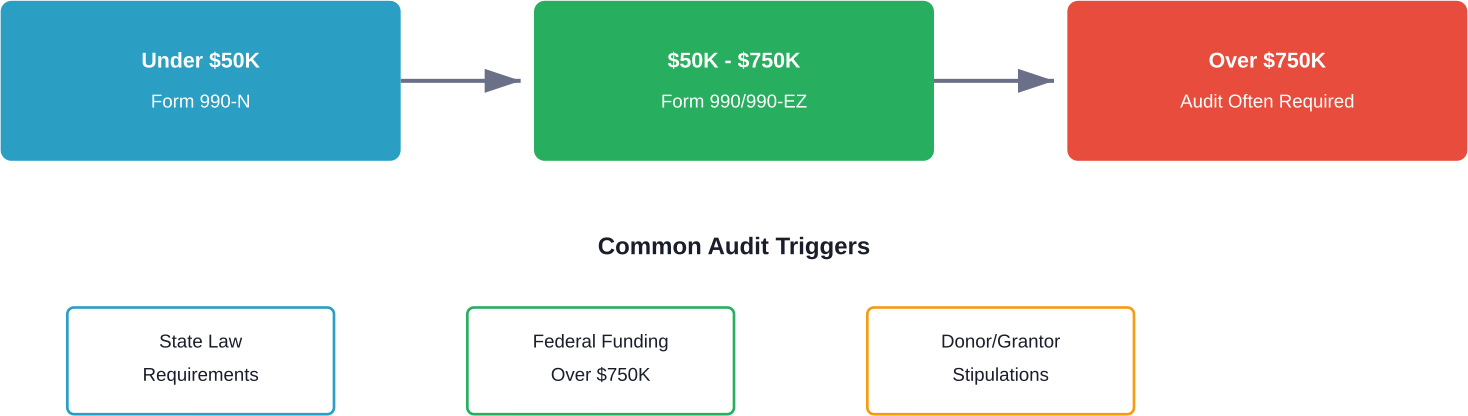
According to the IRS, tax-exempt organizations must file annual information returns based on their gross receipts. Organizations that normally have $50,000 or more in gross receipts must file Form 990 or Form 990-EZ. The IRS considers receipts "normally" within these thresholds if organizations have existed for 1 year or less and received $75,000 or less, or have existed 1-3 years and averaged $60,000 or less.
However, external audit requirements extend beyond IRS filing obligations. Many states mandate audits for charities exceeding certain revenue thresholds, which vary by state. Federal funding recipients must comply with Uniform Guidance requirements, which typically require audits when federal expenditures exceed $1,000,000.
What External Audits Cover
External audits examine financial statements against Generally Accepted Accounting Principles (GAAP). Independent auditors review internal controls, verify asset existence, confirm revenue sources, and assess expense classifications.
The IRS conducts two types of audits for exempt organizations: field audits and correspondence audits. Field audits involve in-person meetings with IRS agents, while correspondence audits handle issues through mail communication. Both examine whether organizations maintain their tax-exempt status and properly report activities on Form 990 series returns.
According to AICPA guidance in their Not-for-Profit Entities audit standards, external audits must address unique nonprofit considerations including restricted fund accounting, donated services valuation, and functional expense allocation across program, management, and fundraising activities.
Key Audit Components
| Audit Area | What Auditors Examine | Common Issues Found |
|---|---|---|
| Financial Statements | Balance sheet, income statement, cash flows | Misclassified net assets, timing errors |
| Internal Controls | Segregation of duties, approval processes | Single-person authorization, weak documentation |
| Revenue Recognition | Donation restrictions, grant conditions | Improper restriction release, revenue timing |
| Form 990 Accuracy | Public disclosure consistency, schedule completeness | Inconsistent reporting, missing schedules |
| Compliance Testing | Donor restrictions, grant terms, regulatory requirements | Restricted fund violations, unallowable costs |
Benefits Beyond Compliance
External audits do more than satisfy requirements. They provide stakeholder assurance that financial statements present organization activities fairly. Donors increasingly expect audited financials before making substantial gifts.
Audits also identify operational weaknesses before they become serious problems. Auditors' management letters highlight internal control gaps and recommend improvements to accounting processes, documentation practices, and financial oversight.
Sound familiar? Many charities discover their biggest audit value comes from catching small documentation errors early rather than one catastrophic issue later.
Preparing for Smooth Audits
Audit readiness isn't a year-end scramble. Organizations that maintain organized records throughout the year experience faster, less disruptive audits. This means consistent chart of accounts usage, timely bank reconciliations, and systematic documentation of restricted gifts and grant expenditures.
According to the GAO's Yellow Book standards (Government Auditing Standards 2024 revision), which many nonprofit auditors follow for federally-funded organizations, audit quality management requires systematic approaches to documentation, review processes, and professional competence.
Essential Audit Preparation Steps
- Maintain detailed general ledger with clear transaction descriptions
- Document all board meeting minutes and financial resolutions
- Track restricted contributions separately with release schedules
- Reconcile all accounts monthly, not just at year-end
- Retain supporting documentation for all material transactions
- Review Form 990 draft against audited statements before filing
Organizations must also make their Form 990 available for public inspection for three years following the filing deadline. This transparency requirement underscores why audit accuracy matters—financial information becomes permanently public record.
Selecting the Right Audit Firm
Specialized nonprofit audit experience matters. Firms familiar with fund accounting, restricted revenue recognition, and nonprofit governance requirements deliver more efficient audits than generalist practices.
The National Council of Nonprofits recommends evaluating audit firms based on nonprofit client concentration, familiarity with organization size and mission area, and communication style. Audit fees vary widely based on organization complexity, revenue size, and geographic location.
Real talk: the cheapest audit isn't always the best value. Inexperienced auditors spend more time learning nonprofit nuances, which can increase disruption despite lower hourly rates.

Get Your Charity Audit Signed Off
External audits for charities need to meet SORP, Charity Commission, and Companies Act requirements. Acumon is an ICAEW and FRC-regulated firm based in London, with a dedicated charity audit team working across not-for-profit organisations, grant-funded entities, and charities with complex funding structures. The approach is risk-based and designed to deliver clear assurance on financial statements, controls, and compliance.
Stay Compliant and Audit-Ready
Acumon covers the key external audit requirements charities actually face:
- Independent assurance on financial statements and internal controls
- Grant audit and verification of funding conditions
- Compliance with Charity SORP and sector reporting frameworks
- Independent examination for charities below audit thresholds
Speak with Acumon and get your charity audit signed off without delays.
Conclusion
Charity external audit services provide essential accountability infrastructure for nonprofit organizations. While compliance drives many audit engagements, the real value emerges through improved financial controls, stakeholder confidence, and operational insights.
Organizations that treat audits as annual learning opportunities rather than regulatory burdens position themselves for stronger financial management and increased mission impact. Ready to strengthen your charity's financial accountability? Consider consulting with a specialized nonprofit audit firm to assess your organization's audit readiness and compliance obligations.
Frequently Asked Questions
Audit costs vary significantly based on organization size, complexity, and location. Consult with local nonprofit audit firms for current pricing specific to organization circumstances.
Audits provide the highest assurance level through extensive testing and verification. Reviews offer limited assurance with analytical procedures and inquiries but no detailed testing. Compilations simply present financial information without providing any assurance. Many funders and states require full audits, not reviews or compilations.
Field work typically spans 1-3 weeks depending on organization size and record readiness. The entire process from planning to final report delivery usually requires 2-4 months. Well-prepared organizations with organized documentation experience shorter timelines.
According to the IRS, organizations that fail to file required returns for three consecutive years automatically lose tax-exempt status. Audits revealing significant private benefit, excessive lobbying, or prohibited political activity can also jeopardize exemption. Most audit findings, however, result in corrective actions rather than status revocation.
Volunteer time doesn't require the same documentation as financial transactions. However, if organizations report contributed services on financial statements, auditors verify the valuation methodology and that services meet GAAP recognition criteria—they create or enhance nonfinancial assets or require specialized skills.
Auditors require organizations to correct material errors before issuing clean opinions. Uncorrected material misstatements result in qualified or adverse opinions. Management must also assess whether errors indicate internal control deficiencies requiring disclosure in audit reports.
Single audits apply to organizations expending $1,000,000 or more in federal awards annually. They include both financial statement audits and compliance testing of federal program requirements. Single audits follow the Uniform Guidance requirements and are more extensive than standard financial statement audits.